Lesson 03 — Food Marketing: Claims vs. Evidence
Learners distinguish a food-marketing claim — a promise designed to sell — from evidence that can be checked, and begin to ask the questions that separate them. Every family's way of eating is honored; no food is labeled good or bad, and no body is judged.
Objectives
Objectives
- D03.S3.07.02 Critically evaluate food marketing and advertising, telling claims apart from evidence.
Essential question
How do I tell a food-marketing claim apart from evidence?
Key vocabulary
Materials
Standard materials
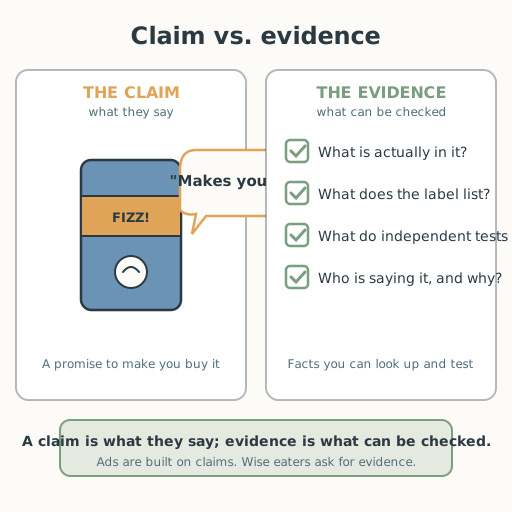
- Claim-vs-evidence diagram · 1 A food package with a bold claim ("Makes you strong!") beside a checklist of checkable evidence (what is in it, what the label lists, what independent tests show, who is saying it and why)
- Food packages or ads · 3–5 Empty packages, labels, or printed ads from a variety of places (markets, snacks, drinks) — clean and age-appropriate
Low-tech / no-cost
- Voice and memory Describe a familiar food ad and its claim aloud, then ask the evidence questions — no packages needed
- Drawn packages Draw a simple package and write a made-up claim on it to practice separating claim from evidence
Enriched / lab & device
- A shared screen or projector · 1 To show real food advertisements from different countries and read their fine print together
- Internet or library access · 1 per group To look up an ingredient list or an independent review for one product (supervised, age-appropriate)
Works in different contexts
- large-group Read a claim aloud together, then have the whole group call out evidence questions; keep comments about products, never about anyone's eating
- multi-age Older learners read a nutrition label aloud to younger ones; together they decide whether the claim is supported
- self-directed A learner reads the diagram, picks one food ad from memory, and writes the claim and one evidence question they would ask
- level-grouped Learners ready to extend compare two products' claims against their labels and say which claim is better supported by evidence
- outdoor-only At a market, stall, or shop window, find one food sign and name its claim, then ask one evidence question — no paper needed
Lesson 3 — Food Marketing: Claims vs. Evidence
Summary
Learners distinguish a food-marketing claim — a promise designed to sell — from evidence that can be checked, and begin to ask the questions that separate them. Every family’s way of eating is honored; no food is labeled good or bad, and no body is judged.
Objectives
- Critically evaluate food marketing and advertising by telling claims apart from evidence. (D03.S3.07.02)
Connection
Walk through any market, shop, or screen full of food and you will hear promises: “gives you energy,” “natural,” “just like homemade,” “makes you strong.” Some promises are true; some are only partly true; some are just a feeling dressed up as a fact. The difference between them is not a secret — it is a question you can learn to ask: what is the claim, and what is the evidence? A claim is what someone says; evidence is what can be checked.
Materials
- Claim-vs-evidence diagram
- Food packages or ads (varied, clean, age-appropriate)
Preparation
- Print or draw the claim-vs-evidence diagram.
- Gather a few empty packages, labels, or printed food ads from varied places.
- Prepare to keep comments about products, never about anyone’s eating or body.
Facilitator note
This lesson is written to the learner (“you”). The core skill is exactly the standard:
tell a claim apart from evidence. The facts to land: food marketing worldwide makes
health-linked promises (energy, growth, naturalness, strength) that are often emotional
appeals rather than evidence, and advertising aimed at young people is widespread and
powerful — which is why the WHO recommends limits on marketing foods high in fat, salt,
and sugar to children (WHO marketing recommendations; WHO healthy diet). The values held
as values: every family’s way of eating is honored, and no food is “good” or “bad” — the
lesson evaluates claims and evidence, never a person’s food. Keep all examples about
products, never about any learner’s own eating, body, or family. Avoid calorie or diet
talk entirely. See docs/facilitation.md.
Procedure
- Gather and recall (5 min). Think of a food ad you know by heart — a jingle, a mascot, a slogan. What promise does it make? Today you learn to test that promise.
- Meet claim vs evidence (10 min). Look at the diagram. A claim is what the package says: “makes you strong!” Evidence is what can be checked: what is actually in it, what the label lists, what independent tests show, and who is saying it and why. Say the difference in one sentence: a claim is what they say; evidence is what can be checked.
- Practice the evidence questions (15 min). With a partner, pick one package or ad. Read its claim aloud, then ask the four evidence questions from the diagram. Does the package show you the evidence, or does it only promise? Talk about what you would need to check to find out.
- Name the appeal (10 min). Many food claims appeal to a feeling — fun, belonging, energy, being “natural” — rather than to facts. Name the feeling an ad is selling. (Remember: the ad is the thing being judged, never the food or the person.)
- Close (5 min). You do not have to distrust every food — you only need to know the difference between a promise and a fact. Asking for evidence is a skill you will use for life.
Differentiation
- Support: Use the frame “The claim is ___. The evidence I would need is ___.” Focus on naming one claim and one evidence question.
- Extension: Compare two products’ claims against their labels and write which claim is better supported by evidence, and why.
Assessment
- Formative (observation): Can the learner name a claim and ask at least one evidence question, and explain the difference between a promise and a checkable fact?
- Portfolio: A claim-versus-evidence note (one product’s claim + the evidence questions they would ask), kept as a portfolio artifact.
Home connection
If it feels safe, look at one food package at home with a trusted adult. Find the claim and read the label together, then decide what evidence you would want. Keep it about the package, never about anyone’s eating.
Resources
- WHO — Set of recommendations on the marketing of foods and non-alcoholic beverages to children: https://www.who.int/publications/i/item/9789241500210
- WHO — Healthy diet fact sheet: https://www.who.int/news-room/fact-sheets/detail/healthy-diet