Lesson 04 — Evaluating Food Ads: Spotting the Claim, Asking for Evidence
Learners evaluate a whole food advertisement using a four-part read — claim, feeling appeal, fine print, and missing evidence — first on a worked example, then on real ads. Every family's way of eating is honored; evaluation targets the ad, never a person's food or body.
Objectives
Objectives
- D03.S3.07.02 Critically evaluate food marketing and advertising, telling claims apart from evidence.
Essential question
How do I evaluate a whole food advertisement, piece by piece?
Key vocabulary
Materials
Standard materials
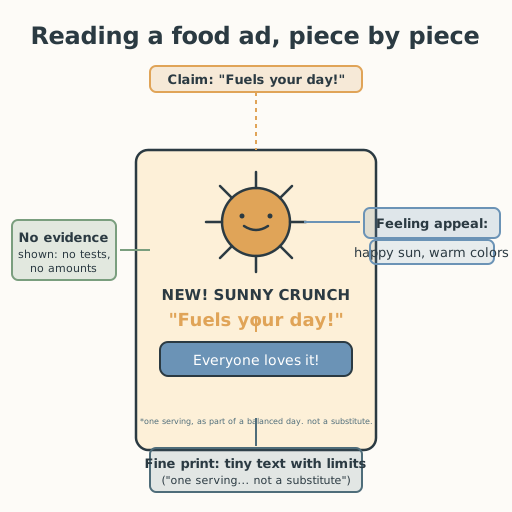
- Reading-a-food-ad diagram · 1 A worked example — a mock ad with callouts labeling the claim, the feeling appeal, the fine print, and the missing evidence
- Real food ads · 4–6 Printed or shown food advertisements from varied places and countries (age-appropriate, non-shaming)
Low-tech / no-cost
- Voice and memory Rebuild a familiar food ad from memory, then label its claim, appeal, fine print, and missing evidence aloud — no paper needed
- A made-up ad Learners invent a small ad on scrap paper, then swap and evaluate each other's claims against evidence
Enriched / lab & device
- A shared screen or projector · 1 To show the worked-example diagram large and compare real ads from different countries
- Internet or library access · 1 per group To look up one product's nutrition label or an independent review and compare it with the ad's claim
Works in different contexts
- large-group Evaluate the worked example together first, then have pairs evaluate one real ad; keep comments about ads, never about anyone's eating or body
- multi-age Older learners lead the four-part read (claim, appeal, fine print, missing evidence); younger learners point to each part on the poster
- self-directed A learner studies the worked example, then applies the four labels to one real or remembered ad and writes a one-sentence verdict
- level-grouped Learners ready to extend write a full evaluation — claim, appeal, fine print, missing evidence, and what would settle the question
- outdoor-only Find one food sign outdoors, name its claim and appeal, and say what evidence is missing — no paper needed
Lesson 4 — Evaluating Food Ads: Spotting the Claim, Asking for Evidence
Summary
Learners evaluate a whole food advertisement using a four-part read — claim, feeling appeal, fine print, and missing evidence — first on a worked example, then on real ads. Every family’s way of eating is honored; evaluation targets the ad, never a person’s food or body.
Objectives
- Critically evaluate food marketing and advertising by telling claims apart from evidence. (D03.S3.07.02)
Connection
Last lesson you learned the difference between a claim and evidence. Now you put it together on a whole ad. Real advertisements are not just one claim — they are a package of pieces working together: a big promise up top, a warm feeling in the middle, and tiny limits down at the bottom. Reading them piece by piece is like reading a map: once you can label the parts, the ad stops doing its work on you without your permission.
Materials
- Reading-a-food-ad diagram (worked example)
- Real food ads (varied, age-appropriate)
Preparation
- Print or draw the reading-a-food-ad diagram.
- Gather several food ads from varied places and countries.
- Prepare to keep all evaluation about ads, never about anyone’s eating or body.
Facilitator note
This lesson is written to the learner (“you”). It is a worked example + guided practice
structure: model the four-part read on the diagram, then have learners apply it. The four
labels: claim (the promise), feeling appeal (the emotion the ad stirs — fun,
belonging, warmth, energy), fine print (the tiny text that limits the claim), and
missing evidence (no tests, no amounts, no independent check shown). The facts: food
marketing uses these tactics worldwide, and marketing to children of foods high in fat,
salt, and sugar is widespread enough that the WHO recommends limits (WHO marketing
recommendations). The values held as values: every way of eating is honored, no food is
“good” or “bad,” and we evaluate the message, never a person. Avoid calorie/diet talk
entirely. See docs/facilitation.md.
Procedure
- Gather and recall (5 min). Quick recall: what is the difference between a claim and evidence? (A claim is what they say; evidence is what can be checked.) Today you evaluate a whole ad.
- Worked example (10 min). Look at the reading-a-food-ad diagram. Walk it together: the claim is “Fuels your day!”; the feeling appeal is the happy sun and warm colors; the fine print is the tiny “one serving… not a substitute”; and the missing evidence is that no test or amount is shown. Notice how the pieces work as a team.
- Guided practice (15 min). With a partner, take one real ad and label all four parts. Ask: what would it take to prove the claim? What evidence is the ad not showing you? Write or say your four labels.
- Independent check (10 min). Choose a second ad and do the four-part read on your own. Then trade verdicts with your partner: did you find the same claim? The same missing evidence?
- Close (5 min). You now have a tool you can pull out anywhere — a market, a screen, a street. The ad can make its promise; you get to ask for the evidence.
Differentiation
- Support: Use the four-part frame “Claim: ___. Feeling appeal: ___. Fine print: ___. Missing evidence: ___.” Label one part at a time with a partner.
- Extension: Write a full evaluation of one ad and state exactly what evidence would settle the question — then compare with a partner.
Assessment
- Formative (observation): Can the learner label at least three of the four parts (claim, appeal, fine print, missing evidence) on a real ad and name one missing piece of evidence?
- Portfolio: The four-part food-ad evaluation, kept as a portfolio artifact.
Home connection
If it feels safe, evaluate one food ad you see this week — on a package, a screen, or a wall — with a trusted adult. Name the claim and the evidence together. Keep it about the ad, never about anyone’s eating.
Resources
- WHO — Set of recommendations on the marketing of foods and non-alcoholic beverages to children: https://www.who.int/publications/i/item/9789241500210
- WHO — Healthy diet fact sheet: https://www.who.int/news-room/fact-sheets/detail/healthy-diet