Lesson 05 — First Aid Basics: Bleeding & Burns
Learners explain basic first aid for bleeding — cover and press with a clean cloth — and for burns — cool under cool running water, never ice — and, crucially, when to get adult or medical help. First aid is taught factually and safely, with the emphasis on getting help when unsure.
Objectives
Objectives
- D03.S4.07.01 Explain basic first aid for common emergencies, such as bleeding, burns, and choking, and when to seek adult or medical help.
Essential question
What is the basic first aid for bleeding and burns, and when do I get adult or medical help?
Key vocabulary
Materials
Standard materials
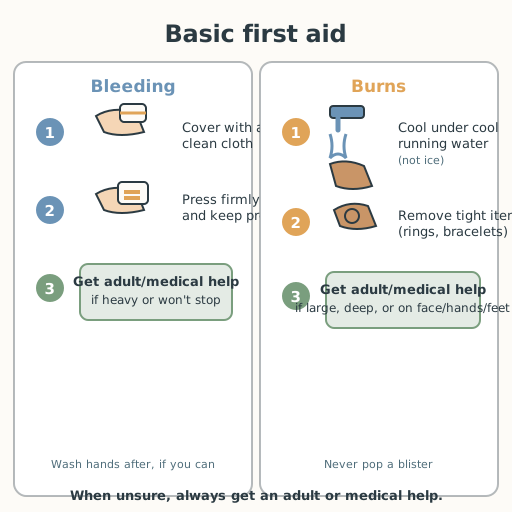
- Bleeding-and-burns first-aid diagram · 1 Two panels — bleeding (cover, press, get help) and burns (cool under running water, remove tight items, get help) — with the "get help" step emphasized
- First-aid scenario cards · 1 set Short scenarios (a nosebleed, a small cut, a kitchen burn, a heavy bleed) for learners to decide the steps and whether to get help
Low-tech / no-cost
- Voice and acting Act out the steps on a partner (mime the cloth and pressure; mime the water) — no supplies needed
- Drawn steps Draw the three steps for bleeding and burns as simple pictures to remember them
Enriched / lab & device
- Clean cloths and a cool-water source (demonstration only) · 1 set To practice the motion of pressure and cooling — never on a real injury
- A certified first-aid instructor or video · 1 A Red Cross/Red Crescent or equivalent demonstration (verified accurate) to reinforce the steps
Works in different contexts
- large-group Demonstrate the steps at the front, then have pairs practice the motions; keep all practice on imagined injuries, never real ones
- multi-age Older learners model the steps; younger learners copy the motions and repeat "get an adult if unsure"
- self-directed A learner studies the diagram and writes the steps for bleeding and burns, including when to get help, and self-checks against the diagram
- level-grouped Learners ready to extend explain *why* each step works (pressure slows bleeding; cool water cools the burn and eases pain) and when help is essential
- outdoor-only Say the steps aloud and mime them; name one adult nearby you would get in an emergency — no paper needed
Lesson 5 — First Aid Basics: Bleeding & Burns
Summary
Learners explain basic first aid for bleeding — cover and press with a clean cloth — and for burns — cool under cool running water, never ice — and, crucially, when to get adult or medical help. First aid is taught factually and safely, with the emphasis on getting help when unsure.
Objectives
- Explain basic first aid for bleeding and burns, and when to seek adult or medical help. (D03.S4.07.01)
Connection
An emergency is not something you plan for — it is something that happens in an ordinary moment: a cut in the kitchen, a burn from a pan, a bad scrape on the road. In those first seconds, knowing two or three calm, correct actions — and knowing when to get help — can keep a small injury from becoming a big one. First aid is not about being a hero; it is about being ready, and about being willing to ask for help.
Materials
- Bleeding-and-burns first-aid diagram
- First-aid scenario cards
Preparation
- Print or draw the bleeding-and-burns first-aid diagram.
- Copy and cut the scenario cards.
- Arrange space to practice the motions safely; all practice is on imagined injuries only.
Facilitator note
This lesson is written to the learner (“you”). Teach first aid factually and safely,
and lead with the rule: when unsure, get an adult or medical help. The facts to land:
for bleeding, apply direct pressure with a clean cloth and keep pressing, and get medical
help if bleeding is heavy, spurting, or will not stop; for burns, cool the burn under cool
running water (not ice) for about 20 minutes if possible, remove tight items such as rings,
do not pop blisters, and get medical help for large or deep burns or burns to the face,
hands, feet, or joints (IFRC Global First Aid Reference Centre; WHO burns fact sheet). Do
not teach advanced or uncertain techniques; this age needs the safe basics plus the help-
seeking reflex. Reassure learners that getting help is part of first aid, not a failure.
Remind them that hands-on practice with a certified instructor (Red Cross/Red Crescent or
equivalent) is the best way to build confidence. See docs/facilitation.md.
Procedure
- Gather and recall (5 min). Think of a time someone got a small cut or a burn. What did people do first? Today you learn the calm, correct first steps.
- Bleeding (15 min). Look at the bleeding panel. The steps: cover the cut with a clean cloth, press firmly and keep pressing, and get adult or medical help if the bleeding is heavy or will not stop. Practice the motions with a partner on an imagined cut — cloth on, press, hold. Say aloud when you would get help.
- Burns (15 min). Look at the burns panel. The steps: cool the burn under cool running water — never ice, which can harm the skin — for about 20 minutes if you can; remove tight items like rings; and get adult or medical help for large or deep burns or burns to the face, hands, or feet. Never pop a blister. Practice the motions.
- Scenario practice (10 min). Draw a scenario card. Decide the steps and — always — whether to get help. Share your reasoning with a partner.
- Close (5 min). First aid is calm + correct + ask for help. You now know the first moves for two of the most common injuries — and that asking for help is always part of the plan.
Differentiation
- Support: Use the frames “For bleeding I ___, then ___.” and “For a burn I ___, never ___.” Practice one injury at a time.
- Extension: Explain why each step works (pressure slows bleeding; cool water cools the burn and eases pain; ice can damage skin further) and name a case where help is essential.
Assessment
- Formative (observation): Can the learner state the steps for bleeding and for burns, and name when to get adult or medical help?
- Portfolio: A first-aid note (steps for bleeding + burns + when to get help), kept as a portfolio artifact.
Home connection
If it feels safe, walk through the steps with a trusted adult at home — where are the clean cloths, and who would you call for help? Knowing the plan ahead of time is part of being ready.
Resources
- IFRC Global First Aid Reference Centre — evidence-based first-aid guidance: https://www.globalfirstaidcentre.org/
- WHO — Burns fact sheet: https://www.who.int/news-room/fact-sheets/detail/burns