Lesson 06 — First Aid: Choking & Getting Adult Help
Learners explain the basic response to choking — recognize the sign, call for emergency help and get an adult, and give back blows and abdominal thrusts only if trained — and practice how to call for help, saying name, location, and what happened. Help-seeking is framed as part of first aid, never a failure.
Objectives
Objectives
- D03.S4.07.01 Explain basic first aid for common emergencies, such as bleeding, burns, and choking, and when to seek adult or medical help.
Essential question
What is the basic response to choking, and how do I get adult or emergency help?
Key vocabulary
Materials
Standard materials
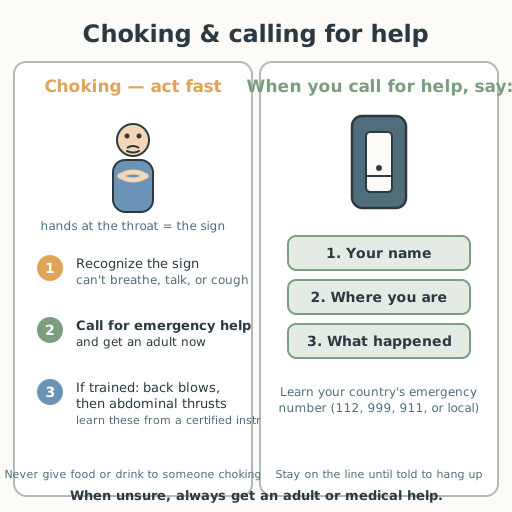
- Choking-and-calling-for-help diagram · 1 A panel on choking (recognize the sign, call for help, back blows and abdominal thrusts if trained) and a panel on what to say when calling for help
- Emergency scenario cards · 1 set Scenarios (someone choking, a fall, a bad burn, heavy bleeding) to practice calling for help and saying name, location, what happened
Low-tech / no-cost
- Voice and role-play Role-play the emergency call aloud — name, location, what happened — with no props
- Drawn steps Draw the choking steps and the three things to say when calling for help
Enriched / lab & device
- A certified first-aid instructor or video · 1 A Red Cross/Red Crescent or equivalent demonstration of back blows and abdominal thrusts (verified accurate, age-appropriate)
- A list of local emergency numbers · 1 The facilitator shares the correct emergency number(s) for the region
Works in different contexts
- large-group Role-play the emergency call together; keep practice calm and matter-of-fact, and do not have learners perform thrusts on each other — use a manikin or instructor only
- multi-age Older learners model the emergency call; younger learners repeat the three things to say
- self-directed A learner studies the diagram, writes the choking steps and the three things to say when calling for help, and memorizes their local emergency number
- level-grouped Learners ready to extend explain *why* you call for help first and learn back blows/thrusts from a certified instructor rather than improvising
- outdoor-only Say the choking steps and the emergency-call script aloud; name the nearest adult and the local emergency number — no paper needed
Lesson 6 — First Aid: Choking & Getting Adult Help
Summary
Learners explain the basic response to choking — recognize the sign, call for emergency help and get an adult, and give back blows and abdominal thrusts only if trained — and practice how to call for help, saying name, location, and what happened. Help-seeking is framed as part of first aid, never a failure.
Objectives
- Explain basic first aid for choking and when to seek adult or medical help. (D03.S4.07.01)
Connection
Choking is different from a cut or a burn: a person who is truly choking cannot breathe, talk, or cough, and every second matters. The single most important thing is to get help fast — call the emergency number and get an adult — while doing what you are trained to do. Knowing how to call for help is itself a first-aid skill, and it is one you can practice until it feels calm and automatic.
Materials
- Choking-and-calling-for-help diagram
- Emergency scenario cards
Preparation
- Print or draw the choking-and-calling-for-help diagram.
- Copy the scenario cards.
- Confirm and share the correct emergency number(s) for your region.
Facilitator note
This lesson is written to the learner (“you”). Teach choking response safely and
factually, and lead with the rule: call for emergency help and get an adult
immediately. The facts to land: if someone is choking and cannot breathe, talk, or
cough — the “universal sign” is hands clutching the throat — call the emergency number
and get an adult at once; back blows and abdominal thrusts can help but must be learned
from a certified instructor, and learners at this age should be taught to seek help and,
if trained, assist (IFRC Global First Aid Reference Centre). Do not have learners
practice thrusts on each other — use a manikin or instructor demonstration only. Teach
the emergency call: say your name, where you are, and what happened, and stay on the line
until told to hang up. Emergency numbers differ by country (112, 999, 911, and local
numbers) — teach the correct one for the region. Frame getting help as skill and courage,
never as weakness. See docs/facilitation.md.
Procedure
- Gather and recall (5 min). Recall last lesson: what are the first steps for bleeding and for burns? Today: choking — and the skill of calling for help.
- Recognize the sign (10 min). Look at the diagram. A person who is choking cannot breathe, talk, or cough, and often clutches their throat — the universal sign. If you see it, act: call for emergency help and get an adult now.
- Assist if trained (10 min). Back blows (firm hits between the shoulder blades) and abdominal thrusts can clear the airway — but they are skills to learn from a certified instructor, not to improvise. Say the steps in order, and remember: calling for help comes first.
- Practice the emergency call (15 min). Role-play with a partner. When you call, say three things: your name, where you are, what happened — and stay on the line until you are told to hang up. Take turns; make it calm and clear.
- Close (5 min). First aid is not about being a hero — it is about acting calmly, getting help fast, and doing what you are trained to do. You now know the plan for choking and how to make the call.
Differentiation
- Support: Use the frame “If someone is choking, I first ___, then I say ___.” Focus on calling for help and saying the three things.
- Extension: Explain why calling for help comes first, and why back blows and abdominal thrusts should be learned from a certified instructor rather than improvised.
Assessment
- Formative (observation): Can the learner state the choking response (recognize, call for help, assist if trained) and recite the three things to say when calling for help?
- Portfolio: A first-aid note (choking steps + the emergency-call script + local emergency number), kept as a portfolio artifact.
Home connection
If it feels safe, learn and write down your local emergency number with a trusted adult, and practice the three things to say. Being ready is a gift to the people around you.
Resources
- IFRC Global First Aid Reference Centre — evidence-based first-aid guidance: https://www.globalfirstaidcentre.org/
- WHO — Adolescent health: https://www.who.int/health-topics/adolescent-health