Lesson 03 — Many Causes, Many Consequences
Learners build the historian's habit of looking for multiple causes and multiple consequences. A big change — the spread of an invention, a large migration — rarely has one cause or one result; it has many, some intended and some not. They learn and practice the diagram that holds this thinking, readying them to apply it to a real change in the next lesson.
Objectives
Objectives
- D08.S1.07.02 Analyze the multiple causes and consequences of one major change, such as the spread of an invention or a large migration.
Essential question
Why do great changes rarely have one cause or one consequence?
Key vocabulary
Materials
Standard materials
- Cause-and-consequence diagram · 1 per learner A blank version of the many-causes/many-results diagram to fill in
- Statement cards · 1 set per pair Cards with everyday changes and possible causes/results to sort and connect
Low-tech / no-cost
- Voice and a shared board or ground Build the diagram aloud and in sand with sticks and stones — no paper needed
- A familiar local change Use a change everyone knows (a road built, a market that grew) and list causes and results together
Enriched / lab & device
- A digital whiteboard · 1 per pair Build cause-and-consequence webs with movable arrows on a screen
- A news story about a current change · 1 Analyze a real, recent change's causes and consequences together
Works in different contexts
- large-group Build one big diagram on the board for a shared example, then have pairs do their own
- multi-age Younger learners name causes and results of a local change; older learners label intended vs. unintended consequences
- self-directed A learner completes the diagram for one change, then checks it against the worked example and adds one consequence they first missed
- level-grouped Learners ready to extend weigh which cause mattered most and defend the judgment with reasons
- outdoor-only Draw the diagram in soil; place stones as causes and leaves as results, and trace the arrows with a stick
Lesson 3 — Many Causes, Many Consequences
Summary
Learners build the historian’s habit of looking for multiple causes and multiple consequences. A big change rarely has one cause or one result; it has many, some intended and some unintended. They learn and practice the diagram that holds this thinking, readying them to apply it to a real change next lesson.
Objectives
- Analyze a change in terms of multiple causes and multiple consequences, including intended and unintended results. (D08.S1.07.02)
Connection
Why did you end up at this school, or learn to ride a bike, or make the friend you made? The honest answer is almost never “one reason.” It was a mix — a family move, a neighbor’s kindness, a lucky moment, a wish you had. And each of those choices set off other things you did not plan. History is the same. A big change — an invention that spreads, a people that migrates — has many causes, and many consequences, some of which nobody saw coming. The historian’s job is to look for all of them, not just the famous one.
Materials
- Cause-and-consequence diagram
- Statement cards
Preparation
- Copy the diagram and statement cards.
- Have the worked example ready: “a new road opened through a village” — causes (need to move goods, money and labor, a decision by leaders), consequences (faster travel, new shops, more noise, some families displaced).
Facilitator note
This lesson is written to the learner (“you”). The ideas to land: (1) a major change has multiple causes; (2) it has multiple consequences; (3) some consequences are intended, some are not, and consequences fall on different people unequally. Model the worked example explicitly before independent work (Kirschner, Sweller & Clark, 2006); this is a skill, and skills are taught with a worked example and guided practice. The critical-thinking lens: resist single-cause and single-effect stories — they flatten the real, tangled past. The global lens: the same change looks different from different places; a road is a blessing to a trader and a loss to a displaced family, and both views are true. The egalitarian lens: always ask who gains and who is left out of a consequence — consequences are not shared equally. The technology lens: inventions are a frequent “change” in this frame, and their spread (next lesson) is a model case of many causes and consequences. Keep it concrete; the abstract diagram is earned through the familiar examples first.
Procedure
- Gather (5 min). Quick recall: what is a calendar’s “year one”? (A choice a people makes.) Today we learn to see that big changes, like calendars, have many causes — not one.
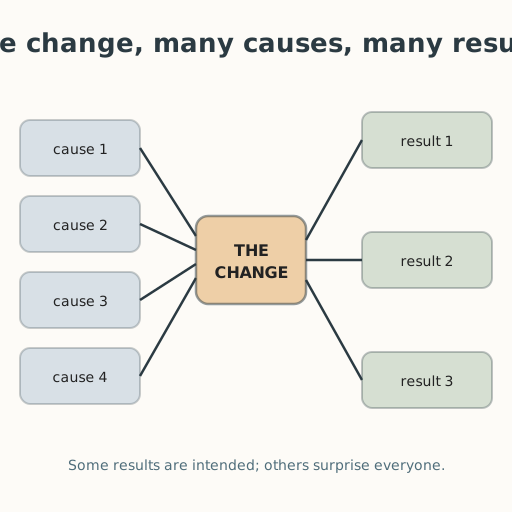
- Meet the diagram (10 min). Look at the diagram. On the left: causes (the things that make a change happen). In the middle: the change. On the right: consequences (the results). Notice there are many on each side.
- Worked example (10 min). Follow along as we fill the diagram for “a new road opened through a village.” Causes: people needed to move goods, money and labor were available, leaders made a decision. Consequences: faster travel (intended), new shops (partly intended), more noise and some families moved from their homes (unintended, and not shared equally).
- Practice with cards (20 min). With a partner, sort the statement cards into causes and consequences for a given change, then build your own diagram for a change you know — a new phone, a bridge, a festival that grew. Mark one consequence as intended and one as unintended.
- Close (5 min). Check each other: did you find more than one cause and more than one result? Tomorrow we apply this tool to a real, world-changing invention: paper.
Differentiation
- Support: Work only with the worked example, using sentence starters (“One cause was…”, “One result was…”); identify intended vs. unintended with a partner.
- Extension: Rank which cause mattered most and defend the ranking; add a consequence that would fall on a different group of people.
Assessment
- Formative (observation/peer): Can the learner produce at least two causes and two consequences for a change, and distinguish an intended from an unintended result?
- Peer-check: Partners trade diagrams and add one cause or consequence the other missed, then explain why it counts.
Home connection
Pick one change in your home or neighborhood (a new shop, a road, a device). List two causes and two consequences of it, and ask someone at home if they can add a third.
Resources
- Multiple causation and intended/unintended consequences are core historical-thinking
concepts; for a classroom-friendly framing, see the historical-thinking resources of
the Stanford History Education Group (sheg.stanford.edu), which treat sourcing and
causality as teachable skills. The claim that consequences fall unevenly on different
people is a fairness commitment (
docs/philosophy.md§4), not a factual finding. - On explicit instruction and worked examples for novice skills: Kirschner, Sweller & Clark (2006), https://doi.org/10.1207/s15326985ep4102_1