Lesson 04 — The Spread of Paper
Learners apply the many-causes/many-consequences tool to a real world change: the spread of paper. Invented in China around the 2nd century BCE and improved there, paper traveled west along trade routes to Central Asia, Baghdad, and Europe. They analyze why it spread (cheaper material, demand, routes, captured papermakers) and what it changed (books, literacy, printing, record-keeping).
Objectives
Objectives
- D08.S1.07.02 Analyze the multiple causes and consequences of one major change, such as the spread of an invention or a large migration.
Essential question
What were the many causes and consequences of the spread of paper?
Key vocabulary
Materials
Standard materials
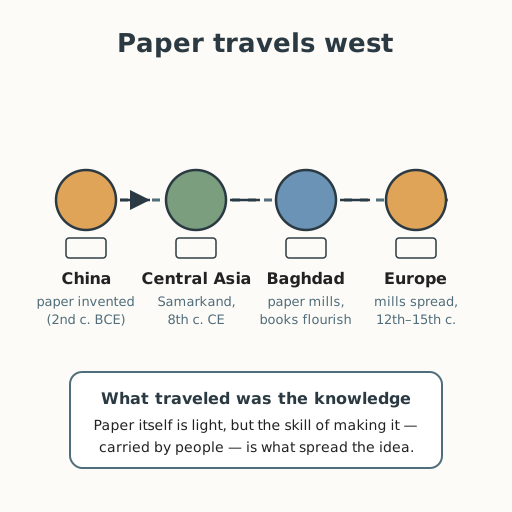
- Paper-spread map sequence · 1 per learner The four-stop journey (China, Central Asia, Baghdad, Europe) to annotate with causes and consequences
- Cause and consequence cards · 1 set per pair Cards naming causes (cheaper material, demand, trade routes, captured papermakers) and consequences (books, literacy, printing, record-keeping) to sort
Low-tech / no-cost
- Found materials to compare writing surfaces Compare writing on a leaf, a bark strip, cloth, and paper to feel why paper was a change; no printed cards needed
- Voice and a drawn map Draw the four-stop journey in sand and retell it aloud, naming causes and consequences as you go
Enriched / lab & device
- A short documentary on early papermaking · 1 A clip showing papermaking in China and its spread, to make the sequence vivid
- A real piece of handmade paper · per pair Handle paper and compare it with bark, cloth, or parchment to feel the difference
Works in different contexts
- large-group Retrace the four-stop journey on the board as a class, adding one cause and one consequence at each stop
- multi-age Younger learners sequence the four stops; older learners connect causes and consequences at each stop and name intended vs. unintended results
- self-directed A learner fills the cause-and-consequence diagram for paper's spread and checks it against the worked list
- level-grouped Learners ready to extend connect paper to later printing (movable type in China) and trace the chain of consequences further
- outdoor-only Lay the four stops on the ground with found objects and walk the route, naming a cause and a consequence at each
Lesson 4 — The Spread of Paper
Summary
Learners apply the many-causes/many-consequences tool to a real world change: the spread of paper. Invented in China around the 2nd century BCE and improved there, paper traveled west along trade routes to Central Asia, Baghdad, and Europe. They analyze why it spread and what it changed.
Objectives
- Analyze the multiple causes and consequences of the spread of paper as one major change. (D08.S1.07.02)
Connection
Think about what you would write on if there were no paper and no screens — a leaf? a strip of bark? smooth clay? People did all of these, and each had a problem: leaves crumble, bark is heavy, clay is bulky. Then, in China, people learned to make a thin, light, cheap sheet from beaten plant fibers — paper. That one idea did not stay in one place. It traveled, and as it traveled it changed every society it reached. How and why it spread is a story with many causes and many consequences — exactly the tool we built yesterday.
Materials
- Paper-spread map sequence
- Cause and consequence cards
Preparation
- Copy the map sequence and cards.
- Retrieval: recall the many-causes/many-consequences diagram from Lesson 3; today we fill it with real history.
Facilitator note
This lesson is written to the learner (“you”). The ideas to land: (1) paper was invented in China (fragments date to the 2nd century BCE; traditionally improved and standardized by Cai Lun around 105 CE); (2) it spread west — to Korea and Japan, then along the Silk Roads to Central Asia (Samarkand), to Baghdad, and on to Europe by the 12th–15th centuries; (3) causes of the spread include cheaper/better material than bamboo, silk, or parchment, rising demand for records, the trade routes themselves, and — by tradition — papermakers captured at the Battle of Talas (751 CE) carrying the skill; (4) consequences include more books, wider literacy, cheaper record-keeping and administration, and, later, printing (movable type developed in China). Model the first stop explicitly, then let learners complete the rest (Kirschner, Sweller & Clark, 2006). These are established historical facts (see Encyclopaedia Britannica, “paper”). The technology lens: paper is a technology — a made thing that changed how humans think, remember, and govern. The global lens: the spread ran east and west, through many peoples, not one; credit belongs to Chinese papermakers, and later to the many hands that carried and adapted the craft. The egalitarian lens: before paper, writing materials were costly, so reading and writing were held by the few; cheap paper widened access — a consequence that was not shared instantly or equally, but trended that way. The ethics lens: knowledge traveling is a good, but note that one route of travel was through war and capture (Talas); we can honor the invention while also noticing the costs and the unequal paths by which ideas move.
Procedure
- Gather (5 min). Quick recall: what did we learn about big changes? (Many causes, many consequences.) Today we apply it to one real change: paper.
- Meet paper (10 min). Paper was invented in China; the oldest fragments date to around the 2nd century BCE, and by tradition a court official named Cai Lun (c. 105 CE) improved and standardized it. It was thin, light, and far cheaper than bamboo, silk, or animal parchment.
- Trace the spread (15 min). Follow the map sequence: China → Korea and Japan → Central Asia (Samarkand) → Baghdad → Europe (12th–15th centuries). At each stop, name one cause that carried it and one consequence it brought.
- Sort causes and consequences (15 min). With a partner, sort the cards: which are causes of paper’s spread, which are consequences? Then build your own diagram for paper, marking one intended and one unintended consequence.
- Close (5 min). One invention, many causes, many consequences — and the knowledge, carried by people, traveled farther than any single sheet. Next we meet a different kind of achievement: a number that changed the world.
Differentiation
- Support: Sequence the four stops only, with a sentence starter at each (“At this stop, paper changed ___”).
- Extension: Connect paper to movable type in China (Bi Sheng, c. 1040s) and trace how cheaper books multiplied the consequences of paper across centuries.
Assessment
- Formative (observation/portfolio): Can the learner name at least two causes and two consequences of paper’s spread, in order across regions?
- Portfolio artifact: The completed paper-spread diagram, kept as evidence of cause-and-consequence analysis.
Home connection
Find one thing in your home that was invented far away and traveled to you (a food, a tool, a word). Ask: how did it get here, and what changed because it did?
Resources
- The facts of paper’s invention in China (2nd century BCE fragments; Cai Lun c. 105 CE) and its westward spread via Samarkand and Baghdad to Europe are documented in Encyclopaedia Britannica, “paper” and “papermaking.” The tradition that papermakers captured at the Battle of Talas (751 CE) carried the craft to the Islamic world is a standard (traditionally attested) account; it is stated here as tradition, not certainty. Movable type (Bi Sheng, c. 1040s) is likewise documented by Britannica.
- On explicit instruction and worked examples: Kirschner, Sweller & Clark (2006), https://doi.org/10.1207/s15326985ep4102_1