Lesson 08 — Choosing to Move, Forced to Move
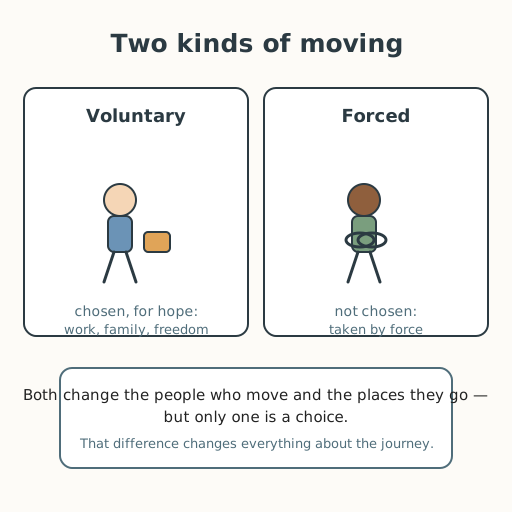
Learners compare voluntary and forced migration. Voluntary migration is chosen — people move for work, family, safety, or hope (push and pull factors). Forced migration is not chosen — people are taken or driven out, as in the transatlantic slave trade. They analyze the causes and effects of each on the people who moved and the places involved, holding the difference between choice and coercion with care.
Objectives
Objectives
- D08.S3.07.01 Compare voluntary and forced migration and analyze their causes and effects on the people who moved and the places involved.
Essential question
What is the difference between voluntary and forced migration, and what causes and effects does each carry?
Key vocabulary
Materials
Standard materials
- Two-migrations comparison page · 1 per learner Two columns to compare a voluntary and a forced migration on causes and effects
- Push-and-pull cards · 1 set per pair Cards naming reasons people move (work, family, safety, freedom, force, danger) to sort as push, pull, or coercion
Low-tech / no-cost
- Voice and a shared board Build the comparison aloud and in sand with stones — no printed cards needed
- A family or community story of moving Invite someone to tell a real story of moving — chosen or not — with care and permission
Enriched / lab & device
- A map of one voluntary and one forced migration route · 1 A map to trace where people moved from and to, and why
- A short, age-appropriate oral-history recording · 1 A first-person account of migration, heard respectfully
Works in different contexts
- large-group Build the two columns on the board; invite the group to add push and pull factors, then pairs refine their own
- multi-age Younger learners sort push vs. pull; older learners explain how coercion differs from both and analyze effects on the people and the places
- self-directed A learner completes the comparison and writes one paragraph on why the voluntary/forced difference changes everything about the journey
- level-grouped Learners ready to extend analyze a second forced migration (e.g., the forced removal of Indigenous peoples) and compare it with the first
- outdoor-only Lay two routes on the ground with found objects — one walked freely, one walked in chains — and discuss the difference
Lesson 8 — Choosing to Move, Forced to Move
Summary
Learners compare voluntary and forced migration. Voluntary migration is chosen — people move for work, family, safety, or hope (push and pull factors). Forced migration is not chosen — people are taken or driven out, as in the transatlantic slave trade. They analyze the causes and effects of each on the people who moved and the places involved.
Objectives
- Compare voluntary and forced migration and analyze their causes and effects on the people who moved and the places involved. (D08.S3.07.01)
Connection
People move for all kinds of reasons. Your own family may have moved — for work, for family, for a safer or better place — and if so, that move was (at least in part) a choice. But not all moving is chosen. Some people in history were taken from their homes against their will, in chains. The difference between “we chose to go” and “we were made to go” changes everything about the journey — its causes, its dangers, and its effects on everyone involved. Today we hold those two kinds of moving side by side, with care.
Materials
- Two-migrations comparison page
- Push-and-pull cards
Preparation
- Copy the comparison page and cards.
- Retrieval: recall from Lesson 4 how paper — and with it, people and ideas — moved along trade routes; today we focus on the people themselves, chosen and forced.
Facilitator note
This lesson is written to the learner (“you”). The ideas to land: (1) migration is
the movement of people from one place to another; (2) voluntary migration is chosen —
push factors (few jobs, hardship, danger at home) and pull factors (work, family,
freedom, safety elsewhere); (3) forced migration is not chosen — people are taken or
driven out, as in the transatlantic slave trade, in which at least 12 million Africans
were forcibly transported across the Atlantic (a topic studied in full in Grade 8);
(4) effects fall on the people who move (loss, separation, but also, in voluntary
cases, opportunity) and on the places involved (both the places left and the places
entered change). These are documented facts (the transatlantic figure is standard in
the Trans-Atlantic Slave Trade Database, slavevoyages.org; see also Encyclopaedia
Britannica). Teach this with care: name feelings before facts, keep detail
non-graphic, and always connect to dignity and survival, not despair (docs/ facilitation.md). The ethics lens: the difference between choice and coercion is a
moral line — respecting it is why we treat the two kinds of movement differently. The
egalitarian lens: forced migration is an injustice, not a “migration like any other”;
calling it by its right name honors the people who endured it. The global lens: both
kinds of movement have happened across all continents and in all eras; no region is
the default. The critical-thinking lens: question stories that say people “moved
willingly” when records show they were taken — the word “migration” can hide coercion.
Procedure
- Gather (5 min). Quick recall: how did two knowledge systems each care for the land? (One by passed-down practice, one by measuring — neither better.) Today: two kinds of moving.
- Meet migration (10 min). Migration is the movement of people from one place to another. Voluntary migration is chosen: people move because of push factors (few jobs, hardship, danger at home) and pull factors (work, family, freedom, safety elsewhere).
- Meet forced migration (10 min). Forced migration is not chosen. One terrible example: in the transatlantic slave trade, at least 12 million African people were taken by force and carried across the Atlantic over centuries — a crime against human dignity. (You will study this in full in Grade 8; today we name it honestly and briefly.)
- Compare causes and effects (15 min). On your page, compare: What caused each kind of move? What were the effects on the people who moved? What were the effects on the places left behind and the places entered?
- Sort push, pull, coercion (10 min). With a partner, sort the cards: which reasons are push, which are pull, and which are coercion (force)? Close: the difference between “we chose” and “we were taken” changes everything.
Differentiation
- Support: Use only push vs. pull sorting with two starter labels, and one sentence each about causes and effects.
- Extension: Analyze a second forced migration — the forced removal of Indigenous peoples from their homelands — and compare its causes and effects with the first.
Assessment
- Formative (observation/portfolio): Can the learner distinguish voluntary from forced migration and name a cause and an effect of each?
- Portfolio artifact: The completed two-migrations comparison, kept as evidence of migration analysis.
Home connection
Ask, gently and with permission, whether anyone in your family has a story of moving — chosen or not. Listen; then notice whether the story was a choice, and how that shaped it.
Resources
- The transatlantic slave trade’s scale (at least 12 million Africans forcibly
transported) is documented by the Trans-Atlantic Slave Trade Database
(https://www.slavevoyages.org/); the UNESCO “Routes of Enslaved Peoples” project
also documents this history. It is named here briefly and without graphic detail,
for fuller study in Grade 8. Push/pull factors in voluntary migration are a standard
geographic framing. The claim that coercion differs in kind from choice is a moral
distinction (
docs/philosophy.md§4), not a factual finding. - On explicit instruction and worked examples: Kirschner, Sweller & Clark (2006), https://doi.org/10.1207/s15326985ep4102_1