Lesson 10 — Ways People Resist
Learners analyze five forms of resistance — protest, boycott, refusal, art, and storytelling — and how people choose among them. Through short, age-appropriate cases (the Salt March, the Montgomery bus boycott, capoeira, acts of refusal, and oral traditions), they see that resistance takes many forms, chosen for a people's goal, risk, and community, and that dignity and agency sit at the center of all of them.
Objectives
Objectives
- D08.S4.07.01 Analyze forms of resistance, such as protest, boycott, refusal, art, and storytelling, and how people choose among them.
Essential question
What forms does resistance take — protest, boycott, refusal, art, storytelling — and how do people choose among them?
Key vocabulary
Materials
Standard materials
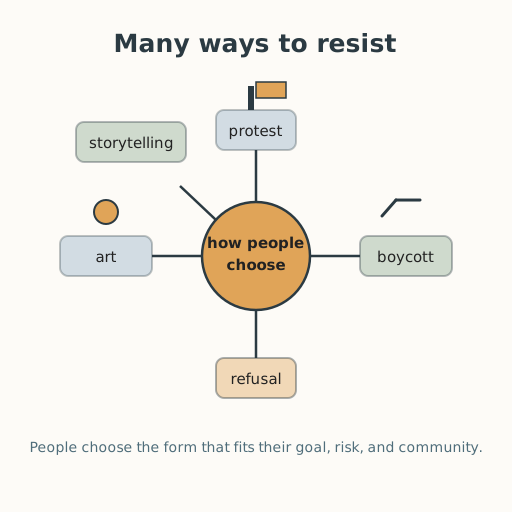
- Resistance-forms wheel · 1 per learner A five-spoke wheel (protest, boycott, refusal, art, storytelling) to annotate with examples
- Resistance case cards · 1 set per pair Short, age-appropriate cases (Salt March, Montgomery bus boycott, capoeira, a refusal, a storytelling tradition) to sort by form
Low-tech / no-cost
- Voice and a shared board Build the wheel aloud on any surface — no printed cards needed
- A local story of speaking up Invite someone to tell a local story of protest, boycott, refusal, or art for change, with permission
Enriched / lab & device
- A short film on the Salt March or a boycott · 1 A clip showing one form of resistance in action, handled with care
- An excerpt of a resistance song or poem · 1 A short, age-appropriate text of resistance art to read and discuss
Works in different contexts
- large-group Build the wheel on the board and sort the cases as a class, then pairs refine their own
- multi-age Younger learners match each case to a form; older learners explain why people chose that form (goal, risk, resources) over another
- self-directed A learner sorts the cases and writes one paragraph on why a group chose one form rather than another
- level-grouped Learners ready to extend analyze how two forms combined (protest + boycott, art + storytelling) to strengthen each other
- outdoor-only Act out each form in a circle and discuss when a person might choose each, respecting that staying quiet is also a choice
Lesson 10 — Ways People Resist
Summary
Learners analyze five forms of resistance — protest, boycott, refusal, art, and storytelling — and how people choose among them. Through short, age-appropriate cases, they see that resistance takes many forms, chosen for a people’s goal, risk, and community, and that dignity and agency sit at the center of all of them.
Objectives
- Analyze forms of resistance — protest, boycott, refusal, art, and storytelling — and how people choose among them. (D08.S4.07.01)
Connection
When something is unfair, there is not just one way to answer it. You could march and shout (protest), stop buying or doing something (boycott), simply say no (refusal), make something beautiful or powerful (art), or keep the story alive so no one forgets (storytelling). People have used every one of these — and more — to push back against injustice. The question is not only what people did, but why they chose that way, with the risks and resources they had. Today we meet five forms, and the choosing.
Materials
- Resistance-forms wheel
- Resistance case cards
Preparation
- Copy the wheel and case cards.
- Retrieval: recall from Lesson 8 the difference between choice and coercion; today, resistance is people choosing to push back against coercion and injustice.
Facilitator note
This lesson is written to the learner (“you”). The ideas to land: (1) resistance takes many forms — protest, boycott, refusal, art, storytelling — and they are often combined; (2) examples: the Salt March (India, 1930) — Gandhi led a long walk to make salt in protest of the British salt tax, an act of protest and civil disobedience; the Montgomery bus boycott (USA, 1955–56) — people stopped riding segregated buses for over a year; capoeira (Brazil) — an art of movement and song created by enslaved Africans, carrying strength and identity; refusal — enslaved and colonized people’s everyday acts of saying no; storytelling — oral traditions that keep memory and resistance alive; (3) people choose a form based on their goal, the risk they face, and their community and resources. These are documented facts (Encyclopaedia Britannica, “Salt March,” “Montgomery bus boycott,” “capoeira”; UNESCO inscribed the “capoeira circle” in 2014, registered as S-056). Teach with care: resistance is agency and dignity, not glorified violence; the forms studied here are nonviolent and artful. The ethics lens: resistance is a response to injustice — the moral question is what wrong it answers and how. The egalitarian lens: resistance is the voice of those with less power; honoring it is honoring dignity, not chaos. The global lens: these forms appear on every continent — India, the USA, Brazil, and beyond — no region is the default. The critical-thinking lens: question why a form was chosen, and notice that the choice is shaped by context, not by one “right” way to resist.
Procedure
- Gather (5 min). Quick recall: how did geography both connect and separate peoples? (Rivers, oceans, deserts, mountains.) Today: what people do about injustice.
- Meet five forms (15 min). Look at the wheel. Protest — march and speak (the Salt March, India 1930: a long walk to make salt, defying an unjust tax). Boycott — stop buying or using (the Montgomery bus boycott, USA 1955–56: people stopped riding segregated buses for over a year). Refusal — simply say no. Art — make something that carries strength (capoeira, Brazil: movement and song created by enslaved Africans). Storytelling — keep the story alive so no one forgets.
- Sort the cases (15 min). With a partner, sort the resistance case cards by form. Notice: many cases fit more than one form — resistance often combines them.
- Why that form? (10 min). For one case, answer: what was the people’s goal? What risk did they face? What resources did they have? Why did that shape their choice of form?
- Close (5 min). Resistance is not one thing; it is a choice made with care and courage. Tomorrow we meet what resistance was often answering: colonization.
Differentiation
- Support: Use only three cases with a starter sentence each (“This was ___ (form) because ___”).
- Extension: Analyze how two forms combined (protest + boycott, or art + storytelling) and explain how each strengthened the other.
Assessment
- Formative (observation/portfolio): Can the learner name the five forms and explain why a people chose one form over another in a specific case?
- Portfolio artifact: The annotated resistance wheel, kept as evidence of analyzing forms of resistance.
Home connection
Ask someone at home about a time people in your community spoke up or made change — how did they do it (protest, boycott, refusal, art, storytelling), and why that way?
Resources
- The Salt March (India, 1930), the Montgomery bus boycott (USA, 1955–56), and capoeira (Brazil, created by enslaved Africans) are documented in Encyclopaedia Britannica (“Salt March,” “Montgomery bus boycott,” “capoeira”). The UNESCO inscription of the “capoeira circle” (2014) is registered as S-056. Refusal and storytelling as resistance are standard in the historical record of enslaved and colonized peoples; they are treated here as agency and dignity, never glorified violence. The claim that people choose a form for goal, risk, and resources is an analytical framing, not a factual finding.
- On explicit instruction and worked examples: Kirschner, Sweller & Clark (2006), https://doi.org/10.1207/s15326985ep4102_1