Lesson 11 — What Colonization Took
Learners explain how colonization affected colonized peoples: the loss of land (dispossession), the loss of culture (languages and practices suppressed, children taken to distant schools), and the loss of self-rule (foreign rule imposed). They hold these losses with care and accuracy, and always pair them with what peoples kept alive — language, story, and resistance — so the lesson ends in dignity, not despair.
Objectives
Objectives
- D08.S4.07.02 Explain how colonization affected colonized peoples, including loss of land, culture, and self-rule, with care and accuracy.
Essential question
How did colonization affect colonized peoples, in the loss of land, culture, and self-rule?
Key vocabulary
Materials
Standard materials
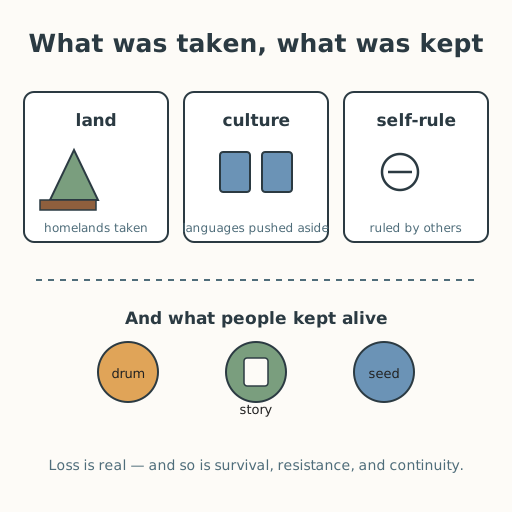
- Three-losses page · 1 per learner Three columns — land, culture, self-rule — to record what was taken and, below, what people kept alive
- Then-and-still cards · 1 set per pair Cards naming losses and continuities (homelands taken; languages suppressed; foreign rule imposed; languages and stories kept alive) to sort
Low-tech / no-cost
- Voice and a shared board Build the three columns aloud on any surface — no printed cards needed
- A story told with care and permission Invite someone to share, if they wish and it is right, a family or community story of surviving colonization
Enriched / lab & device
- A short documentary on Indigenous resilience · 1 A clip made with and by Indigenous communities about what was lost and what continues, handled with care
- A map of colonization's spread · 1 A map showing where European colonization reached, to see its global scale
Works in different contexts
- large-group Build the three columns on the board, sorting the cards as a class before pairs refine their own; hold the close with hope
- multi-age Younger learners match losses to the three columns; older learners explain the link between loss and resistance and name what continued
- self-directed A learner completes the three-losses page and writes a short reflection pairing one loss with one thing that continued
- level-grouped Learners ready to extend analyze one specific case (e.g., a particular people's experience) with a named source, at a respectful depth
- outdoor-only Discuss in a circle, pairing each loss with a survival, so the conversation ends in dignity and continuity
Lesson 11 — What Colonization Took
Summary
Learners explain how colonization affected colonized peoples: the loss of land (dispossession), the loss of culture (languages and practices suppressed, children taken to distant schools), and the loss of self-rule (foreign rule imposed). They hold these losses with care and accuracy, and always pair them with what peoples kept alive — language, story, and resistance — so the lesson ends in dignity, not despair.
Objectives
- Explain how colonization affected colonized peoples, including the loss of land, culture, and self-rule, with care and accuracy. (D08.S4.07.02)
Connection
Imagine someone came and said your home now belonged to them, that your language could no longer be spoken in school, and that strangers would make your community’s rules. You would feel the loss in three places at once: the ground under you, the words in your mouth, and the power to decide your own life. This is what colonization did, on a vast scale, to peoples across the Americas, Africa, Asia, and Oceania. It is a hard thing to look at — and we look at it carefully and honestly, and we also look at what people kept alive against it.
Materials
- Three-losses page
- Then-and-still cards
Preparation
- Copy the page and cards.
- Retrieval: recall from Lesson 10 the forms of resistance; today we meet the injustice those forms so often answered.
Facilitator note
This lesson is written to the learner (“you”). The ideas to land: (1) colonization
is one people taking and ruling another’s land and life; from the late 1400s onward,
European powers colonized much of the Americas, Africa, Asia, and Oceania; (2) its
effects include loss of land (dispossession of Indigenous peoples), loss of culture
(languages and practices suppressed; in some places children were taken to distant
boarding or residential schools where their languages were punished), and loss of
self-rule (foreign governments and borders imposed, often ignoring existing peoples);
(3) accuracy and care: we name these losses plainly but without gratuitous detail, and
we always pair them with continuity — peoples kept their languages, stories, and
resistance alive, and continue to. These are documented facts (see Encyclopaedia
Britannica, “colonialism”; UNESCO and Indigenous organizations document language loss
and revitalization). Teach with care (docs/facilitation.md): name feelings before
facts, keep detail non-graphic, and end in dignity and agency, never despair. The
ethics lens: colonization was an injustice — the lesson’s moral clarity is honest, not
preachy. The egalitarian lens: telling this from the perspective of colonized peoples,
not the colonizers, is the whole point — history from many sides, never one people’s
triumph. The global lens: colonization touched every inhabited continent; the examples
are deliberately not one nation’s story. The critical-thinking lens: question whose
voice the history books use — “exploration” and “settlement” are words that can hide
what colonized peoples called invasion.
Procedure
- Gather (5 min). Quick recall: what forms of resistance did we meet? (Protest, boycott, refusal, art, storytelling.) Today: what those forms were answering.
- Meet colonization (10 min). Colonization is one people taking and ruling another’s land and life. From the late 1400s onward, European powers colonized much of the Americas, Africa, Asia, and Oceania.
- Three losses (15 min). Fill the three columns. Land — homelands taken from the peoples who lived there (dispossession). Culture — languages and practices suppressed; in some places, children were taken to distant schools where their own languages were punished. Self-rule — foreign governments and borders imposed, ignoring the peoples already there.
- What people kept alive (10 min). Sort the then-and-still cards: pair each loss with something that continued — a language still spoken, a story still told, a people still here. Resistance (Lesson 10) and survival are the other half of this story.
- Close (10 min). The loss was real, and it matters. And so does this: peoples endured, kept their languages and stories, and continue today. We end there — in dignity, not despair.
Differentiation
- Support: Use only the three columns with a picture and a starter sentence for each (“They lost their ___; they kept their ___”).
- Extension: With a named source, analyze one people’s specific experience — one loss and one way they preserved their language or self-rule — at a respectful depth.
Assessment
- Formative (observation/portfolio): Can the learner name the three losses and pair each with one thing peoples kept alive, with accuracy and care?
- Portfolio artifact: The completed three-losses page, kept as evidence of explaining colonization’s effects with care.
Home connection
If it is right for your family, ask an elder what your community kept alive through a hard time — a language, a story, a practice — and notice that continuity is its own quiet victory.
Resources
- The global reach of European colonization from the late 1400s and its effects —
dispossession of Indigenous peoples, suppression of languages, and the imposition of
foreign rule — are documented in Encyclopaedia Britannica (“colonialism”) and in
UNESCO’s work on language loss and revitalization. The boarding/residential-school
practice of punishing children’s languages is documented (e.g., the work of national
truth and reconciliation commissions in Canada, and similar bodies elsewhere); it is
stated here without graphic detail. The pairing of loss with continuity is a
values-and-accuracy commitment (
docs/philosophy.md§4), not a historical claim. - On explicit instruction and worked examples: Kirschner, Sweller & Clark (2006), https://doi.org/10.1207/s15326985ep4102_1