Lesson 12 — The Human Story, from Many Sides
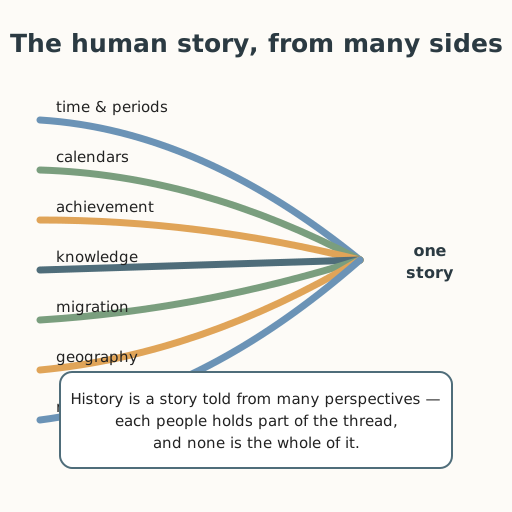
Learners gather the unit's threads — time and periods, calendars, non-European achievement, knowledge systems, migration, geography, resistance, and colonization — and braid them into one many-sided account. Through spaced retrieval and a short synthesis of their own, they practice telling the human story from many perspectives, never as one people's triumph.
Objectives
Objectives
- D08.S1.07.01 Explain why historians divide time into periods and compare two different calendars or ways of counting years used by different peoples.
- D08.S2.07.02 Compare how two different knowledge systems, such as indigenous ecological knowledge and formal science, understand and care for the natural world.
- D08.S3.07.01 Compare voluntary and forced migration and analyze their causes and effects on the people who moved and the places involved.
- D08.S4.07.01 Analyze forms of resistance, such as protest, boycott, refusal, art, and storytelling, and how people choose among them.
- D08.S4.07.02 Explain how colonization affected colonized peoples, including loss of land, culture, and self-rule, with care and accuracy.
Essential question
How does the human story look when it is told from many sides, never as one people's triumph?
Key vocabulary
Materials
Standard materials
- Threads-and-braid page · 1 per learner A page with seven threads (time, calendars, achievement, knowledge, migration, geography, resistance) to braid into one reflection
- Unit-topic cards · 1 set per pair Cards naming each lesson's idea, to retrieve and reconnect across the unit
Low-tech / no-cost
- Voice and a shared braid Recall the unit's ideas aloud and weave them together in a circle — no printed cards needed
- Found objects as memories Each learner holds a found object that stands for one lesson's idea, then braids them into a shared retelling
Enriched / lab & device
- A class digital gallery or shared document · 1 A place to gather each learner's many-sided account into one collection
- A map of the world · 1 Point to the many regions the unit visited — India, the Islamic world, Australia, the Silk Roads, the Americas, Africa, Oceania
Works in different contexts
- large-group Recall each lesson's idea in turn, then let each learner add their own thread to a shared braid on the board
- multi-age Younger learners recall one idea they remember; older learners braid several and explain how they connect
- self-directed A learner completes the threads-and-braid page alone, then writes or records their many-sided account
- level-grouped Learners ready to extend write a two-paragraph account of one thread told from two different perspectives, and compare them
- outdoor-only Sit in a circle; pass a found object and let each learner add one thread of the human story they now hold
Lesson 12 — The Human Story, from Many Sides
Summary
Learners gather the unit’s threads — time and periods, calendars, non-European achievement, knowledge systems, migration, geography, resistance, and colonization — and braid them into one many-sided account. Through spaced retrieval and a short synthesis of their own, they practice telling the human story from many perspectives, never as one people’s triumph.
Objectives
- Recall and connect the unit’s ideas — periods and calendars, non-European achievement, knowledge systems, migration, geography, resistance, and colonization — into one many-sided account of the human story. (D08.S1.07.01, D08.S2.07.02, D08.S3.07.01, D08.S4.07.01, D08.S4.07.02)
Connection
When several people tell you about the same day — a parent, a friend, a neighbor — each remembers it a little differently, and only together do you get the whole of it. History is like that, but bigger: every people holds part of the human story, and no one people holds all of it. For the last three weeks you have gathered threads — how we divide time, what non-European peoples achieved, how knowledge systems meet, why people move, how geography shapes us, and how people resist and endure. Today you braid them into one story, told from many sides.
Materials
- Threads-and-braid page
- Unit-topic cards
Preparation
- Copy the page and cards.
- Retrieval: this whole lesson is a spaced, interleaved retrieval pass across the unit — recalling ideas from every lesson, not re-reading them (Dunlosky et al., 2013).
Facilitator note
This lesson is written to the learner (“you”). The ideas to land: (1) the unit’s threads connect — time, calendars, achievement, knowledge systems, migration, geography, resistance, and colonization are not separate facts but one braided story; (2) telling it from many sides, never one people’s triumph, is the whole discipline; (3) the learner is now an author of that story. Use spaced retrieval — ask learners to recall each lesson’s idea before looking at any card (Dunlosky et al., 2013), and let them build their own synthesis (Kirschner, Sweller & Clark, 2006). The global lens: the unit deliberately visited India, the Islamic world, Aboriginal Australia, the Silk Roads and Indian Ocean, the Americas, Africa, and Oceania — many centers, no default. The egalitarian lens: every people’s thread is equally part of the braid; none is the whole. The ethics lens: telling history fairly — naming loss and survival, resistance and continuity — is itself an ethical act. The critical-thinking lens: question any story told as one people’s triumph; ask whose voice is missing and whose is centered. This is the unit’s capstone; keep it a celebration of the learner’s own gathering, not a test.
Procedure
- Gather (5 min). Without looking, recall the unit’s ideas: What did we learn about time? about zero and the Canon? about knowledge systems? about migration and geography? about resistance and colonization? Say or write as many as you can.
- Retrieve the threads (15 min). Work through the unit-topic cards with a partner. For each, recall one thing you learned — then check. Notice which ideas came back easily and which needed a nudge; that is retrieval doing its work.
- Braid them (20 min). On your threads-and-braid page, choose three threads that connect and write or draw how they braid together. Example: the numerals (a non-European achievement) traveled along geography’s routes, carried by people on the move — three threads, one story.
- Tell it from many sides (10 min). Write or tell one short account of a thread from two different perspectives — the people who gained and the people who lost, or two peoples who remember it differently. Notice: only together is it whole.
- Close (5 min). You are now a keeper of the human story, told from many sides. Carry it with care, and keep listening for the voices the story has left out.
Differentiation
- Support: Recall one idea per lesson with a picture or partner prompt, and braid just two threads with a starter sentence (“These connect because ___”).
- Extension: Write two paragraphs telling one thread from two perspectives, then name one perspective the history books often leave out and why it matters.
Assessment
- Summative (portfolio/self): The threads-and-braid page and the two-perspective account show whether the learner can recall the unit’s ideas and connect them into a many-sided story.
- Self-check: The learner asks, “Did I recall the unit’s ideas, connect at least two threads, and tell one story from more than one side?”
Home connection
Tell someone at home one thing you will remember from this unit, and one voice in the human story you think deserves to be heard more. Ask what they would add.
Resources
- Spaced retrieval and distributed practice are among the highest-utility learning techniques: Dunlosky, Rawson, Marsh, Nathan & Willingham (2013), Psychological Science in the Public Interest, https://doi.org/10.1177/1529100612453266.
- On explicit instruction and worked examples: Kirschner, Sweller & Clark (2006), https://doi.org/10.1207/s15326985ep4102_1