Lesson 01 — Three Questions: Helped, Harmed, Fair
Learners meet a simple three-question framework — who is helped, who is harmed, and what is fair — and use it to reason about a moral question. They see the framework modeled step by step, then apply it with a partner to an everyday situation.
Objectives
Objectives
- D09.S1.07.01 Apply a simple framework (such as who is helped, who is harmed, and what is fair) to a moral question.
Essential question
How do I reason about a moral question — who is helped, who is harmed, and what is fair?
Key vocabulary
Materials
Standard materials
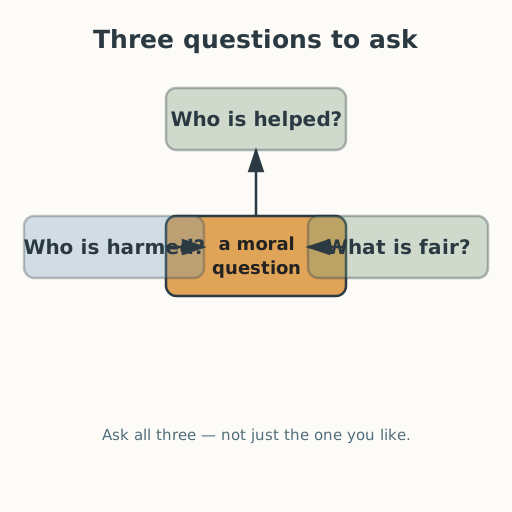
- Three-questions framework card · 1 per learner A simple organizer with three boxes — "Who is helped?", "Who is harmed?", "What is fair?"
- Scenario cards · 1 set per pair Short everyday situations with a moral question at the center
Low-tech / no-cost
- Voice and a shared board Draw the three boxes on any surface and talk through the questions aloud; no cards needed
- A familiar situation Use a situation from the learners' own day (a shared space, a borrowed item) instead of printed cards
Enriched / lab & device
- Projected or digital framework · 1 Display the three questions large for the whole group, editable on a device
- A short news-style scenario · 1 One age-appropriate current event to run through the three questions as a class
Works in different contexts
- large-group Work one scenario together on the board, then pairs apply the framework to a second scenario and share one finding
- multi-age Younger learners answer "helped" and "harmed"; older learners add the "fair" question and explain their weighing
- self-directed A learner reads the worked example, then applies the three questions to two scenarios and writes one sentence per question
- level-grouped Learners ready to extend compare two different answers to "fair" and say which they find stronger and why
- outdoor-only Use an outdoor shared-resource situation (a tree to climb, water to fetch, a path everyone uses) as the scenario
Lesson 1 — Three Questions: Helped, Harmed, Fair
Summary
Learners meet a simple framework for moral questions — three questions to ask: who is helped, who is harmed, and what is fair. They watch it modeled step by step on one situation, then apply it with a partner to a second situation.
Objectives
- Apply a simple framework — who is helped, who is harmed, and what is fair — to a moral question. (D09.S1.07.01)
Connection
Every day you face small choices that are also questions about right and wrong: who gets the last of the water, whether to tell a friend something hard, whether to keep a promise that has become costly. None of these comes with a label saying “right” or “wrong.” A framework is just a set of questions you can ask yourself to think more clearly. Today you learn three of them.
Materials
- Three-questions framework card
- Scenario cards
Preparation
- Copy the framework card and scenario cards.
- Retrieval: from Grade 6, recall the difference between a fact (what is), a belief (what someone holds to be true), and a value (what someone thinks is right or good). Today’s questions are about values — but we reason about them with the same care we use for facts.
Facilitator note
This lesson is written to the learner (“you”). The ideas to land: (1) a moral question is a question about right and wrong, and a framework is a set of questions that helps you think; (2) the three questions are: who is helped, who is harmed, and what is fair; (3) reasoning means asking all three, not just one. Model the framework once, out loud and step by step (a worked example — see Kirschner, Sweller & Clark 2006, S-011), before learners try it themselves. The ethics lens: these questions make consequences and fairness visible instead of leaving them as a gut feeling. The egalitarian lens: asking “who is helped and who is harmed” pushes us to notice people we might otherwise forget — the ones with less power or less voice. The global lens: the framework is deliberately simple and portable; it works on a village water question, a classroom dispute, or a market decision anywhere. The critical-thinking lens: the questions are held as questions — the framework does not hand out answers, it disciplines the asking. Do not present any single answer to “what is fair” as the correct one; the point is the reasoning, not the conclusion.
Procedure
- Gather and recall (5 min). Think back to Grade 6: what is the difference between a fact, a belief, and a value? Say it to a partner. Today we work with values — questions of right and wrong — and we learn a tool for them.
- Meet the three questions (10 min). Look at the framework card. A moral question is a question about right and wrong. When you meet one, ask three questions: Who is helped? Who is harmed? What is fair? Notice you ask all three, not just the one you like.
- Watch it modeled (10 min). Here is a situation: A group has one ball for a break time, and one person keeps it the whole time. Run it through the three questions out loud: who is helped? (The one person, for now.) Who is harmed? (Everyone else, who cannot play; and maybe the friendship.) What is fair? (A turn system, sharing, or deciding together — there is more than one fair answer.) Notice the questions made the situation thinkable.
- Try it with a partner (15 min). Choose a scenario card. Read it, then together answer the three questions — one sentence each. If you disagree about “fair,” that is good: say why you think so.
- Close (10 min). Share one finding with the group. Remember: the framework is not a machine that gives one answer. It is a way to see the choice more fully.
Differentiation
- Support: Use a two-question starter (helped, harmed) before adding “fair”; give sentence starters (“This helps ___ because ___”).
- Extension: Take one scenario and compare two different answers to “what is fair,” then say which you find stronger and why.
Assessment
- Formative (observation): Can the learner name the three questions and apply each to a scenario with a concrete answer (who, who, what)?
- Portfolio artifact: The completed framework card for one scenario, kept as the first piece of the unit’s moral-reasoning portfolio.
Home connection
Bring one small question home: ask someone in your household what they think is fair in a shared-resource situation (who does the dishes, how a ride is shared) — and whether they ask who is helped and who is harmed.
Resources
- On explicit instruction and worked examples for novice skills: Kirschner, Sweller & Clark (2006), https://doi.org/10.1207/s15326985ep4102_1 (S-011).