Lesson 02 — Using the Three Questions
Learners apply the three-question framework to four everyday dilemmas, produce a written moral-question analysis, and practice holding more than one fair answer at once. This is the unit's first formal portfolio artifact.
Objectives
Objectives
- D09.S1.07.01 Apply a simple framework (such as who is helped, who is harmed, and what is fair) to a moral question.
Essential question
How do I apply the three questions — helped, harmed, fair — to a real moral question, and hold more than one fair answer at once?
Key vocabulary
Materials
Standard materials
- Moral-question worksheet · 1 per learner A one-page organizer — the scenario, the three questions, a space for "my answer and why"
- Scenario set · 1 set per group Four short dilemmas from everyday life (a shared well, a borrowed item, a group project, a kept secret)
Low-tech / no-cost
- Paper and a shared surface Fold a page into three columns for the three questions; no printed worksheet needed
- A dilemma from daily life Use a real, low-stakes situation learners raise, keeping it anonymous and safe
Enriched / lab & device
- A shared digital document · 1 Learners write their three answers and reasons in a shared doc for peer feedback
- A short news dilemma · 1 One age-appropriate current event run through the three questions with evidence
Works in different contexts
- large-group Model one scenario on the board, then groups each take a different scenario and post their three answers to compare
- multi-age Younger learners complete helped/harmed; older learners write the full "my answer and why" with a trade-off named
- self-directed A learner completes the worksheet for two scenarios and self-checks that they answered all three questions for each
- level-grouped Learners ready to extend name the trade-off explicitly and say which value they weighed heavier and why
- outdoor-only Run the three questions on an outdoor commons — water, shade, a path — and write answers in the dust or on a shared board
Materials
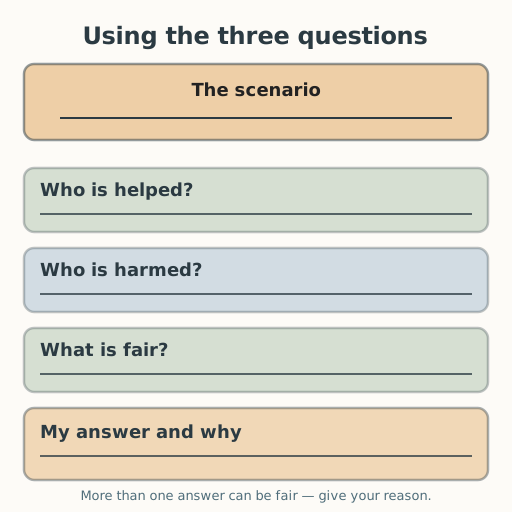
Lesson 2 — Using the Three Questions
Summary
Learners apply the three questions — who is helped, who is harmed, what is fair — to everyday dilemmas, and write a short moral-question analysis with a reason. They practice holding more than one fair answer at once, which is what real reasoning about values requires.
Objectives
- Apply a simple framework — who is helped, who is harmed, and what is fair — to a moral question. (D09.S1.07.01)
Connection
Thinking clearly about right and wrong is a skill, and like any skill it grows with practice. Yesterday you met the three questions; today you actually use them — the way a person uses a map by walking with it, not by staring at it. The goal is not to find the one “correct” answer, but to be able to say, calmly and with reasons, here is what I think is right and here is why — a skill you will use in a family argument, a job, and a vote.
Materials
- Moral-question worksheet
- Scenario set
Preparation
- Copy the worksheet and scenario set.
- Retrieval: recall the three questions from Lesson 1 (helped, harmed, fair) without looking — then check against the card.
Facilitator note
This lesson is written to the learner (“you”). The idea to land: applying the framework means answering all three questions in writing, then giving a reason for your answer — and it is normal, not failure, to find more than one fair answer. Model the full worksheet once on the board before independent work (worked example, S-011), then use guided practice: do one scenario together, let groups do the rest, and give feedback in the moment. The ethics lens: a reason matters as much as an answer; “because it feels right” is a start, not a finish. The egalitarian lens: some dilemmas have a voice that is easy to forget (the person who owns the borrowed item, the quiet member of the group) — check whether you heard them. The global lens: the scenarios are deliberately set in everyday, low-cost settings (water, borrowing, group work, a secret) so they travel across city and village, coast and mountain. The critical-thinking lens: when learners disagree on “fair,” do not arbitrate to one right answer; ask each to give their reason, and let the disagreement stand as evidence that fairness is reasoned, not obvious. Keep the written work; it is a portfolio artifact.
Procedure
- Recall (5 min). Without looking: what are the three questions? Say them, then check.
- Model it (10 min). Watch the worksheet be completed for one scenario: A neighbor borrowed a tool and returned it broken without saying anything. Who is helped? (No one, in the long run — the borrower avoided an awkward moment.) Who is harmed? (The owner, who must fix or replace it, and the trust between them.) What is fair? (The borrower says what happened and helps repair or replace it.) “My answer and why”: the borrower should own it and help fix it, because trust is worth more than avoiding embarrassment.
- Guided practice (15 min). With a group, choose a scenario. Answer all three questions in writing. If your group has two answers to “fair,” write both and a reason for each.
- Independent work (15 min). Complete a second worksheet on your own, or with one partner. Self-check: did I answer all three questions? Did I give a reason, not just an answer?
- Close (5 min). Trade worksheets with a partner and read each other’s reasons. Ask one question about theirs. Remember: more than one answer can be fair — what matters is the reasoning.
Differentiation
- Support: Provide sentence starters (“This is fair because ___”; “This helps ___ and harms ___”) and a two-scenario limit.
- Extension: Name the trade-off in the dilemma (what you give up to be fair) and say which value you weighed heavier and why.
Assessment
- Formative (observation): Does the written analysis answer all three questions and include a reason?
- Portfolio artifact: The completed moral-question worksheet, kept in the portfolio.
- Self-assessment: Learners self-check against the mastery checklist — “Could I apply the three questions alone, and explain them to someone else?”
Home connection
Take the framework home and apply it aloud to one small family decision this week. Ask someone else their three answers, and compare reasons.
Resources
- On explicit instruction and worked examples for novice skills: Kirschner, Sweller & Clark (2006), https://doi.org/10.1207/s15326985ep4102_1 (S-011).