Lesson 04 — Seeing Injustice: Affected, Benefiting, Just
Learners analyze a case of inequality — unequal access to clean water — by naming who is affected, who benefits, and what would make it more just. They apply the same three-column analysis to a second case of their choosing.
Objectives
Objectives
- D09.S2.07.01 Analyze a case of inequality or injustice, identifying who is affected, who benefits, and what would make it more just.
Essential question
How do I analyze a case of inequality or injustice — who is affected, who benefits, and what would make it more just?
Key vocabulary
Materials
Standard materials
- Case study sheet · 1 per learner A one-page water-access case with a three-column analyzer — who is affected, who benefits, what would make it more just
- Case cards · 1 set per group Additional short cases (unequal pay for equal work, a school only some can reach, a shared space only some may use)
Low-tech / no-cost
- Voice and a shared board Tell the case aloud and build the three columns together on any surface
- A local inequality Name an inequality learners can see around them, keeping it respectful and anonymous
Enriched / lab & device
- A data display · 1 A simple chart or map showing unequal access to water or schooling, to read as a class
- A short documentary clip · 1 An age-appropriate clip about unequal access to a basic need, handled with care
Works in different contexts
- large-group Analyze the water case as a class on the board, then groups take one extra case each and report
- multi-age Younger learners identify who is affected and who benefits; older learners add the "more just" proposal with a reason
- self-directed A learner reads the case, completes the three columns in writing, and checks that each column names real people or groups
- level-grouped Learners ready to extend propose a structural change (a rule or system) as well as a one-time fix, and compare them
- outdoor-only Use a local shared resource — a water source, a field, a path — as the case, and identify who is affected and who benefits
Lesson 4 — Seeing Injustice: Affected, Benefiting, Just
Summary
Learners analyze a case of inequality — unequal access to clean water — using three columns: who is affected, who benefits, and what would make it more just. They then apply the same analysis to a second case. This connects the moral framework of Lesson 1–2 to questions of justice in society.
Objectives
- Analyze a case of inequality or injustice, identifying who is affected, who benefits, and what would make it more just. (D09.S2.07.01)
Connection
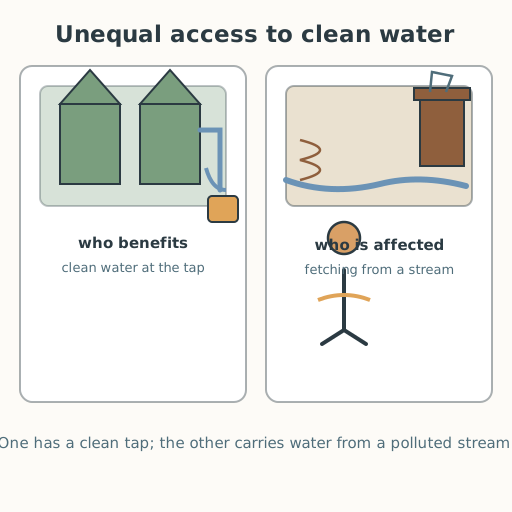
Fairness is not only about one person’s choice; it is also about how whole systems treat groups of people. When one part of a town has clean water piped to the tap while another part drinks from a stream that carries waste, that is not just a series of individual choices — it is a pattern. Learning to see a pattern like that, and to name who is affected and who benefits, is the first step toward changing it. Today you practice that kind of seeing.
Materials
- Case study sheet
- Case cards
Preparation
- Copy the case study sheet and case cards.
- Retrieval: recall the three questions (helped, harmed, fair). Today we extend “helped” and “harmed” to whole groups — who is affected and who benefits — and ask what would make the situation just.
Facilitator note
This lesson is written to the learner (“you”). The ideas to land: (1) inequality is a pattern where some people get more of something important (or carry more of a burden) than others; injustice is inequality that is also unfair; (2) to analyze a case you name who is affected, who benefits, and what would make it more just; (3) “more just” can mean a one-time fix or a change to a rule or system. Model the water case once on the board (worked example, S-011), then let groups work a second case. The ethics lens: analysis here is descriptive first (who is affected, who benefits — these are observable) and normative second (what would be more just — this is a value claim, and learners may differ). The egalitarian lens: injustice usually falls hardest on those with the least power; notice whose voice is missing. The environment lens: clean water is an environmental and a justice issue at once. The critical-thinking lens: the fact (about 1 in 4 people globally still lack safely managed drinking water — WHO/UNICEF JMP, S-065) is evidence; the claim that this should change is a value — keep them distinct. The water case is a composite illustration, not a named real community, so no real place is misrepresented. Handle with care and hope: end on agency (what could be done), never despair.
Procedure
- Recall (5 min). What were the three questions? Now we ask them of a whole situation affecting many people, not just one choice.
- Meet the three columns (5 min). To analyze inequality, ask: Who is affected? Who benefits? What would make it more just?
- Analyze the water case (15 min). Read this case: In a town, one neighborhood has clean water piped to every home. A poorer neighborhood down the hill has no pipes; people fetch water from a stream that also carries factory waste upstream. More people in the poor neighborhood get sick. Fill the three columns: Who is affected? (The people of the poorer neighborhood — especially the sick, the old, and those who spend hours carrying water.) Who benefits? (The factory, which disposes of waste cheaply; and the piped neighborhood, which stays clean.) What would make it more just? (Stop the waste, bring clean water to everyone, make the factory pay for the harm, and include the affected people in the decision.)
- Apply it (15 min). With a group, take a second case card. Complete the three columns. If you propose a rule or system change as well as a fix, say which and why.
- Close (10 min). Share one “more just” idea. Notice: analysis does not by itself fix anything — but you cannot fix what you cannot see.
Differentiation
- Support: Provide the affected/benefiting groups pre-listed and ask learners to match them to the columns, then add one “more just” idea.
- Extension: Propose a structural change (a rule, a tax, a new way of deciding) and compare its likely effect with a one-time fix.
Assessment
- Formative (observation): Can the learner name who is affected, who benefits, and at least one “more just” change, with a reason?
- Portfolio artifact: The completed case analysis, kept in the portfolio.
Home connection
Look around your own neighborhood or town: name one thing that is not shared equally (water, shade, transport, a place to play) and ask who is affected and who benefits.
Resources
- WHO/UNICEF Joint Monitoring Programme (JMP) — about 1 in 4 people globally (roughly 2.1 billion) still lack safely managed drinking water (2025 household report): https://washdata.org/ (S-065). This fact is the evidence; the claim that everyone should have clean water is a value, stated openly as such.
- On explicit instruction and worked examples: Kirschner, Sweller & Clark (2006), https://doi.org/10.1207/s15326985ep4102_1 (S-011).