Lesson 03 — Where Our Ideas of Right and Wrong Come From
Learners explore how background, culture, and position shape what people think is right, using paired cases where two people see the same act differently. They learn the difference between understanding a view and agreeing with it, and map where their own ideas of right and wrong come from.
Objectives
Objectives
- D09.S1.07.02 Explain how someone's background, culture, or position can shape what they think is right.
Essential question
How can someone's background, culture, or position shape what they think is right?
Key vocabulary
Materials
Standard materials
- Perspective cases · 1 set per pair Short situations where two people, in different positions or cultures, see the same act differently
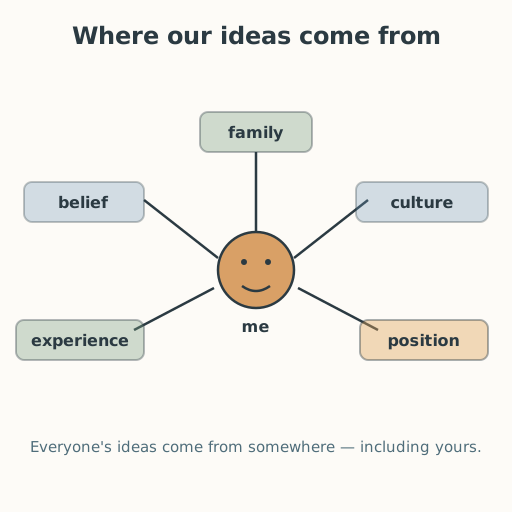
- "Where my ideas come from" web · 1 per learner A blank web — "me" at the center, with spokes for family, culture, position, experience, and belief
Low-tech / no-cost
- Voice and a shared board Talk through the cases aloud and draw the web together on any surface
- A local practice Invite learners to name a practice in their own home or community and explain what makes it right to them
Enriched / lab & device
- A short film clip · 1 A clip showing the same custom or act viewed differently in two places, handled with respect
- A cross-cultural example set · 1 set per group Cards pairing the same act (a greeting, a meal, a gift) as seen in two different traditions
Works in different contexts
- large-group Do one case as a whole class, then pairs take different cases and report the two perspectives they found
- multi-age Younger learners identify the two people and what each thinks; older learners explain how each person's position shaped their view
- self-directed A learner reads two cases and writes, for each, how background, culture, or position shaped what each person thought was right
- level-grouped Learners ready to extend distinguish "understand why" from "agree with" and say which they are doing for each case
- outdoor-only Discuss a shared local resource (a fishing spot, a grazing field, a fruit tree) and how different users each think their use is right
Lesson 3 — Where Our Ideas of Right and Wrong Come From
Summary
Learners explore how background, culture, and position shape what people think is right. Through paired cases where two people see the same act differently, they practice the crucial distinction between understanding a view and agreeing with it, and they map where their own ideas come from.
Objectives
- Explain how someone’s background, culture, or position can shape what they think is right. (D09.S1.07.02)
Connection
Two people can watch the same thing and reach different answers about what is right — and each can be sincere. The neighbor who keeps a goat and the neighbor who grows vegetables may see a shared fence very differently; the older and younger members of a family may disagree about how loudly to celebrate; a guest and a host may each think they are being polite while doing opposite things. Before you can reason with someone, it helps to see where their view is coming from. That is today’s work.
Materials
- Perspective cases
- “Where my ideas come from” web
Preparation
- Copy the perspective cases and the web.
- Retrieval: recall the three questions (helped, harmed, fair) — today we add a new layer: why people answer them differently.
Facilitator note
This lesson is written to the learner (“you”). The ideas to land: (1) what a person thinks is right is shaped by their background (how and where they grew up), their culture (the shared ways of a people), and their position (their role — parent or child, owner or worker, host or guest, powerful or powerless); (2) this shaping is not a flaw — it is simply true of everyone, including us; (3) understanding a view is not the same as agreeing with it. Hold the difference between “understand” and “agree” carefully: learners may understand why someone holds a view and still disagree with it, and that is legitimate. The ethics lens: we reason about values more honestly when we know where they come from. The egalitarian lens: position matters — people with more power and people with less often see “fair” differently, and neither view is automatically right. The global lens: use examples from many places, and invite learners’ own practices without ranking any tradition above another (see philosophy §11 — no one culture is the default). The critical-thinking lens: ask “where does that idea come from?” about every view, including our own. Do not require any learner to disclose personal or family information; the web may be completed with invented or general examples.
Procedure
- Recall (5 min). Name the three questions from the last two lessons. Now a new question: why might two people answer “what is fair?” differently?
- Meet the shapers (10 min). Three things shape what a person thinks is right: background (how and where they grew up), culture (the shared ways of their people), and position (their role and how much power they have). Everyone’s ideas come from somewhere — including yours.
- Read a case together (10 min). A family keeps a shop. The parent thinks the child should work in the shop after school to help the family; the child thinks evenings should be for study. Whose view is shaped by what? (The parent’s, by position and by the family’s need; the child’s, by position and by valuing education.) Understand both — you do not have to agree with either.
- Pairs (15 min). Take a perspective case. For each person, answer: what is their background, culture, or position, and how does it shape what they think is right? Say aloud whether you understand their view and whether you agree with it — and keep the two separate.
- Map your own (10 min). On the web, put “me” in the center and add spokes: family, culture, position, experience, belief. Write one idea of right and wrong you hold, and one source it may have come from. Share only what you wish.
Differentiation
- Support: Use a single case and two sentence starters (“___ thinks ___ because their ___ is ___”; “I understand this view when ___”).
- Extension: Take one case and write two sentences: one that explains the view you disagree with, and one that explains why you still disagree — showing you can hold both.
Assessment
- Formative (observation): Can the learner name background, culture, or position as a source of a character’s view, and distinguish “understand” from “agree”?
- Self-assessment: The completed web, checked against the question “Can I name one source of my own ideas of right and wrong?”
Home connection
Ask someone at home: “What is one thing you think is right that you learned from your own upbringing or people?” Listen without arguing, then tell them one of yours.
Resources
- The claim that values vary across cultures and are shaped by background and position is a widely held anthropological and ethical observation, not a single factual finding; it is treated here as a framework for understanding, not a ranking of any tradition. The “understand vs. agree” distinction is a standard tool of civil discourse.
- On explicit instruction and worked examples: Kirschner, Sweller & Clark (2006), https://doi.org/10.1207/s15326985ep4102_1 (S-011).