Lesson 05 — What Are Human Rights?
Learners learn what human rights are — claims every person has simply by being human, grounded in equal dignity — through the Universal Declaration of Human Rights and the Convention on the Rights of the Child. They distinguish a right (what should be) from a fact (whether it is honored).
Objectives
Objectives
- D09.S2.07.02 Explain what human rights are and analyze a case where they were honored or violated.
Essential question
What are human rights, and why do they belong to every person?
Key vocabulary
Materials
Standard materials
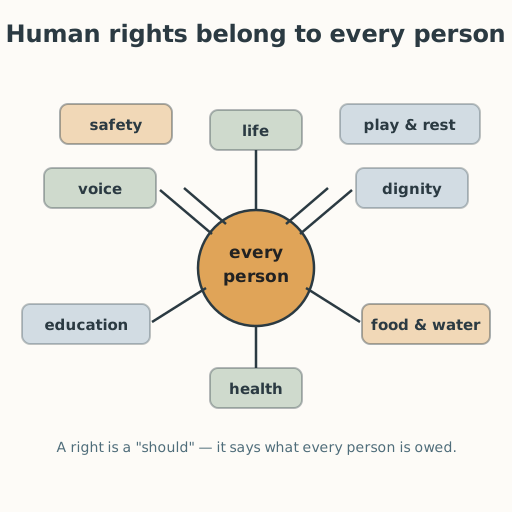
- Human-rights wheel · 1 per learner A circle with "every person" at the center and rights around it — life, dignity, food, water, health, education, voice, safety, play and rest
- UDHR excerpt cards · 1 set per group Short, plain-language excerpts from the Universal Declaration of Human Rights
Low-tech / no-cost
- Voice and a shared board Build the wheel aloud and read the excerpts together; no cards needed
- Chalk or a stick in the ground Draw the wheel outdoors and name the rights together
Enriched / lab & device
- A child-friendly UDHR summary · 1 A printed or projected plain-language version of the Declaration
- A short video on the UDHR · 1 An age-appropriate clip explaining what human rights are and where they came from
Works in different contexts
- large-group Read the excerpts round-robin and build one big wheel on the board, then pairs discuss one right each
- multi-age Younger learners match a right to a picture of a need; older learners explain why rights are universal and what "dignity" means
- self-directed A learner reads the excerpts, completes the wheel, and writes what makes a right a *right* (not just a nice thing to have)
- level-grouped Learners ready to extend compare a human right with a law or a courtesy, and explain the difference
- outdoor-only Build the wheel with stones or drawn chalk, placing a need (water, rest, play) at each spoke
Lesson 5 — What Are Human Rights?
Summary
Learners learn what human rights are — claims every person has simply by being human, grounded in equal dignity — through the Universal Declaration of Human Rights (1948) and the Convention on the Rights of the Child. They practice distinguishing a right (what should be) from a fact (whether it is honored).
Objectives
- Explain what human rights are and analyze a case where they were honored or violated. (D09.S2.07.02)
Connection
Some things are not privileges you earn or gifts you are given — they are claims that belong to you simply because you are human: enough food, clean water, safety, a chance to learn, a voice that is heard. When you are too hot, tired, or hungry, you can feel that these are not extras but needs. Human rights are the world’s agreed way of saying: these needs are not favors; every person is owed them. Today you learn what that means and where the idea comes from.
Materials
- Human-rights wheel
- UDHR excerpt cards
Preparation
- Copy the wheel and excerpt cards.
- Retrieval: recall the three columns from Lesson 4 (affected, benefiting, more just). Human rights are one answer to “what would be more just” — a shared standard for everyone.
Facilitator note
This lesson is written to the learner (“you”). The ideas to land: (1) a human right is a claim that belongs to every person simply because they are human — it does not have to be earned and cannot be taken away in principle; (2) rights rest on equal dignity: every person is born with worth; (3) the Universal Declaration of Human Rights was adopted by the United Nations in 1948 after a devastating war, as a shared promise to the world; (4) a right is a “should” — saying everyone has a right is not the same as saying everyone already enjoys it. Distinguish “should” (value/aspiration) from “is” (fact) explicitly and repeatedly — this is the unit’s evidence-vs-values spine. The ethics lens: rights are a moral standard we hold ourselves and others to. The egalitarian lens: rights are universal — they do not depend on wealth, birthplace, or power. The global lens: the UDHR was written by people from many countries (and has been translated into hundreds of languages), and it is one shared agreement among many traditions, not the invention of one region. The critical-thinking lens: the Declaration is a document humans wrote — question it, but also know what it says. Cite the UDHR (S-149) and the Convention on the Rights of the Child (S-060). Do not quiz learners on memorizing article numbers; the goal is the concept of universality and dignity.
Procedure
- Recall (5 min). From Lesson 4: what did “what would make it more just” mean? Today we meet a shared, worldwide standard for that question.
- Meet a right (10 min). A human right is a claim that belongs to every person simply because they are human. It rests on dignity — the worth every person is born with. A right is a “should”: it says what every person is owed, whether or not it is honored everywhere yet.
- Meet the documents (10 min). In 1948, after a terrible war, countries came together under the United Nations and wrote the Universal Declaration of Human Rights — a shared promise that every person has rights like life, dignity, food, water, health, education, a voice, and safety. For children there is also the Convention on the Rights of the Child, which adds rights to play, rest, and be heard.
- Read the excerpts (15 min). With a group, read the UDHR excerpt cards. For each, answer: what need does this right protect? Is it a “should” (a claim about what is owed) or an “is” (a fact about what already happens everywhere)? Notice the difference.
- Close (10 min). Add one right you care about to the wheel, in your own words. Rights are promises the world has made — and promises must still be kept.
Differentiation
- Support: Match each right to a picture of a need (water, a book, a bed, a speaking voice) before reading the words.
- Extension: Explain in writing the difference between a right, a law, and a courtesy, with one example of each.
Assessment
- Formative (observation): Can the learner define a human right (a claim every person has by being human) and separate a right (should) from a fact (is)?
- Portfolio artifact: The completed human-rights wheel, kept in the portfolio.
Home connection
Ask at home: “If you could make one promise that every person on Earth is owed, what would it be?” Compare it with the rights on the wheel.
Resources
- Universal Declaration of Human Rights, United Nations (adopted 1948; Article 1 affirms that all human beings are born free and equal in dignity and rights): https://www.un.org/en/about-us/universal-declaration-of-human-rights (S-149).
- UN Convention on the Rights of the Child, UNICEF child-friendly summary (rights to learn, play, be safe, rest, and be heard — Arts. 12, 19, 28, 31): https://www.unicef.org/child-rights-convention (S-060).