Lesson 06 — A Human-Rights Case: Honored and Violated
Learners analyze the right to vote as a human-rights case: where it was violated for most people through most of history, where and when it was honored, and what made the difference. They see that a right can be honored in one place and still denied in another, and produce the unit's human-rights case study as a portfolio artifact.
Objectives
Objectives
- D09.S2.07.02 Explain what human rights are and analyze a case where they were honored or violated.
Essential question
How do I analyze a case where a human right was honored in one place and violated in another?
Key vocabulary
Materials
Standard materials
- Case study sheet · 1 per learner A one-page case on the right to vote, with an analyzer — the right, where it was violated, where it was honored, and what made the difference
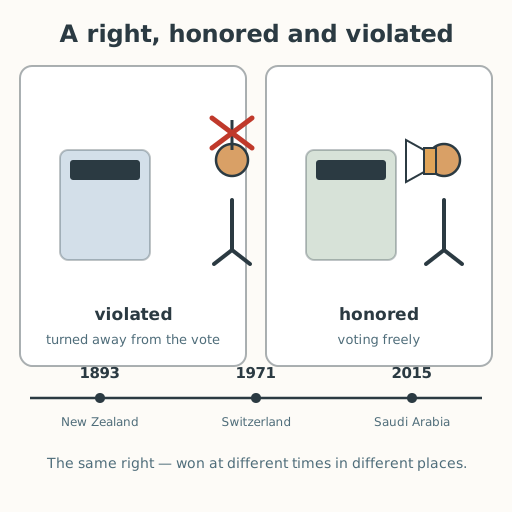
- Timeline strip · 1 per group Key dates for women's voting rights in different countries (New Zealand 1893, Switzerland 1971, Saudi Arabia 2015, and others)
Low-tech / no-cost
- Voice and a shared board Tell the case aloud and build the analyzer and timeline together on any surface
- A local story of a right won Invite learners to recall (or hear) a story of a right gained in their own community or country
Enriched / lab & device
- A short film or map · 1 An age-appropriate clip or animated map showing when different countries extended the vote, handled with care
- A plain-language article · 1 A short, learner-friendly text on the history of women's suffrage in one country
Works in different contexts
- large-group Build the analyzer on the board as a class, then groups take one country's date and discuss what it shows
- multi-age Younger learners place the dates on a timeline; older learners explain what made the difference between violation and honor
- self-directed A learner completes the analyzer in writing and checks that they named the right, a violation, and an honoring
- level-grouped Learners ready to extend compare the right to vote with another right (education, safety) and note where each is still uneven
- outdoor-only Lay the timeline out on the ground with stones as markers, one stone per date, and walk it together
Lesson 6 — A Human-Rights Case: Honored and Violated
Summary
Learners analyze the right to vote as a human-rights case: where it was violated for most people through most of history, where and when it was honored, and what made the difference. They see that the same right can be honored in one place and still denied in another, and produce the unit’s human-rights case study.
Objectives
- Explain what human rights are and analyze a case where they were honored or violated. (D09.S2.07.02)
Connection
A right can exist on paper and still be denied in life. For most of history, most adults — women everywhere, and many men without property — could not vote, even where “the people” were said to rule. The right to vote was won country by country, at very different times: New Zealand led in 1893, Switzerland followed only in 1971, and in Saudi Arabia women first voted in 2015. The same right, honored in one place and one time, violated in another. Today you analyze how that looks up close.
Materials
- Case study sheet
- Timeline strip
Preparation
- Copy the case study sheet and timeline strip.
- Retrieval: recall from Lesson 5 what a human right is (a claim every person has by being human) and the difference between a right (should) and a fact (is). Today we watch one right move from “should” toward “is” — unevenly.
Facilitator note
This lesson is written to the learner (“you”). The ideas to land: (1) the right to vote is a human right — the Universal Declaration of Human Rights (Article 21) says everyone has the right to take part in their country’s government, directly or through freely chosen representatives, with equal voting; (2) for most of history this right was violated for most people — women were excluded nearly everywhere, and many men too; (3) the right was honored at different times in different places — New Zealand 1893 (the first self-governing country to grant women the national vote), Switzerland 1971, Saudi Arabia 2015 — so “honored” and “violated” can coexist in the world at the same moment; (4) analyzing the case means naming the right, the violation, the honoring, and what made the difference (movements, changing ideas, and law). Cite the UDHR (S-149) for the right itself; the historical dates are documented in Encyclopaedia Britannica (“woman suffrage”) and are stated with a “for example” hedge. The ethics lens: exclusion from voting is a moral wrong because it treats some people as less than full members of the community. The egalitarian lens: this is a story about who was counted as “the people” and who was left out — the heart of egalitarianism. The global lens: the case spans many world regions and shows no single country as the default or the hero; the vote arrived at different times everywhere. The critical-thinking lens: the right being honored in law does not by itself mean every person can exercise it freely — ask what still stands in the way. Handle with care and end on agency: these rights were won by ordinary people organizing.
Procedure
- Recall (5 min). What is a human right? What is the difference between a right and a fact? Say both to a partner.
- Meet the right (5 min). The right to vote is a human right: every person should be able to take part in deciding who governs them. Its being declared a right is not the same as its being enjoyed.
- Analyze the case (15 min). On the case sheet, name: the right (to vote, and to take part in government); where it was violated (for most of history, women were excluded nearly everywhere, and many men without property too); where it was honored (New Zealand, 1893 — the first self-governing country to give women the national vote; then others, slowly: Switzerland in 1971, Saudi Arabia in 2015); and what made the difference (people organized, argued, and protested; ideas changed; and finally law changed).
- Read the timeline (10 min). With a group, place the dates on the timeline strip. Notice: the same right arrived decades apart in different places — honored here, still violated there, at the very same moment.
- Close (10 min). Answer in writing: what does this case show about human rights? One honest answer: rights are won, not automatic, and the winning is uneven — which is why people keep working for them.
Differentiation
- Support: Provide the right, the violation, and the honoring pre-stated; learners match them to the analyzer and add one “what made the difference.”
- Extension: Compare the right to vote with another right (education or safety), naming one place or time each was honored and one where it is still denied.
Assessment
- Formative (portfolio): Does the case study name the right, a violation, an honoring, and at least one thing that made the difference?
- Portfolio artifact: The completed human-rights case study, kept in the portfolio.
- Self-assessment: Learners check against the question “Can I explain what a human right is and use a case to show it honored and violated?”
Home connection
Ask someone at home when people in your country or community first got the right to vote — and whether everyone actually could. Compare with the timeline you studied.
Resources
- Universal Declaration of Human Rights, Article 21 (the right to take part in government and to equal voting), United Nations: https://www.un.org/en/about-us/universal-declaration-of-human-rights (S-149).
- The dates of women’s suffrage (New Zealand 1893, Switzerland 1971, Saudi Arabia 2015) are documented in Encyclopaedia Britannica, “woman suffrage” (S-327); they are offered as examples of a right honored at different times, not as a complete list.