Lesson 07 — Influencing Decisions: Voting, Protest, Petitions, Organizing
Learners analyze four ways people influence decisions — voting, protest, petitions, and organizing — and the limits of each. They see that no single method is complete, and that people often combine them. They produce the unit's people-influence-decisions analysis as a portfolio artifact.
Objectives
Objectives
- D09.S3.07.01 Analyze how people influence decisions in their society, such as voting, protest, petitions, or organizing, and the limits of each.
Essential question
How do people influence decisions in their society — voting, protest, petitions, organizing — and what are the limits of each?
Key vocabulary
Materials
Standard materials
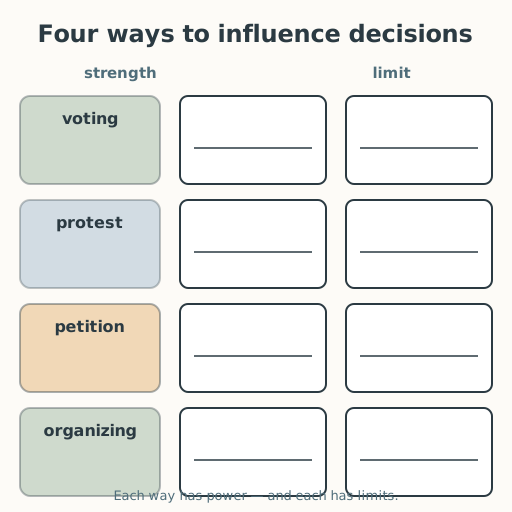
- Methods-and-limits chart · 1 per learner A four-row chart — voting, protest, petition, organizing — with a "strength" and a "limit" column for each
- Example cards · 1 set per group Short, real examples of each method from different world regions
Low-tech / no-cost
- Voice and a shared board Build the chart aloud and discuss the examples together; no cards needed
- A local decision Use a decision your community is actually facing (a road, a rule, a resource) and imagine each method
Enriched / lab & device
- A short news item · 1 One current example of people influencing a decision, to analyze as a class
- A sample petition or campaign page · 1 A real petition or campaign to read for its method and its limits
Works in different contexts
- large-group Fill the chart as a class, then groups each analyze one method's example and report a strength and a limit
- multi-age Younger learners match each example to its method; older learners explain the limit of that method in that case
- self-directed A learner completes the chart for all four methods and writes one sentence each on when a method works and when it does not
- level-grouped Learners ready to extend analyze how two methods combine (protest + organizing, petition + voting) and what each adds
- outdoor-only Act out each method in a circle and discuss, for each, what it can and cannot do
Materials
Lesson 7 — Influencing Decisions: Voting, Protest, Petitions, Organizing
Summary
Learners analyze four ways people influence decisions — voting, protest, petitions, and organizing — and the limits of each. They see that no single method is complete and that people often combine them, and they produce the unit’s people-influence-decisions analysis.
Objectives
- Analyze how people influence decisions in their society — voting, protest, petitions, organizing — and the limits of each. (D09.S3.07.01)
Connection
You influence decisions every day — which game the group plays, how a chore is divided — but whole societies make decisions too, and ordinary people have ways to shape them. Each way has real power, and each has limits. A vote gives many people a say, but it happens only now and then and can leave a minority out. A protest is loud and visible, but it can be ignored or met with force. A petition is easy to join, but easy to ignore. Organizing — building a group that works together over time — is strong but slow. Knowing both the power and the limit of each is how you choose well.
Materials
- Methods-and-limits chart
- Example cards
Preparation
- Copy the chart and example cards.
- Retrieval: recall the difference between “who benefits” and “who is affected” from Lesson 4. Today: how people try to change who benefits.
Facilitator note
This lesson is written to the learner (“you”). The ideas to land: (1) four common ways people influence decisions are voting, protest, petitions, and organizing; (2) each has real power and real limits; (3) limits are not reasons to give up — they are reasons to combine methods and to think clearly. Model one method’s strength-and-limit on the board (worked example, S-011), then let groups work the rest. The ethics lens: influencing decisions is itself a moral act — how we influence matters as much as what we want. The egalitarian lens: notice who can vote, who can safely protest, whose petition gets read — power shapes access to every method. The global lens: these methods exist in many forms across many countries, and no one country is the model; keep examples region-varied (a ballot in one country, a protest in another, a petition in a third, a union or neighborhood group in a fourth). The technology lens: these methods now also travel through digital tools — online petitions, messaging that gathers a crowd, organizing across distance — which can widen who gets heard and also let loud or false voices drown out the quiet; technology changes a method’s reach, not its rightness. The critical-thinking lens: for every method, ask who is left out and what it cannot do — that is the discipline of the “limits” column. Present these as descriptions of how influence works, not as a ranking of political systems; do not teach any one method as always right or always enough.
Procedure
- Recall (5 min). From Lesson 4: who was affected and who benefited in the water case? Today: how people try to change such situations.
- Meet four methods (10 min). Voting — choosing a representative or a decision by casting a vote. Protest — gathering and speaking out publicly. Petition — many people signing their names to demand something. Organizing — building a lasting group that works together over time.
- Model one (5 min). Take voting: its strength is that many people at once get a say, and it can change who governs. Its limit is that it happens only sometimes, and a majority can leave a minority out; and not everyone is allowed to vote everywhere.
- Fill the chart (20 min). With a group, complete the strength and the limit for each of the other three methods, using the example cards. For each, ask: who is included, and who is left out?
- Close (10 min). Share one method and its limit. Notice that people rarely use just one — a movement may protest and petition and organize. The limits are not failures; they are the reason for combining.
Differentiation
- Support: Provide the strengths and limits mixed up and have learners sort them into the right method’s row.
- Extension: Explain how two methods combined (for example, protest + organizing) cover each other’s limits, with one example.
Assessment
- Formative (observation): Can the learner name the four methods and give one strength and one limit for each?
- Portfolio artifact: The completed methods-and-limits chart, kept as the unit’s people-influence-decisions analysis.
Home connection
Ask someone at home about a time they tried to change a decision (at work, in a building, in a community) — what method did they use, and what was its limit?
Resources
- The four methods and their limits are a standard analytical framing in civic education, not a single factual finding; the “limits” column is a thinking tool, and the examples are illustrative. Specific historical cases of protest and organizing appear across the curriculum (e.g., the Salt March, the Green Belt Movement — see S-059) and are treated as documented facts where named.
- On explicit instruction and worked examples: Kirschner, Sweller & Clark (2006), https://doi.org/10.1207/s15326985ep4102_1 (S-011).