Lesson 08 — Civil Society: Acting for the Common Good
Learners learn what civil society is — the space of voluntary groups between people and government — and how groups and movements act for the common good when government does not. They study real movements from several world regions, including the Green Belt Movement in Kenya and the Chipko movement in India.
Objectives
Objectives
- D09.S3.07.02 Explain what civil society is and how groups and movements act for the common good when government does not.
Essential question
What is civil society, and how do groups and movements act for the common good when government does not?
Key vocabulary
Materials
Standard materials
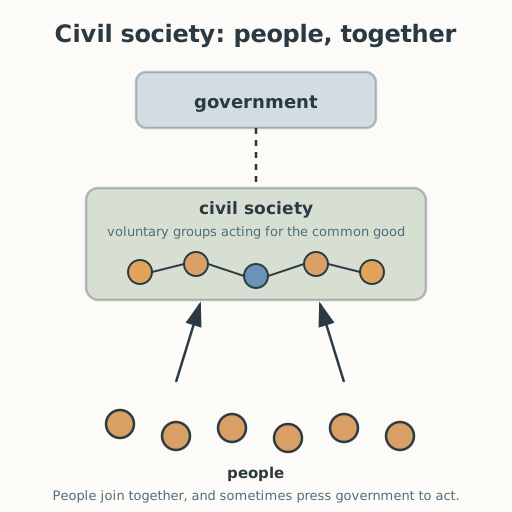
- Civil-society diagram · 1 per learner A three-layer diagram — people, civil-society groups, government — with arrows for how groups act when government does not
- Movement cards · 1 set per group Short profiles of civil-society groups and movements from several world regions
Low-tech / no-cost
- Voice and a shared board Build the diagram aloud and discuss the movements together; no cards needed
- A local group Invite learners to name a voluntary group in their own community and what common good it serves
Enriched / lab & device
- A short film · 1 An age-appropriate clip about a community group or movement acting for the common good
- A visit or guest · 1 A member of a local civil-society group (a water committee, a women's group, a cooperative) to talk with, in person or by call
Works in different contexts
- large-group Read the movement profiles round-robin, then groups each present one movement's goal and method
- multi-age Younger learners say what common good each group serves; older learners explain how the group acted when government did not
- self-directed A learner reads two movement profiles and writes, for each, its goal, its method, and the common good it served
- level-grouped Learners ready to extend compare two movements' methods and say what made each suited to its situation
- outdoor-only Use a local shared resource as the "common good" and plan how a voluntary group might protect or share it
Lesson 8 — Civil Society: Acting for the Common Good
Summary
Learners learn what civil society is — the space of voluntary groups between individual people and government — and how groups and movements act for the common good when government does not. They study real movements from several world regions, including the Green Belt Movement in Kenya and the Chipko movement in India.
Objectives
- Explain what civil society is and how groups and movements act for the common good when government does not. (D09.S3.07.02)
Connection
Between you alone and the government, there is a whole world of people acting together: a neighborhood that clears a shared path, a women’s group that runs a savings circle, a cooperative of farmers, a movement that plants trees. None of these is the government, and none is a single person acting alone — they are civil society. Often they do what government is slow, unwilling, or unable to do, and sometimes their work pushes government to act. Today you meet this middle layer of shared life.
Materials
- Civil-society diagram
- Movement cards
Preparation
- Copy the diagram and movement cards.
- Retrieval: recall the four methods of influence from Lesson 7. Civil society is one of the deepest forms of organizing — people acting together, over time, without waiting for government.
Facilitator note
This lesson is written to the learner (“you”). The ideas to land: (1) civil society is the space of voluntary groups between the individual and government — community groups, cooperatives, faith communities, unions, and social movements; (2) groups act for the common good when government does not — they fill gaps, meet needs, and often press government to act; (3) examples: the Green Belt Movement, founded in Kenya in 1977 by Wangari Maathai, organized people to plant trees, and grew to plant over thirty million trees — work for which Maathai received the Nobel Peace Prize in 2004 (S-059); the Chipko movement in India, beginning in the 1970s, saw villagers — especially women — embrace trees to stop them being cut, protecting forests their communities depended on; and the Red Cross/Red Crescent movement, which gives neutral humanitarian aid in crises. Cite Maathai/Green Belt Movement to S-059; Chipko and the Red Cross/Red Crescent are documented historical facts (Chipko is well documented — S-328; the Red Cross/Red Crescent — S-329 — both stated with a “for example” hedge). The ethics lens: the common good is the good we share — clean air, water, safety, belonging — and acting for it is an ethical act. The egalitarian lens: civil society is often how people with less power get a voice — it is the “voice of the many,” not a favor from above. The environment lens: both movements named are environmental — caring for land and forests is a form of caring for people. The community lens: civil society is the curriculum’s own vision of cooperation over competition, made real in the world. Do not romanticize — civil society can also be imperfect — but hold the examples with dignity and hope.
Procedure
- Recall (5 min). What were the four methods of influence? Which one is “building a lasting group”? Today we go deep into that one.
- Meet civil society (10 min). Look at the diagram: at the bottom are people; at the top is government; in the middle is civil society — the voluntary groups people form for a shared purpose. They act for the common good: the good we all share, like clean air, water, safety, and belonging.
- Meet two movements (15 min). Read the movement cards. The Green Belt Movement (Kenya, founded 1977 by Wangari Maathai) organized people to plant trees — over thirty million of them — repairing land and livelihoods; Maathai won the Nobel Peace Prize in 2004. The Chipko movement (India, 1970s) saw villagers embrace trees to stop them being cut, protecting the forests their communities depended on. In both, ordinary people acted together when government did not.
- Analyze (10 min). With a group, answer for one movement: what was its goal? What common good did it serve? How did it act without waiting for government?
- Close (10 min). Name one voluntary group you know of or can imagine, and the common good it serves. Civil society is not a distant idea — it is people, together.
Differentiation
- Support: Match each movement to a single phrase (trees/forests, planting/embracing) before writing about it.
- Extension: Compare the two movements’ methods and write why each method fit its situation (planting trees vs. physically protecting trees).
Assessment
- Formative (observation): Can the learner define civil society and explain how one movement acted for the common good without government?
- Portfolio artifact: The completed civil-society diagram and one movement analysis, kept in the portfolio.
Home connection
Ask at home: “What group in our community helps everyone, without being the government?” Find out what common good it serves and how people join it.
Resources
- The Green Belt Movement (founded 1977 by Wangari Maathai; over thirty million trees; Nobel Peace Prize 2004): Nobel Prize facts page, https://www.nobelprize.org/prizes/peace/2004/maathai/facts/ (S-059).
- The Chipko movement (India, 1970s) is a documented historical movement (S-328); it is offered as one example of civil society acting to protect a shared environment. The Red Cross/Red Crescent is likewise a documented example of voluntary humanitarian action (S-329).