Lesson 04 — Can I Trust This Source?
Learners learn five questions that make a source trustworthy — who made it, why, what evidence, when, and whether another source agrees — and use them to compare two sources on the same topic for reliability.
Objectives
Objectives
- D10.S2.07.01 Explain what makes a source trustworthy, and compare two sources on the same topic for reliability.
Essential question
What makes a source trustworthy, and how do I compare two sources on the same topic for reliability?
Key vocabulary
Materials
Standard materials
- Five-questions checklist · 1 per learner A five-row card — who made it, why, what evidence, when, does another source agree
- Source pairs · 1 set per pair Two short sources on the same topic (a signed science explainer vs. an anonymous post) for comparison
Low-tech / no-cost
- Voice and a shared board Read the two sources aloud and build the five-question comparison together on any surface
- A claim from daily life Use a claim learners have actually heard (an ad, a rumor, a label) instead of printed sources
Enriched / lab & device
- A live web page · 1 Open two real pages on one topic and run the five questions on each, projected for the group
- A fact-checking walkthrough · 1 Watch or follow a short fact-check demonstration (e.g., a reverse-image search) as a class
Works in different contexts
- large-group Compare the two sources as a class on the board, then pairs compare a second pair and report one difference
- multi-age Younger learners name who made it and whether a second source agrees; older learners add purpose and evidence
- self-directed A learner reads both sources, completes the five questions in writing, and checks that each answer points to real details
- level-grouped Learners ready to extend compare three sources and rank them for reliability with reasons
- outdoor-only Use a spoken claim (a weather rumor, a "this plant is safe" claim) and ask the five questions aloud, finding a second voice to check
Lesson 4 — Can I Trust This Source?
Summary
Learners learn five questions that make a source trustworthy and use them to compare two sources on the same topic for reliability. They work one pair of sources as a modeled example, then compare a second pair with a partner.
Objectives
- Explain what makes a source trustworthy, and compare two sources on the same topic for reliability. (D10.S2.07.01)
Connection
Every day you meet claims — a headline, a post, a label, a friend’s message. Some of them are solid; some are not. The difference is not how loudly a claim is repeated or how confident it sounds, but where it comes from. A trustworthy source has a name behind it, a reason for existing you can see, and evidence you can check. Today you learn five questions that separate a source you can lean on from one you should hold lightly.
Materials
- Five-questions checklist
- Source pairs
Preparation
- Copy the five-questions checklist and source pairs.
- Retrieval: from Grade 6, recall what a persuasive technique is (D10.S2.06.02). Today we move from “what is this trying to do to me?” to “can I trust what it says?”
Facilitator note
This lesson is written to the learner (“you”). The ideas to land: (1) trustworthiness is checked, not felt — five questions do the checking: who made it, why, what evidence, when, and whether a second source agrees; (2) comparing two sources means asking all five questions of each and then placing them side by side; (3) reliability is about the source, not whether we like its answer. Model the first pair once (worked example, S-011). The critical-thinking lens: this is the unit’s core “question the answer” habit, made into a checklist. The egalitarian lens: the ability to check a source is power — people who are lied to cannot act fairly; teaching everyone to check is a leveling act. The global lens: the five questions work on any source in any language and any place. The technology lens: digital tools make it easier than ever to publish — which makes checking more necessary, not less. Use a low-stakes, non-scary example pair (e.g., a claim about whether a plant is safe, or whether recycling works) so the skill is practiced without fear. The checklist is an age-appropriate version of source analysis (S-217; S-063).
Procedure
- Recall (5 min). What is a persuasive technique? Today we ask a harder question: is this source telling me something I can trust?
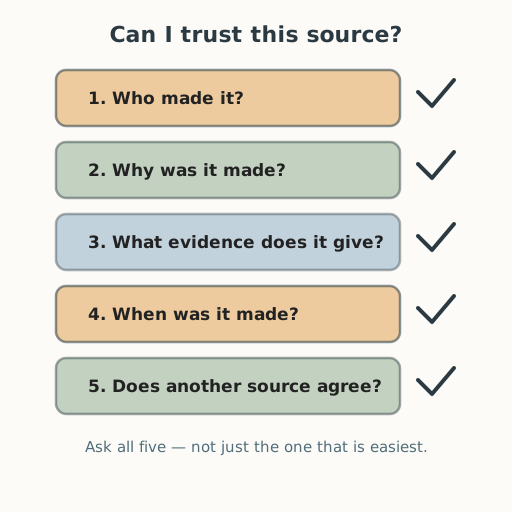
- Meet the five questions (8 min). To check a source, ask: Who made it? Why was it made? What evidence does it give? When was it made? Does another source agree? Look at your checklist — you ask all five, not one.
- Watch it modeled (15 min). Here is a claim: “Drinking water with a little salt cures all illness.” Source A is a signed page from a health organization, with the author named, the purpose (to inform) stated, evidence cited, a recent date, and agreement from other health bodies. Source B is an anonymous post with no author, no evidence, no date, and the clear purpose of selling a salt product. Run all five questions on both. Source A is far more reliable — not because it is polite, but because it survives the questions.
- Compare a second pair (15 min). With a partner, take a source pair on one topic. Run the five questions on each, then say which is more reliable and why.
- Close (7 min). Share one difference you found. Remember: trust is earned by evidence, not by confidence.
Differentiation
- Support: Provide the five questions with two possible answers each (“author named / no author named”) and ask learners to circle the more reliable one.
- Extension: Find a third source on the same topic and rank all three for reliability, with reasons.
Assessment
- Formative (observation): Can the learner name the five questions and apply them to two sources to say which is more reliable, with a reason?
- Portfolio artifact: The completed comparison of one source pair, kept in the portfolio.
Home connection
Pick one claim you see this week — on a screen, a package, or a sign — and ask the five questions about where it came from. Tell someone what you found.
Resources
- UNESCO — Media and Information Literacy: https://www.unesco.org/en/media-information-literacy (S-217).
- Common Sense Education — News & Media Literacy: https://www.commonsense.org/education/digital-citizenship/topic/news-and-media-literacy (S-063).
- On explicit instruction and worked examples: Kirschner, Sweller & Clark (2006), https://doi.org/10.1207/s15326985ep4102_1 (S-011).