Lesson 05 — False by Mistake, False on Purpose
Learners learn the difference between **misinformation** (false by mistake) and **disinformation** (false on purpose). They sort examples by the *intent* behind the falsehood — a person who believes a false thing versus a person who knows and spreads it to trick.
Objectives
Objectives
- D10.S2.07.02 Explain the difference between misinformation (false by mistake) and disinformation (false on purpose), with an example of each.
Essential question
What is the difference between misinformation and disinformation, and how do I tell them apart?
Key vocabulary
Materials
Standard materials
- Mistake-or-purpose sheet · 1 per learner A two-column organizer — "misinformation (false by mistake)" and "disinformation (false on purpose)" — with example strips
- Example strips · 1 set per pair Short cases — a shared old date, a made-up cure, an edited photo — to sort by intent
Low-tech / no-cost
- Voice and a shared board Tell the examples aloud and sort them into the two columns together on any surface
- A familiar mix-up Use a rumor or mix-up learners have actually seen (an old notice, a misheard rule) instead of printed strips
Enriched / lab & device
- A projected sort board · 1 Display the two columns large and drag example strips into them as a class
- A short video case · 1 One age-appropriate example of a false claim spreading, discussed with care
Works in different contexts
- large-group Sort the first three examples as a class, then pairs sort a fresh set and justify one placement
- multi-age Younger learners sort clear examples; older learners also explain how the *intent* changes what we should do about it
- self-directed A learner reads the worked example, sorts the strips in writing, and checks each placement against the intent
- level-grouped Learners ready to extend write one "what should we do differently" for a misinformation case and one for a disinformation case
- outdoor-only Use a spoken rumor that could spread through a village or a market and decide by intent whether it is misinformation or disinformation
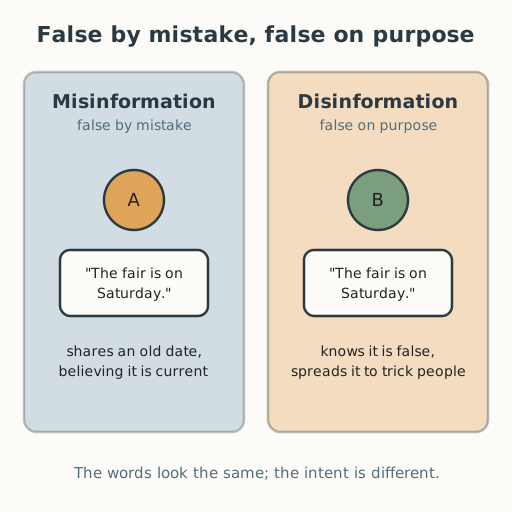
Lesson 5 — False by Mistake, False on Purpose
Summary
Learners learn the difference between misinformation (false by mistake) and disinformation (false on purpose). The dividing line is intent — did the person believe the false thing, or know it was false and spread it anyway? They sort examples by intent.
Objectives
- Explain the difference between misinformation (false by mistake) and disinformation (false on purpose), with an example of each. (D10.S2.07.02)
Connection
Imagine two people share the same wrong notice: “The fair is on Saturday.” The first person read an old poster from last year and truly believed it. The second person knows the fair was moved, but spreads the Saturday notice to make people show up at the wrong time. Both shared something false — but one did it by mistake and the other on purpose. That difference matters, because what we do about a mistake is not the same as what we do about a trick.
Materials
- Mistake-or-purpose sheet
- Example strips
Preparation
- Copy the mistake-or-purpose sheet and example strips.
- Retrieval: from Lesson 4, recall the five questions for checking a source. Today we add one more layer — not just is it false? but was the falsehood meant?
Facilitator note
This lesson is written to the learner (“you”). The ideas to land: (1) misinformation is false information shared by mistake — the sharer believes it; disinformation is false information spread on purpose — the spreader knows it is false and means to deceive; (2) the difference is intent, which we often must infer from context rather than read off the message; (3) our response should match the intent — correct a mistake kindly, resist and expose a trick. Model the first example once (worked example, S-011). The critical-thinking lens: this is the unit’s “hold claims open” habit applied to falsehood itself. The ethics lens: spreading a known falsehood to deceive is a wrong against other people’s ability to choose — but an honest mistake deserves correction, not blame. The egalitarian lens: disinformation often targets people with less access to good sources; teaching everyone to see intent protects the most exposed. The technology lens: digital sharing makes both kinds travel farther and faster, so the habit of asking “mistake or purpose?” is now a basic life skill. Frame the two terms accurately and consistently (S-217; S-063) and keep examples low-stakes and non-frightening.
Procedure
- Recall (5 min). What were the five questions for checking a source? Today we sort false things by one key question: was the falsehood meant?
- Meet the two words (8 min). Misinformation is false information shared by mistake — the sharer believes it. Disinformation is false information spread on purpose — the spreader knows it is false and means to trick. The difference is intent.
- Watch it modeled (12 min). Two people post the same false claim: “The well water here is poisoned.” Person A heard it from a neighbor and, worried, repeats it to warn others — believing it true. Person B knows the water is safe but spreads the claim to scare people away from the market. Both are false. A’s is misinformation (mistake); B’s is disinformation (purpose). Sort them.
- Sort the examples (15 min). With a partner, take the example strips. For each, ask: did the person believe it, or know it was false? Sort into the two columns and say why.
- Close (10 min). Share one placement and your reasoning. Remember: the same false words can be a mistake or a trick — intent is the difference.
Differentiation
- Support: Provide each strip with a one-line hint (“this person believed it / this person knew it was false”) and ask learners to match.
- Extension: For one misinformation and one disinformation case, write what you would do differently in response to each.
Assessment
- Formative (observation): Can the learner give one example of each kind and explain the intent behind each?
- Portfolio artifact: The completed sort sheet, kept in the portfolio.
Home connection
Talk with someone at home about a time a false thing spread — was it a mistake or a trick? How did people find out, and what did they do?
Resources
- UNESCO — Media and Information Literacy: https://www.unesco.org/en/media-information-literacy (S-217).
- Common Sense Education — News & Media Literacy: https://www.commonsense.org/education/digital-citizenship/topic/news-and-media-literacy (S-063).
- On explicit instruction and worked examples: Kirschner, Sweller & Clark (2006), https://doi.org/10.1207/s15326985ep4102_1 (S-011).