Lesson 06 — The Carbon Cycle: Matter That Never Leaves
Learners trace how matter and energy move through a forest ecosystem and are **reused, not created new**. They follow carbon through four steps — photosynthesis, eating, respiration, and decomposition — and see the loop close.
Objectives
Objectives
- D10.S3.07.01 Explain how matter and energy move through an ecosystem, such as the carbon in a forest, and are reused rather than created new.
Essential question
How do matter and energy move through an ecosystem and get reused rather than created new?
Key vocabulary
Materials
Standard materials
- Carbon-cycle sheet · 1 per learner A forest diagram with four labeled steps — photosynthesis, eating, respiration, decomposition — to trace the carbon
- Step cards · 1 set per group Cards for the four steps, to arrange into a loop in the correct order
Low-tech / no-cost
- Voice and a shared board Draw the loop together and act out the four steps with bodies (a tree, an animal, the soil); no cards needed
- A real plant and soil Look at a real leaf and soil, and talk through where the carbon in each is going
Enriched / lab & device
- A live plant in a jar (or terrarium) · 1 A sealed jar with a small plant to see matter staying inside a closed loop over time
- A short animation · 1 An age-appropriate animation of the carbon cycle to watch and then retell
Works in different contexts
- large-group Arrange the loop as a class, then groups each trace one step's input and output and report
- multi-age Younger learners trace one step; older learners connect the steps into the full loop and explain why matter is reused
- self-directed A learner arranges the step cards into a loop, writes the input and output of each step, and checks the loop closes
- level-grouped Learners ready to extend trace the same carbon atom through all four steps and say what it becomes at each one
- outdoor-only In a real green space, point to a tree, an animal or insect, and dead leaves, and trace the carbon moving among them
Lesson 6 — The Carbon Cycle: Matter That Never Leaves
Summary
Learners trace how matter and energy move through an ecosystem — the carbon in a forest — and are reused rather than created new. They follow a single thread of carbon through four steps: photosynthesis, eating, respiration, and decomposition, and see that the loop closes.
Objectives
- Explain how matter and energy move through an ecosystem, such as the carbon in a forest, and are reused rather than created new. (D10.S3.07.01)
Connection
Take a breath in, then out. The carbon you just breathed out was not made fresh inside you — it came from food you ate, which came from plants, which pulled that very carbon out of the air. The same atoms have been going round and round through air, plants, animals, and soil for as long as life has existed. Earth is a closed loop: matter is reused, never created new. Today you trace one loop through a forest.
Materials
- Carbon-cycle sheet
- Step cards
Preparation
- Copy the carbon-cycle sheet and step cards.
- Retrieval: from Grade 6, recall what a food chain is (D10.S3.06.01 — predator and prey, and energy passing from plants up). Today we add the missing piece: the same matter returns.
Facilitator note
This lesson is written to the learner (“you”). The ideas to land: (1) matter (like carbon) cycles — it is reused again and again, never created new; energy flows in and is released as heat, but the atoms themselves go round; (2) four steps carry carbon in a forest — photosynthesis (plants take CO₂ from the air), eating (animals take in plant matter), respiration (living things release CO₂ back), and decomposition (dead matter returns carbon to the soil and air); (3) the loop closes — that is why the amount of carbon on Earth stays the same while it moves around. Model the loop once (worked example, S-011). The environment lens: this is the ground truth of “our Earth home” — nothing is truly thrown away. The global lens: the cycle is the same everywhere, though the living things differ by place — and many peoples have long observed and honored this recycling of matter through their own knowledge traditions, held side by side with the science here (philosophy §11). The technology lens: human activity (burning buried carbon as fuel) pushes extra carbon into the air faster than the loop removes it — a preview of Lesson 8. The critical-thinking lens: “reused, not created new” is a checkable scientific fact, not a guess (S-253). Keep the claim precise: Earth is effectively a closed system for carbon, so its total carbon is nearly constant (S-253); energy, by contrast, flows through and is not recycled.
Procedure
- Recall (5 min). From Grade 6: what is a food chain, and which way does energy move? Today we see that matter returns.
- Meet the loop (8 min). Matter in an ecosystem moves in a cycle — it is reused, not made new. Energy flows in from the Sun and leaves as heat; the atoms themselves stay and go round.
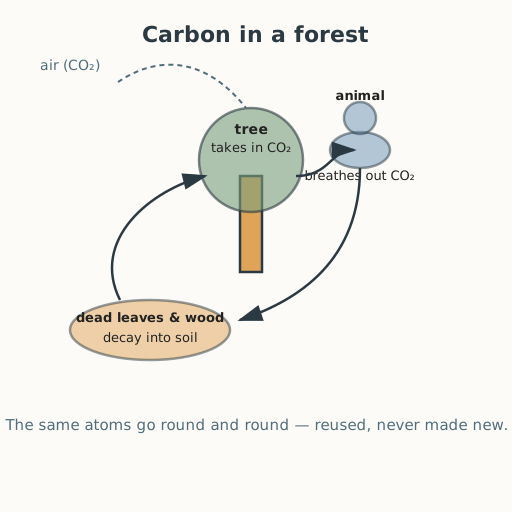
- Watch it modeled — carbon in a forest (15 min). Trace one carbon atom: (1) Photosynthesis — a tree pulls carbon dioxide (CO₂) from the air to build its leaves and wood. (2) Eating — a deer eats the leaves; the carbon becomes part of the deer. (3) Respiration — the deer (and the tree, at night) breathe out CO₂, returning carbon to the air. (4) Decomposition — dead leaves and wood decay; fungi and tiny living things return their carbon to the soil and the air. The loop closes — the same carbon, going round.
- Arrange the loop (15 min). With a group, place the four step cards in order and draw arrows between them. Say, for each step, what the carbon enters as and leaves as.
- Close (7 min). Share one step you can now explain. Remember: nothing is thrown away on Earth — it only changes form.
Differentiation
- Support: Provide the four steps pre-ordered and ask learners to match each to its input and output.
- Extension: Trace the same carbon atom through all four steps, naming what it becomes at each one, and then say one way burning fuel disrupts the loop’s balance.
Assessment
- Formative (observation): Can the learner name the four steps in order and explain that carbon is reused, not created new?
- Portfolio artifact: The completed carbon-cycle sheet, kept in the portfolio.
Home connection
Look at any plant near home. Ask: where did the carbon in this plant come from, and where will it go when the plant dies? Talk through the loop with someone.
Resources
- National Geographic Education — The Carbon Cycle: https://education.nationalgeographic.org/resource/carbon-cycle/ (S-253).
- National Geographic Education — Food Chain: https://education.nationalgeographic.org/resource/food-chain/ (S-252).
- On explicit instruction and worked examples: Kirschner, Sweller & Clark (2006), https://doi.org/10.1207/s15326985ep4102_1 (S-011).