Lesson 07 — Partners in Life: Pollination and Symbiosis
Learners describe a **symbiotic relationship** — pollination — and explain how **both organisms benefit**. They work the bee-and-flower pair as a worked example, then trace a second partnership the same way.
Objectives
Objectives
- D10.S3.07.02 Describe a symbiotic relationship, such as pollination, and explain how both organisms benefit or are affected.
Essential question
What is a symbiotic relationship, and how do both organisms benefit — as in pollination?
Key vocabulary
Materials
Standard materials
- Partnership sheet · 1 per learner A two-arrow organizer — "this organism gets ___" and "the other gets ___" — for one symbiotic pair
- Partnership cards · 1 set per group Cards for symbiotic pairs — bee and flower, coral and algae, human and gut bacteria, lichen
Low-tech / no-cost
- Voice and a shared board Draw the two arrows and name the benefits aloud for one pair; no cards needed
- A real partnership outdoors Find a bee or butterfly at a flower, or a lichen on a rock or tree, and name what each side gets
Enriched / lab & device
- A magnifier or microscope · 1 Look closely at a flower or a lichen to see the partnership's parts
- A short nature clip · 1 An age-appropriate clip of pollination or coral and algae, to watch and retell
Works in different contexts
- large-group Work the bee-and-flower pair together on the board, then groups take one pair each and report the two benefits
- multi-age Younger learners name what each partner gets; older learners also name a third symbiotic pair and why it is mutualism
- self-directed A learner reads the worked example, completes the two-arrow sheet for a second pair, and checks each arrow names a real benefit
- level-grouped Learners ready to extend contrast mutualism (both benefit) with parasitism (one benefits, one is harmed) using a named example
- outdoor-only Observe a real partnership in a green space — a pollinator at a flower or lichen on a rock — and name the benefit to each side
Lesson 7 — Partners in Life: Pollination and Symbiosis
Summary
Learners describe a symbiotic relationship — pollination — and explain how both organisms benefit. They work the bee-and-flower pair as a worked example, then trace a second partnership (coral and algae) the same way.
Objectives
- Describe a symbiotic relationship, such as pollination, and explain how both organisms benefit or are affected. (D10.S3.07.02)
Connection
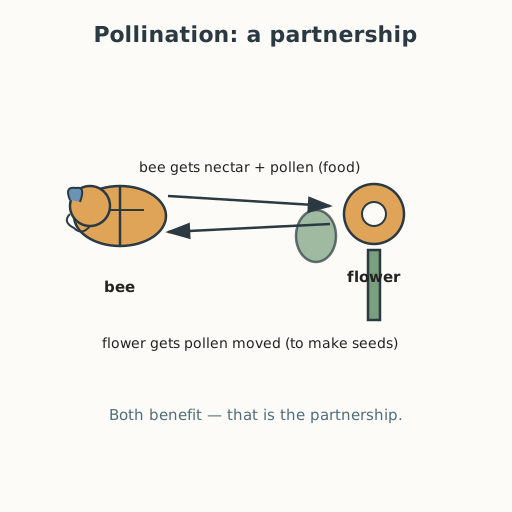
Watch a bee at a flower. The bee is not doing the flower a favor out of kindness — it is there for the sweet nectar, its food. Yet as it moves from flower to flower, it carries pollen on its body and, without meaning to, helps the flower make seeds. Each side gets something it needs. Life is full of these partnerships, called symbiosis, where two different living things depend on each other. Today you learn how they work.
Materials
- Partnership sheet
- Partnership cards
Preparation
- Copy the partnership sheet and partnership cards.
- Retrieval: from Lesson 6, recall that matter cycles through an ecosystem. Today we look at the partnerships that keep that cycle moving — like pollination, which lets plants make the next generation.
Facilitator note
This lesson is written to the learner (“you”). The ideas to land: (1) symbiosis is a close relationship between two different species; in mutualism, both benefit; (2) pollination is a mutualism — the pollinator gets food (nectar, pollen) and the plant gets its pollen moved so it can make seeds; (3) “benefit” means each side gets something it needs to live or reproduce, not that they intend to help each other. Model the bee-and-flower pair once (worked example, S-011). The environment lens: symbiosis shows that living systems are webs of interdependence, not solitary competition. The global lens: pollination happens worldwide, with many different partners — bees, butterflies, moths, bats, birds — differing by region. The technology & ethics lens: humans depend on pollination for much of our food, so caring for pollinators is also caring for ourselves and for farmers everywhere. Keep the science precise: pollination is a real mutualism; coral gets food from its symbiotic algae, and the algae get shelter (S-215, S-330); distinguish these facts from the value that interdependence is worth honoring.
Procedure
- Recall (5 min). What cycles through an ecosystem? Today we meet the partnerships that keep the cycle going.
- Meet the idea (8 min). Symbiosis is a close relationship between two different species. When both benefit, it is called mutualism. Pollination is one famous example.
- Watch it modeled — bee and flower (15 min). The bee visits a flower for nectar and pollen — its food. As it feeds, pollen sticks to its body. When it flies to the next flower, some pollen rubs off — and the flower gets its pollen moved, so it can make seeds. Neither is being kind; both are getting something they need. Fill in your two arrows: bee gets food; flower gets seeds made.
- Trace a second partnership (15 min). With a group, take the coral and algae card. Coral gives the tiny algae a safe, sunny home; the algae make food the coral can use. Name what each side gets, and draw the two arrows.
- Close (7 min). Share one partnership you traced. Remember: in mutualism, both sides benefit — even if neither one planned it.
Differentiation
- Support: Provide the two benefits pre-listed and ask learners to match each to the right partner.
- Extension: Contrast mutualism with a relationship where one side benefits and the other is harmed (parasitism), using a named example, and say what makes them different.
Assessment
- Formative (observation): Can the learner name both benefits in a symbiotic pair and explain why each is a benefit?
- Portfolio artifact: The completed partnership sheet for coral and algae, kept in the portfolio.
Home connection
Find a partnership near home — a pollinator at a flower, lichen on a rock, or a bird that eats insects off a large animal. Name what each side gets.
Resources
- Encyclopaedia Britannica — Pollination: https://www.britannica.com/science/pollination (S-330).
- Encyclopaedia Britannica — Symbiosis: https://www.britannica.com/science/symbiosis (S-331).
- NOAA — What is coral bleaching? (symbiotic algae): https://oceanservice.noaa.gov/facts/coral_bleach.html (S-215).
- On explicit instruction and worked examples: Kirschner, Sweller & Clark (2006), https://doi.org/10.1207/s15326985ep4102_1 (S-011).