Lesson 01 — My Identity: Then, Now, Next
Learners close the year by retrieving the "then/now" identity map from Unit 1 and adding a third panel — "next" — to predict how their identity may keep growing. They reflect on who they were, who they are, and who they are becoming, and keep the result as the "who I am becoming" opening piece of the year-end portfolio.
Objectives
Objectives
- D01.S2.07.01 Reflect on how their identity has changed over time and predict ways it may keep growing.
Essential question
Who am I becoming — and how do I know my identity will keep growing?
Key vocabulary
Materials
Standard materials
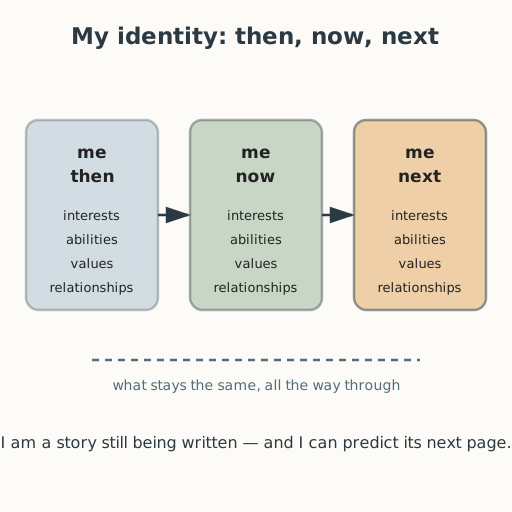
- Then/now/next poster · 1 A three-panel poster — "me then", "me now", "me next" — joined by arrows, with room for interests, abilities, values, and relationships
- Then/now/next page · 1 per learner A three-column page for the learner to record who they were, who they are, and who they predict they may become
- Pencils and crayons · per learner
Low-tech / no-cost
- Voice and story Tell then/now/next aloud in three breaths; no poster or page needed
- Three found objects A seed, a sapling, and a tree — or three stones — stand in for then, now, and next; name one change between each
Enriched / lab & device
- A "then/now/next" gallery · 1 A shared wall where learners post their three panels, showing many growing selves side by side
- A short reflective reading or audio · 1 A brief account of a real person describing how they changed and kept growing — a model of predicting one's own growth
Works in different contexts
- large-group Fill the then/now/next poster together for one made-up example, then learners complete their own and share one "next" line in a whip-around
- multi-age Younger learners name one then/now change; older learners also predict one way they may grow next and give a reason
- self-directed A learner fills the three columns and writes one sentence predicting a future change with the evidence for it (a growing interest, a new skill)
- level-grouped Learners ready to extend name a continuity that will likely stay the same into "next" and explain why it anchors them
- outdoor-only Compare yourself to a growing thing — seed, sapling, tree — and name then, now, and next aloud; no paper needed
Lesson 1 — My Identity: Then, Now, Next
Summary
Learners open the year-end unit by retrieving the “me then / me now” identity map they built in Unit 1 and adding a third panel — “me next” — to predict how their identity may keep growing. They reflect on who they were, who they are, and who they are becoming, and keep the result as the “who I am becoming” opening page of the year-end portfolio.
Objectives
- Reflect on how their identity has changed over time and predict ways it may keep growing. (D01.S2.07.01)
Connection
Think of yourself at eight, at ten, at twelve. The games, the fears, the dream jobs — some of it is gone, some of it grew, and some of it is still quietly at your center. A river is still a river even though the water is always new; a tree is still the seed it was, grown. Your identity is like that: continuous and changing. Today you add one more step the younger you could not see yet — the one that comes next.
Materials
- Then/now/next poster
- Then/now/next page
- Pencils and crayons
Preparation
- Print or draw the then/now/next poster (three panels joined by arrows).
- Copy a then/now/next page for each learner.
- Retrieval: from Unit 1, recall the “me then / me now” map and its four parts — interests, abilities, values, relationships. This lesson adds the third panel.
Facilitator note
This lesson is written to the learner (“you”). The idea to land: identity is a continuous, changing story, and because it changed before, we can predict (with honesty, not certainty) how it may keep growing. This closes the year by deepening Unit 1, Lesson 5 (which asked “how has my identity changed?”); here learners complete the objective by looking forward. Identity as a lifelong, re-forming process is developmentally real (Erikson, S-155); frame “next” as a prediction with reasons, not a fortune-telling or a demand to commit. The ethics lens: who I am becoming raises the question “who do I want to become, and what is right for others in that?” The egalitarian lens: growth looks different in every life — no one’s “next” is ranked against another’s, and a learner with fewer choices still authors their own story. The global lens: people everywhere understand the self as a story that grows, in many different idioms (a river, a tree, a path, a weaving); honor many ways of saying it rather than one. The technology lens: devices and media now shape the self — invite learners to notice whether their “next” is theirs or borrowed from a screen. Retrieval here is deliberate spaced recall (Dunlosky et al., 2013, S-039); model the three panels once as a worked example (Kirschner, Sweller & Clark, 2006, S-011). Distinguish evidence from values: that identity changes is observable; that every person’s growth deserves equal honor is a value this curriculum holds — name it as one. Keep identity work low-stakes and voluntary; it can brush against sensitive material (family change, migration, loss), so let learners choose safe examples and never require disclosure.
Procedure
- Gather and recall (10 min). Think back across the whole year — and all the way back to Unit 1. You once mapped “me then” and “me now.” Quick retrieval, no notes: name one way your interests changed, one way your abilities grew, one value that deepened, and one relationship that shifted. Check against a partner.
- Meet the third panel (10 min). Look at the poster: “me then”, “me now”, and now “me next.” Worked example: Then, I was shy and loved only drawing. Now, I speak up in class and play a sport — and I still draw. Next: my drawing may grow into design or animation, and I may learn to lead a small team. Notice the “next” follows from evidence in the “then” and “now” — it is a prediction with reasons, not a guess.
- Map your own three panels (15 min). On your page, write or draw three columns — then, now, next — for the four parts (interests, abilities, values, relationships), plus any part that matters to you (place, language, faith, body). For your “next” column, write what you predict may grow, and add one word about why you think so.
- Name your continuity (5 min). Under all three columns, write the one thing that has stayed the same and likely will keep staying — a value, a love, a habit. Growth and staying are both true.
- Share and close (10 min). Share one “next” prediction with a partner, and let them check: does it follow from something real about you? Close by remembering: you are not the person you were, and that is the point of growing — and you are the author of the next page.
Differentiation
- Support: Provide a partly filled then/now/next page, a word bank (interests, abilities, values, relationships, changed, stayed, next), and sentence starters (“Next, I may ___ because I now ___”).
- Extension: Write one paragraph connecting a past change to a predicted future change, naming the evidence that links them — a small “story so far, and where it points.”
Assessment
- Formative (observation): Can the learner name at least one way their identity has changed, one thing that has stayed, and one future change with a reason that follows from the evidence?
- Portfolio (artifact): The then/now/next page, kept as the “who I am becoming” opening piece of the year-end portfolio.
Home connection
Ask an older family member how they have changed since they were your age and what they think they may still become. Notice that grown-ups are still writing their next page too.
Resources
- On identity as a lifelong, developing process: Erikson, Childhood and Society (1950), cited here for the framing that identity forms and reforms across the life, not as a fixed trait (S-155).
- On self-awareness as a core competency, for classroom framing: CASEL, https://casel.org/fundamentals-of-sel/ (S-001).
- On spaced retrieval of prior learning: Dunlosky et al. (2013), Psychological Science in the Public Interest, https://doi.org/10.1177/1529100612453266 (S-039).
- On modeling a new skill before independent practice: Kirschner, Sweller & Clark (2006), https://doi.org/10.1207/s15326985ep4102_1 (S-011).