Lesson 02 — Looking Back on My Decisions to Choose Better
Learners retrieve the decision loop from Unit 1 and deepen it: instead of one decision, they look back across the whole year at several small choices, find a pattern among them, and turn the lesson into one concrete "better next choice" to carry into Grade 8. The result joins the year-end decision-and-routine note.
Objectives
Objectives
- D01.S3.07.01 Reflect on a past decision and its consequences to make a better choice next time.
Essential question
How do I look back across a year of decisions and turn what I learned into a better choice I will carry forward?
Key vocabulary
Materials
Standard materials
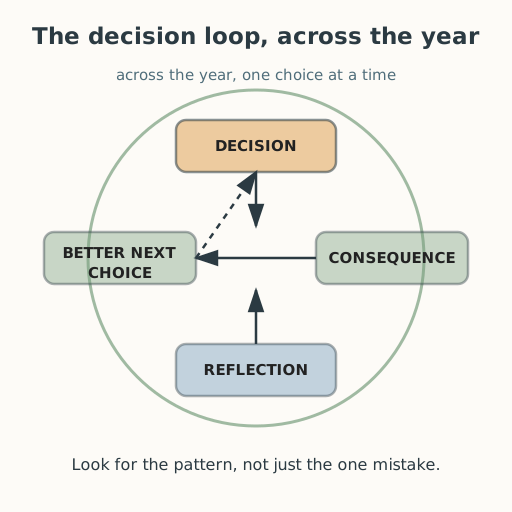
- Decision-loop poster (revisited) · 1 The four-step loop — DECISION, CONSEQUENCE, REFLECTION, BETTER NEXT CHOICE — with an outer ring "across the year, one choice at a time"
- Year-of-decisions page · 1 per learner A page with room to list a few small decisions from the year, find a pattern among them, and write one "better next choice" to carry into Grade 8
- Pencils · per learner
Low-tech / no-cost
- Voice and a shared surface Recall decisions aloud and draw the loop in the dirt or on a board; no page needed
- A talking circle Each learner names one small decision and what it taught, passing a stone or stick in turn
Enriched / lab & device
- A class "loops we learned from" wall · 1 A shared display of one loop each (anonymous if preferred), showing reflection across the year as normal and shared
- A short account of a real person's turning point · 1 A brief story of someone who looked back at a pattern of choices and changed course — mapped onto the loop
Works in different contexts
- large-group Work one loop together on the poster, then learners list their own year of decisions and share only their "better next choice" step
- multi-age Younger learners name one decision and its consequence; older learners also find a pattern and write a precise next choice
- self-directed A learner lists several small decisions from the year, finds one pattern, and writes a concrete "better next choice" that follows from it
- level-grouped Learners ready to extend separate the *decision* from its *consequence* from the *reasoning*, and name which part to change next time
- outdoor-only Recall small decisions about a place or a path (a shortcut, a route) and walk their loop aloud across the year; no paper needed
Lesson 2 — Looking Back on My Decisions to Choose Better
Summary
Learners retrieve the four-step decision loop from Unit 1 and deepen it: instead of reflecting on one choice, they look back across the whole year at several small decisions, find a pattern among them, and turn what they learned into one concrete better next choice to carry into Grade 8. The result becomes the first half of the year-end decision-and-routine note.
Objectives
- Reflect on a past decision and its consequences to make a better choice next time. (D01.S3.07.01)
Connection
One choice tells you a little; a hundred choices tell you a lot. You lent a tool you needed, spoke sharply and watched a face close, stayed up too late before a big day. Alone, each is just a moment. Together they form a pattern — a habit of choosing — and the pattern is what you can actually change. Today you do not just read one ripple; you read the whole year’s current, and steer.
Materials
- Decision-loop poster (revisited)
- Year-of-decisions page
- Pencils
Preparation
- Print or draw the revisited decision-loop poster (four steps with the “across the year” ring).
- Copy a year-of-decisions page for each learner.
- Retrieval: from Unit 1, recall the four steps — decision, consequence, reflection, better next choice. This lesson runs the loop over a year, not a single choice.
Facilitator note
This lesson is written to the learner (“you”). The idea to land: reflection is a learnable loop — decision → consequence → reflection → better next choice — and it is most powerful when it runs over a pattern of choices, not one isolated mistake. This deepens Unit 1, Lesson 9, which taught the loop on a single decision; here learners scan the year for a habit of choosing and convert it into a next step they will carry forward. The goal is never to shame the past but to extract its lesson; a past decision is information, never a verdict. Teach the loop as a worked example before independent practice (Kirschner, Sweller & Clark, 2006, S-011). The ethics lens asks what a pattern of choices did to others; the egalitarian lens asks whose needs it counted and whose it left out — and notices that some learners carry heavier constraints on their choices (work, care, travel) that are not personal failures. The global lens: reflecting on choices and adjusting course is a human practice everywhere, not one culture’s habit. Let learners choose small, safe, recent decisions and offer a made-up example as an option; never require disclosure of painful material. Feedback is built in as a peer check that the “next time” step actually follows from the pattern found. The year-spanning retrieval is deliberate spacing (Dunlosky et al., 2013, S-039). Distinguish evidence from values: that reflection improves later judgment is supported by learning science; that a learner’s past is never a verdict is a value this curriculum holds — name it as one.
Procedure
- Gather and recall (8 min). You learned this loop in Unit 1. Quick retrieval: name the four steps — decision, consequence, reflection, better next choice. Now you will run the same loop over a whole year.
- Meet the revisited loop (10 min). Look at the poster: the same four steps, wrapped in a ring that says “across the year, one choice at a time.” Worked example: This year I rushed into group work without listening — twice it caused a clash, once I did all the work. Reflection: my pattern is acting before hearing others. Better next choice: I will ask one question before I answer, starting next term. Notice the loop found a pattern, not just one event.
- List your year of decisions (12 min). On your page, list three or four small decisions from the year — not your heaviest ones, just ordinary ones (how you spent time, how you answered someone, when you prepared or did not). For each, one line: what I chose, and what happened.
- Find the pattern (10 min). Look across your list. Do the choices rhyme? (Do I rush? Do I avoid? Do I choose comfort now and pay later?) Write the pattern in one sentence, then write one concrete better next choice — “I will ___,” not “I should try to ___.”
- Peer check and close (10 min). Swap with a partner. Does your “next choice” actually follow from the pattern you named? Is it concrete? Offer one improvement and take one. Close: you are not stuck with your pattern — noticing it is the first step to choosing differently.
Differentiation
- Support: Provide sentence starters for each step (“I chose ___, what happened was ___, the pattern I notice is ___, next time I will ___”) and a partially filled list to copy first.
- Extension: Add a fifth question to one decision: whose needs did my choice count, and whose did it leave out? Then note whether the pattern would change if you counted those needs.
Assessment
- Formative (observation): Can the learner name a pattern across several decisions and produce a concrete “better next choice” that follows from it?
- Portfolio (artifact): The year-of-decisions page, kept as the first half of the unit’s decision-and-routine note.
Home connection
Ask someone at home about a choice they used to make repeatedly and how they changed it — and share the pattern you noticed and the next choice you named.
Resources
- On responsible decision-making as a core competency, for classroom framing: CASEL, https://casel.org/fundamentals-of-sel/ (S-001).
- On reflection and retrieval strengthening learning over time: Dunlosky et al. (2013), https://doi.org/10.1177/1529100612453266 (S-039).
- On modeling a new skill before independent practice: Kirschner, Sweller & Clark (2006), https://doi.org/10.1207/s15326985ep4102_1 (S-011).