Lesson 03 — The Routine I'll Carry Forward
Learners retrieve the routine wheel from Unit 1 and deepen it into a **commitment to carry forward**: they name the goal of who they are becoming, draft the study-sleep-movement routine that serves it, add an if-then plan for the hard moment, and set a way to track and adjust it. The result becomes the second half of the year-end decision-and-routine note.
Objectives
Objectives
- D01.S3.07.02 Build and follow a personal routine, such as study, sleep, or movement, that supports their own goals.
Essential question
What routine — study, sleep, movement — will I carry forward into Grade 8, and how will it serve who I am becoming?
Key vocabulary
Materials
Standard materials
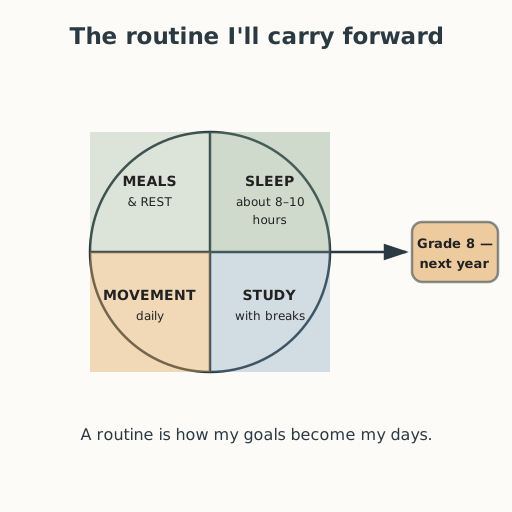
- Carry-forward wheel poster · 1 The 24-hour wheel of study, sleep, movement, meals, and rest, with an arrow leaving the wheel into a gate labeled "Grade 8 / next year"
- My carry-forward page · 1 per learner A page to name one goal, draft the routine that serves it, add an if-then plan for the hard moment, and a way to track and adjust it
- Pencils and crayons · per learner
Low-tech / no-cost
- Voice and body Say the day aloud in order — wake, move, study, eat, rest, sleep — and name one amount for each and the goal it serves; no poster needed
- A day drawn in the dirt Draw the wheel on the ground and walk its blocks, then step out of it into "next year"; no page needed
Enriched / lab & device
- A sleep-and-movement fact sheet · 1 A one-page summary of recommended amounts (about 8–10 hours of sleep for teens, daily movement, breaks in study) to ground the routine in evidence
- A week-long tracker · 1 per learner A simple chart to tick each day which parts of the routine they followed, for checking and adjusting at home
Works in different contexts
- large-group Build the carry-forward wheel together, then learners draft their own and share one "if-then" plan each
- multi-age Younger learners name one block (sleep, study, movement) and its amount; older learners also connect each block to their goal and write an if-then plan
- self-directed A learner drafts a full routine, names a goal, writes one if-then plan, and sets a way to track and adjust it next week
- level-grouped Learners ready to extend connect each block to *why* it serves their specific "who I am becoming" goal and plan an adjustment if one block fails
- outdoor-only Use the sun and the day itself as the wheel — where will you study, move, and sleep next year? — and name each block aloud; no paper needed
Lesson 3 — The Routine I’ll Carry Forward
Summary
Learners retrieve the routine wheel from Unit 1 and deepen it into a commitment to carry forward: they name the goal of who they are becoming, draft the study–sleep–movement routine that serves it, add an if-then plan for the hard moment, and set a way to track and adjust it. The result becomes the second half of the year-end decision-and-routine note.
Objectives
- Build and follow a personal routine (study, sleep, movement) that supports their own goals. (D01.S3.07.02)
Connection
Big things are built of small, repeated things — a house of bricks, a field of rows, a skill of practice returned to day after day. A routine is how a goal stops being a wish and starts being days. Study grows your mind; sleep lets the body repair and the brain keep what you learned; movement keeps the whole system clear. Choose the person you are becoming, then build the day that feeds it — in a city apartment or a village house, the pattern is the same.
Materials
- Carry-forward wheel poster
- My carry-forward page
- Pencils and crayons
Preparation
- Print or draw the carry-forward wheel poster (study, sleep, movement, meals, rest, with an arrow into “next year”).
- Copy a my carry-forward page for each learner.
- Prepare a short fact summary on sleep and movement amounts (see Resources).
- Retrieval: from Unit 1, recall the routine wheel and the three evidence-backed blocks — study (spaced and retrieved), sleep (about 8–10 hours for teens), and daily movement.
Facilitator note
This lesson is written to the learner (“you”). The idea to land: a routine is how a goal becomes days — and the routine you carry into Grade 8 should serve the person you are becoming, not just a checklist. This deepens Unit 1, Lesson 10 (which built the wheel); here the wheel is pointed forward and tied to the “who I am becoming” goal from Lesson 1. Rest it on three evidence-backed blocks: study (with breaks, spaced and retrieved), sleep (about 8–10 hours for teens — AASM, S-050), and daily movement (WHO, S-069), plus rest and meals. Use if-then planning for the hard moments (Duckworth, Gendler & Gross, S-097) and keep amounts flexible — every family, shift, and body differs; for a learner with limited mobility, “movement” means whatever their body does (stretching, range-of-motion, physio, breathing), and a routine that cannot bend will break. The egalitarian lens is explicit: a learner with chores, care duties, or long travel has different hours than one without, so teach the routine as “within your real day,” never as a middle-class default schedule. The environment lens: sleep and movement follow daylight and season; many people’s days follow the sun and the land, not a clock. The technology lens: name screens as one real pressure on sleep and study, and plan for it rather than ignore it. Model one routine as a worked example (Kirschner, Sweller & Clark, 2006, S-011). Distinguish evidence from values: that sleep, movement, and spaced study support health and learning is documented; that every learner’s goals deserve equal honor is a value this curriculum holds — name it as one.
Procedure
- Gather and recall (8 min). In Unit 1 you built a routine wheel. Quick retrieval: name the three blocks that matter most — study, sleep, movement — and the amounts that fit your age. Today you point that wheel into next year.
- Meet the carry-forward wheel (10 min). Look at the poster: the familiar wheel, with an arrow leaving it into a gate labeled “Grade 8 — next year.” Worked example: My goal is to keep growing as a musician and a student. My routine: 20 minutes of practice after school, screens off an hour before sleep, lights out by ten, a walk or game in the afternoon. Every block serves the person I am becoming.
- Draft your carry-forward routine (15 min). On your page, write the goal you named yesterday (or a new one). Then draft your real day — study, sleep, movement, meals, rest — with amounts that fit your life. Add one if-then plan for the hard moment: If I feel like skipping practice, then I will do just five minutes. And one way to track it next week (a tick chart, a note, a check-in).
- Check and adjust (7 min). Swap with a partner. Does every block serve the goal? Is the if-then concrete? Plan how you will know next week what to keep and what to adjust — a routine is a living thing, not a cage.
- Close (10 min). You have now named who you are becoming, the pattern in your choices, and the routine that carries your goal into next year. Small, repeated actions, day after day, add up to the life you want. Start next week — or start today.
Differentiation
- Support: Provide a partly filled carry-forward page and a menu of goals; write one if-then plan together as a class first.
- Extension: Connect each block to why it serves your specific “who I am becoming” goal, and plan one adjustment you would make if a block fails next week.
Assessment
- Formative (observation): Can the learner draft a routine with study, sleep, and movement that serves a named goal, plus an if-then plan and a way to track and adjust?
- Portfolio (artifact): The my carry-forward page, kept as the second half of the unit’s decision-and-routine note.
Home connection
Share your carry-forward routine with someone at home and invite them to help you track it next week — then adjust it together, as a living plan rather than a grade.
Resources
- On recommended sleep amounts for young people: American Academy of Sleep Medicine (2016), “Recommended Amount of Sleep for Pediatric Populations,” https://aasm.org/resources/pdf/pediatricsleepdurationconsensus.pdf (S-050).
- On daily movement for health: World Health Organization, “Physical activity” fact sheet, https://www.who.int/news-room/fact-sheets/detail/physical-activity (S-069).
- On if-then planning as a self-control strategy: Duckworth, Gendler & Gross (2016), “Situational Strategies for Self-Control,” https://doi.org/10.1177/1745691615623247 (S-097).
- On adolescence as a formative time for building healthy habits, including sleep: WHO, “Mental health of adolescents,” https://www.who.int/news-room/fact-sheets/detail/adolescent-mental-health (S-311).
- On spacing and retrieval strengthening memory: Dunlosky et al. (2013), https://doi.org/10.1177/1529100612453266 (S-039).
- On modeling a new skill before independent practice: Kirschner, Sweller & Clark (2006), https://doi.org/10.1207/s15326985ep4102_1 (S-011).