Lesson 01 — Steering, Not Sailing Blind: Recalling Grade 7, Previewing Grade 8
Learners recall what Grade 7 taught about feelings, identity, and choices, and preview the three movements of Grade 8: analyzing reactions, knowing a whole self, and steering choices. They meet a first taste of the event-thought-feeling frame as a teaser.
Objectives
Objectives
- D01.S1.08.01 Analyze a strong emotional reaction by separating the event, the thought, and the feeling.
Essential question
What did I learn about feelings, identity, and choices in Grade 7, and what will I learn to do with them in Grade 8?
Key vocabulary
Materials
Standard materials
- Unit-map poster · 1 A simple three-movement map — Analyze my reactions; Know my whole self; Steer my choices — with a "recall Grade 7" banner
- Recall cards · 1 set per pair Short prompts naming six Grade 7 ideas to remember and say aloud
Low-tech / no-cost
- A shared board or the ground Draw the three movements and the recall list with any writing tool; no cards needed
- Voice and body Recall each Grade 7 idea aloud and point to the part of the map it feeds into
Enriched / lab & device
- Projected unit map · 1 Display the map large, editable, for the whole group to annotate
- A one-minute voice recording · 1 Learners record a 30–60 second "here's what I remember, here's what I'm curious about" note
Works in different contexts
- large-group Recall aloud as a whole group with quick turn-and-talk, then post the three questions on the map
- multi-age Older learners recall all six Grade 7 ideas; younger learners recall two and listen for the rest
- self-directed A learner reads the recall list, writes or speaks one memory for each, then reads the three questions ahead
- level-grouped Learners ready to extend already separate event, thought, and feeling in the preview example; others just name the feeling
- outdoor-only Draw the map in the dust or chalk, and walk between the three movements as you recall aloud
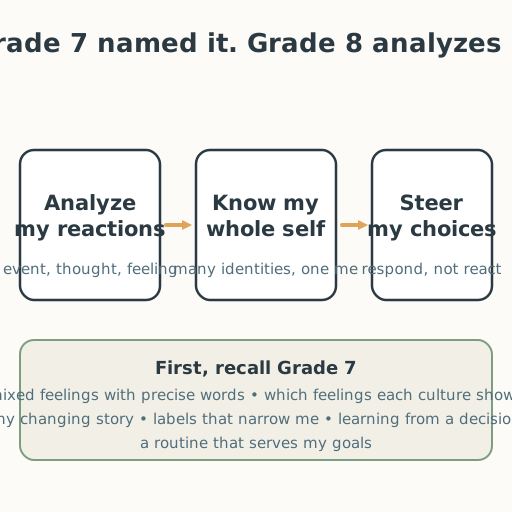
Lesson 1 — Steering, Not Sailing Blind: Recalling Grade 7, Previewing Grade 8
Summary
Learners recall what Grade 7 taught about feelings, identity, and choices, and preview the three movements of Grade 8 — analyze reactions, know a whole self, steer choices. They get a first taste of the event–thought–feeling frame that the next lesson takes apart in full.
Objectives
- Begin to recognize that a strong reaction can be separated into an event, a thought, and a feeling, as a preview of the analysis to come. (D01.S1.08.01)
Connection
A person who sails without reading the water ends up wherever the wind and current take them; a person who reads the water gets to steer. Last year you learned to name the water — mixed feelings, the feelings your culture shows or hides, the labels that would narrow you, the lessons a past choice can teach. This year you learn to steer: to take a reaction apart, to know the whole self that is doing the steering, and to choose your course on purpose.
Materials
- Unit-map poster
- Recall cards
Preparation
- Print or draw the unit-map poster (three movements + a recall banner).
- Copy recall cards for pairs.
- Retrieval prompt ready: “What is one thing Grade 7 taught you about feelings, identity, or choices?”
Facilitator note
This lesson is written to the learner (“you”). The ideas to land: (1) Grade 7 named
feelings, identities, and choices; Grade 8 analyzes and steers them; (2) the year has three
movements — analyze reactions, know a whole self, steer choices; (3) a reaction can be
previewed as three parts — event, thought, feeling. Keep this light: it is a retrieval
and a preview, not a deep lesson. Retrieval practice is one of the strongest learning
techniques we have (Dunlosky et al. 2013, S-039), so spend real time recalling, not
re-reading. The ethics lens: steering is not just about my comfort but about the
consequences my reactions have for others. The egalitarian lens: every learner’s Grade 7
memory is valid — there is no single “right” feeling or identity to recall. The global
lens: feelings are shown, hidden, and valued differently across cultures, and that variety
is exactly what makes a shared map useful. The critical-thinking lens: the three parts
(event, thought, feeling) are held as a question to explore, not an answer to accept. Do
not grade the recall; celebrate it. Where questioning adults is unsafe, frame the preview
as wondering together (see docs/contexts.md).
Procedure
- Gather (5 min). Close your eyes for a moment and remember Grade 7. Without looking at anything: what is one thing you learned about feelings, identity, or choices? Say it to a partner.
- Recall the six ideas (15 min). With your pair, work through the recall cards: (a) mixed feelings, named precisely; (b) which feelings each culture shows, hides, or values; (c) identity as a changing story; (d) stereotypes and the labels that narrow us; (e) learning from a past decision; (f) a routine that serves my goals. For each, say one example from your own life.
- Meet the year (10 min). Look at the unit map. Grade 7 named it; Grade 8 analyzes it. Three movements: analyze my reactions, know my whole self, steer my choices. Point to which movement each recalled idea feeds into.
- First taste: three parts (15 min). Try this seed example: You hear a loud crash in the hallway. What is the event? (The crash.) What is the thought? (What you tell yourself it means.) What is the feeling? (What you feel because of that thought.) Say all three aloud — you will take this apart properly next lesson.
- Close (5 min). Write or say one thing you are curious to learn this year. Keep it; you will look back at it in the final lesson.
Differentiation
- Support: Recall only two of the six ideas and use sentence starters (“I remember ___”; “I wonder ___”).
- Extension: In the seed example, name two different thoughts the crash could spark, and say how the feeling would change with each.
Assessment
- Formative (observation): Can the learner name at least two recalled ideas and match the three parts (event, thought, feeling) to the seed example?
- Self-assessment: “What did I recall that I had forgotten, and what am I curious about?” — one written line kept for the capstone.
Home connection
Ask someone at home what they remember learning at your age about feelings, identity, or choices — and share one memory of your own.
Resources
- On retrieval practice and spacing as high-utility learning techniques: Dunlosky et al. (2013), https://doi.org/10.1177/1529100612453266 (S-039).
- On social-emotional learning competencies for classroom framing: CASEL, https://casel.org/fundamentals-of-sel/ (S-001).