Lesson 02 — Event, Thought, Feeling: Taking a Reaction Apart
Learners learn to separate a strong emotional reaction into its three parts — the event, the thought, and the feeling — watching a worked example, then practicing with a partner and alone. They discover that the thought is the hinge: the same event can produce different feelings depending on the story the mind tells.
Objectives
Objectives
- D01.S1.08.01 Analyze a strong emotional reaction by separating the event, the thought, and the feeling.
Essential question
How do I separate the event, the thought, and the feeling in a strong emotional reaction?
Key vocabulary
Materials
Standard materials
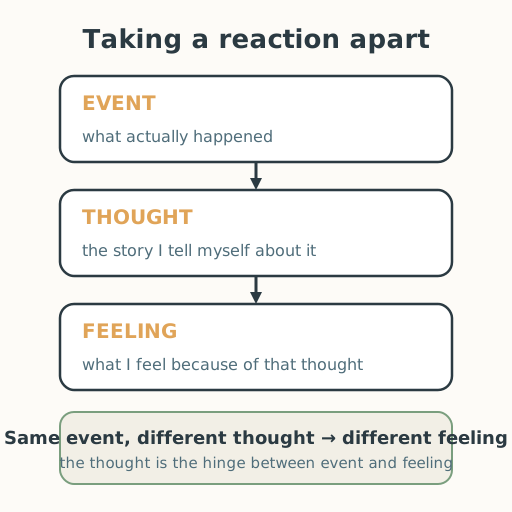
- Event-thought-feeling frame card · 1 per learner A three-box organizer — EVENT, THOUGHT, FEELING — with arrows between them
- Reaction cards · 1 set per pair Short everyday situations with a strong emotional charge (a friend walks past silent, a message left on read, a lost item, a sharp word)
Low-tech / no-cost
- A page folded into three columns Write EVENT, THOUGHT, FEELING at the top of three columns; no printed card needed
- A reaction from the learner's own day Use a real, safe, recent reaction instead of printed cards
Enriched / lab & device
- A shared digital frame · 1 Learners type the three parts into a shared document for peer feedback
- A short film clip of a charged moment · 1 Watch a brief scene and separate its event, a character's likely thought, and the feeling
Works in different contexts
- large-group Model one reaction on the board, then pairs analyze a second and post their three parts to compare
- multi-age Younger learners name the event and the feeling; older learners also name the thought that links them
- self-directed A learner completes the frame for two reactions and self-checks that each box holds only its own part
- level-grouped Learners ready to extend show how a *different* thought about the same event changes the feeling
- outdoor-only Use an outdoor reaction (a sudden noise, a bird that startles you, a lost turn in a game) and talk the three parts aloud
Lesson 2 — Event, Thought, Feeling: Taking a Reaction Apart
Summary
Learners learn to analyze a strong emotional reaction by separating its three parts — the event (what actually happened), the thought (the story the mind tells about it), and the feeling (what is felt because of that thought). They watch a worked example, then practice with a partner and alone, discovering that the thought is the hinge.
Objectives
- Analyze a strong emotional reaction by separating the event, the thought, and the feeling. (D01.S1.08.01)
Connection
A strong feeling can arrive like a storm — all at once, with no visible parts. But every storm has parts: the air that rises, the water that condenses, the wind that follows. A reaction has parts too. The moment your heart drops when a friend walks past without a word is not one single thing; it is an event, a thought, and a feeling stacked so fast you cannot tell them apart. Today you learn to slow the storm down and name each part.
Materials
- Event-thought-feeling frame card
- Reaction cards
Preparation
- Copy the frame card and reaction cards.
- Retrieval: from Lesson 1, recall the three movements of the year and the seed example (the crash in the hallway) — today you take it apart in full.
Facilitator note
This lesson is written to the learner (“you”). The idea to land: a strong reaction has three parts — event, thought, feeling — and the thought is the hinge between the event and the feeling. This is a skill for novices, so teach it with explicit instruction: model the frame once, out loud and step by step (a worked example — Kirschner, Sweller & Clark 2006, S-011), then guided practice before independent work. The frame draws on the ABC model of cognitive-behavioral approaches (activating event, beliefs, consequences — see S-332), used here descriptively, not therapeutically. The ethics lens: separating parts lets a learner see that a reaction is not a single fact — it is partly a story, and stories can be checked before they hurt someone. The egalitarian lens: no learner’s feeling is judged “too much” or “wrong”; the point is clarity, not ranking. The global lens: the same event (spilled water, a silence, a raised voice) is read through different thoughts in different families and cultures, so the same event really can mean different things to different people. The critical-thinking lens: the frame is a tool for questioning one’s own first take, not for insisting on one “right” thought. Keep learners on small, safe reactions; never require disclosure of painful material.
Procedure
- Recall (5 min). Without looking: what are the three movements of the year? What three parts did we preview in the crash example? Say them, then check against the map.
- Meet the frame (10 min). Look at the frame card. A reaction has three parts. EVENT — what actually happened, visible to anyone. THOUGHT — the story you tell yourself about it. FEELING — what you feel because of that thought. Notice the thought sits between the event and the feeling.
- Watch it modeled (10 min). Worked example: A friend walks past you without saying hello. Event: she walked past, silent. Thought: “She is angry with me” (or “She didn’t see me”). Feeling: hurt (or just puzzled). Watch how changing the thought changes the feeling while the event stays exactly the same.
- Guided practice (15 min). With a partner, choose a reaction card. Fill the three boxes. Agree on the event first (that part should be the same for both of you), then each writes your own thought and feeling — they may differ, and that is the point.
- Independent work (10 min). On your own, take apart one real, safe reaction of your own from this week. Self-check: does my EVENT box hold only what happened, with no story in it? Does my THOUGHT box hold the story, and my FEELING box the feeling it caused?
- Close (5 min). Trade frames with a partner and read. The same event can produce different thoughts and feelings — the thought is the hinge.
Differentiation
- Support: Give sentence starters (“The event was ___, I thought ___, so I felt ___”) and a two-part starter (event, feeling) before adding the thought.
- Extension: Take one event and write two different thoughts about it, then name the feeling each thought produces — evidence that the thought, not the event, is doing the work.
Assessment
- Formative (observation): Can the learner place each part in its own box — event, thought, feeling — without blending the event and the thought?
- Portfolio artifact: The completed frame for one reaction, kept as the first piece of the unit’s reaction-analysis portfolio.
- Peer check: A partner confirms the EVENT box holds only observable facts, not stories.
Home connection
Take the frame home and, without naming anyone, take apart one small reaction from the day — event, thought, feeling — and ask someone at home what their thought would have been about the same event.
Resources
- On modeling a new skill before independent practice: Kirschner, Sweller & Clark (2006), https://doi.org/10.1207/s15326985ep4102_1 (S-011).
- On the activating-event–belief–consequence (ABC) frame the organizer adapts: Albert Ellis / REBT (S-332).
- On precise emotion labeling, for classroom framing: RULER, https://www.rulerapproach.org/ (S-015).