Lesson 07 — Pause Before You Pounce: Managing the Impulse
Learners practice managing impulses deliberately — choosing a response rather than reacting in an emotionally charged moment. They learn the hot-system/cool-system idea, walk a four-step pause path, and write a journal entry about a real moment where they chose instead of reacted.
Objectives
Objectives
- D01.S3.08.01 Manage impulses deliberately, choosing a response rather than reacting in emotionally charged moments.
Essential question
How do I choose my response rather than react in an emotionally charged moment?
Key vocabulary
Materials
Standard materials
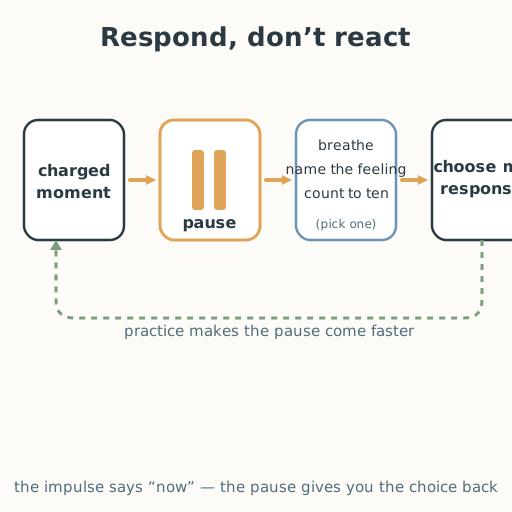
- Pause-path poster · 1 A four-step path — charged moment, pause, pick a tool (breathe, name the feeling, count to ten), choose my response
- Impulse journal page · 1 per learner A page with three columns — the charged moment, my first impulse, and the response I chose instead
Low-tech / no-cost
- The path drawn on a board or ground Draw the four steps and walk them aloud; no poster needed
- Voice and breath Practice the pause aloud — breathe, name the feeling, count — with no materials at all
Enriched / lab & device
- A projected pause path · 1 Display the four steps large, and add the group's own pause tools to it
- A short video clip · 1 A brief scene where a character almost reacts, then pauses and chooses — mapped onto the path
Works in different contexts
- large-group Model the path on the board, then learners practice the pause in pairs on a low-stakes moment
- multi-age Younger learners name the impulse and one pause tool; older learners also name the response they chose and why
- self-directed A learner reads the path, practices one pause tool, and journals one real charged moment and the response they chose
- level-grouped Learners ready to extend compare a first impulse with a chosen response and weigh which served them and others better
- outdoor-only Practice the pause on an outdoor trigger (a dropped ball, a lost turn) and walk the path in place; no paper needed
Lesson 7 — Pause Before You Pounce: Managing the Impulse
Summary
Learners practice managing impulses deliberately — choosing a response rather than reacting in an emotionally charged moment. They meet the hot/cool idea of the mind, walk a four-step pause path, and write a journal entry about a real moment where they chose instead of reacted.
Objectives
- Manage impulses deliberately, choosing a response rather than reacting in emotionally charged moments. (D01.S3.08.01)
Connection
A charged moment — a sharp word, a stolen turn, a flashing notification — sets off an impulse that says act now. And sometimes acting now is exactly wrong: the words you cannot unsay, the choice you cannot undo. Between the moment and the action there is a gap, and in that gap is where you live as the author of your own life. Today you learn to widen the gap and choose what fills it.
Materials
- Pause-path poster
- Impulse journal page
Preparation
- Print or draw the pause-path poster (four steps).
- Copy the impulse journal page.
- Retrieval: from Lessons 2–4, recall the event–thought–feeling frame and the check-the- thought question — the pause is where that checking happens before the reaction fires.
Facilitator note
This lesson is written to the learner (“you”). The idea to land: an impulse is a signal to
act, but you can pause and choose your response instead of reacting — and practice makes the
pause faster. The hot/cool framing — a fast, emotional “hot” system and a slower,
deliberate “cool” system — comes from Mischel’s delay-of-gratification work (S-336); note
the honest caveat that the famous marshmallow findings have been challenged by later, more
careful studies, so we teach the pause skill, not a claim that one childhood test predicts
a life. Teach the path as a worked example (Kirschner, Sweller & Clark 2006, S-011) before
independent practice. The ethics lens: the pause protects other people — it is the
difference between a sharp word that wounds and a chosen response that respects. The
egalitarian lens: every learner has impulses; the skill is learnable by anyone, and no one
is “just hot-headed” — that is a verdict, not information. The global lens: what counts as
an appropriate pause differs by culture — some traditions value a long, silent beat before
speaking, others a quick response — so the tool is shared even where the style differs.
The pause itself — watching an impulse arise without acting — is also a long-practiced skill
in contemplative traditions across South and East Asia, held here side by side with the
psychological account (docs/philosophy.md §11).
The technology lens: notifications and feeds are engineered to trigger impulse; the pause
is a human brake on a machine that wants you to tap now. The critical-thinking lens: the
pause is not suppressing feeling — it is the moment you run the check from Lesson 4. Keep
journal moments small and safe; never require disclosure of conflict that is still painful.
Procedure
- Recall (5 min). From Lesson 4: what is the check question, and where does it happen in a reaction? Today we build the moment before the reaction: the pause.
- Meet the gap (10 min). Look at the path. A charged moment triggers an impulse — a fast “hot” system that says now. But there is a gap before you act. In that gap you can pause, pick one tool — breathe, name the feeling, or count to ten — and then choose your response. Reacting is automatic; responding is chosen.
- Watch it modeled (10 min). Worked example: A teammate blames you for a lost point. First impulse: snap back. The pause: breathe, name it (“I feel defensive and angry”), count to ten. Chosen response: “That stung — can we talk about the play?” Notice the feeling is still there; the choice changed.
- Practice (15 min). With a partner, pick a low-stakes charged moment (a dropped ball, a missed turn). Say your first impulse aloud, then walk the path: pause, pick a tool, choose a response. Swap roles.
- Journal (10 min). On your page, record one real, safe charged moment from this week: the moment, your first impulse, and the response you chose (or wish you had). Keep it.
- Close (5 min). The impulse says “now.” The pause gives you the choice back. It gets faster with practice — that is the whole point.
Differentiation
- Support: Give a two-option pause (“breathe or count”) and sentence starters (“My first impulse was ___; instead I chose ___”).
- Extension: Compare a first impulse with a chosen response and weigh which served you and others better — then name when acting fast was actually the right call, and why.
Assessment
- Formative (observation): Can the learner name a pause tool and describe choosing a response instead of reacting in a real (or role-played) moment?
- Portfolio artifact: The impulse journal entry, kept for the unit’s impulse-management journal.
- Self-assessment: “Which pause tool worked for me, and what will I reach for next time?” — one written line.
Home connection
Choose one pause tool to try this week (breathe, name, or count), and tell someone at home about one moment you used it.
Resources
- On the hot/cool systems and delay of gratification, with the replication caveat noted: Mischel et al., “Delay of Gratification in Children” (1989), and Watts, Duncan & Quan (2018) on later findings (S-336).
- On modeling a new skill before independent practice: Kirschner, Sweller & Clark (2006), https://doi.org/10.1207/s15326985ep4102_1 (S-011).
- On self-management as a core competency, for classroom framing: CASEL, https://casel.org/fundamentals-of-sel/ (S-001).