Lesson 06 — Inner Worth and Outside Approval: Where Self-Esteem Comes From
Learners analyze where self-esteem comes from, distinguishing inner worth (rooted in values, effort, kindness) from outside approval (rooted in likes, grades, popularity). They sort examples, then write a personal analysis of which source their own self-esteem leans on.
Objectives
Objectives
- D01.S2.08.02 Analyze where self-esteem comes from and distinguish inner worth from outside approval.
Essential question
Where does my self-esteem come from, and what is the difference between inner worth and outside approval?
Key vocabulary
Materials
Standard materials
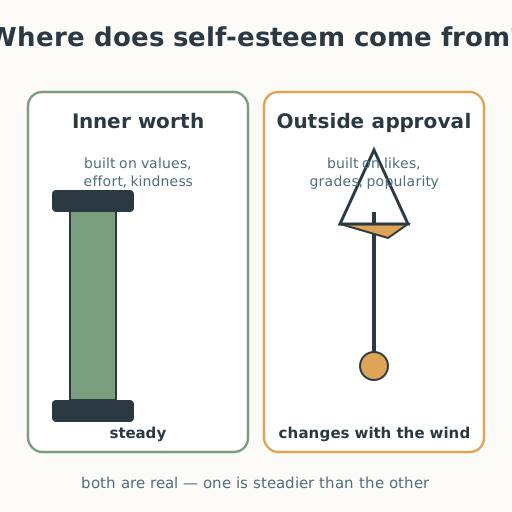
- Worth-versus-approval card · 1 per learner Two panels — a steady pillar ("inner worth") and a weather vane ("outside approval") — with the sources of each
- Scenario cards · 1 set per pair Short situations where self-esteem is being borrowed from approval (counting likes, a bad grade, a fashion trend, a comparison)
Low-tech / no-cost
- Paper and two drawn symbols Draw a pillar and a weather vane on a page and list the sources of each; no card needed
- Voice and a remembered moment Recall a time your mood rode on approval, and a time it did not
Enriched / lab & device
- A projected two-source diagram · 1 Display the pillar and weather vane large, and add the group's own examples to each
- A short profile of a public figure · 1 Read a brief true account of someone who kept steady worth through public criticism, and map it
Works in different contexts
- large-group Sort examples into the two columns together, then each learner writes their own two lists privately
- multi-age Younger learners name one source of each; older learners explain *why* approval is the shakier source
- self-directed A learner writes the two lists and a short analysis of which source their own self-esteem leans on more
- level-grouped Learners ready to extend examine a single approval (a grade, a like) and trace what happens when it disappears
- outdoor-only Stand in two marked spots — one for a pillar (a strong tree), one for a vane (a leaf in the wind) — and talk the difference; no paper needed
Lesson 6 — Inner Worth and Outside Approval: Where Self-Esteem Comes From
Summary
Learners analyze where self-esteem comes from, distinguishing inner worth — rooted in values, effort, and kindness — from outside approval — rooted in likes, grades, and popularity. They sort examples, then write a personal analysis of which source their own self-esteem leans on.
Objectives
- Analyze where self-esteem comes from and distinguish inner worth from outside approval. (D01.S2.08.02)
Connection
Self-esteem is the sense that you are okay — but where does that sense come from? You can borrow it from outside: the like count, the grade, the praise, the number of people who approve of you. Or you can build it from inside: the values you actually live by, the effort you choose, the kindness you give. One of these stands in a storm; the other turns with every wind. Today you learn to tell them apart — and to notice which one you lean on.
Materials
- Worth-versus-approval card
- Scenario cards
Preparation
- Copy the worth-versus-approval card and scenario cards.
- Retrieval: from Lesson 5, recall the self-map and the “whole me.” Today’s question is where the worth of that whole self comes from.
Facilitator note
This lesson is written to the learner (“you”). The idea to land: self-esteem has two
sources — inner worth and outside approval — and inner worth is the steadier one. The
distinction draws on research on contingent self-esteem — self-worth that depends on
meeting external standards is more fragile than worth that is less contingent (Crocker &
Wolfe 2001, S-335). Teach the sort as a worked example (Kirschner, Sweller & Clark 2006,
S-011) before independent work. The ethics lens: worth built on kindness and honesty is
worth that also serves others — it is not self-centered to be steady. The egalitarian
lens: approval is distributed unequally — some people get more likes, praise, and high
grades for reasons that have nothing to do with their worth — so building worth on approval
is building on an unfair floor. The global lens: what earns approval differs wildly by
place — one culture prizes marks, another courage, another service — so borrowed worth
depends on where you happen to stand. Many traditions also ground a person’s worth in
relationship — kinship, belonging, and duty, as in the southern African idea of ubuntu
(“a person is a person through other persons”) or the Confucian self rooted in family and
community — and this relational worth is not the same thing as the fickle like count. Hold
both ways of grounding worth side by side and let learners weigh them (see
docs/philosophy.md §11). The technology lens: feeds and like counts are a
designed, always-on approval machine; naming them as a weather vane helps learners see the
machine for what it is. The critical-thinking lens: neither source is entirely right or
wrong — approval is real information — the skill is weighing which source you let decide
your worth. Distinguish evidence from values: that contingent self-esteem is more fragile is
a research finding (S-335); that every learner has equal worth regardless of any approval is
a value this curriculum holds — name it as one.
Procedure
- Recall (5 min). From Lesson 5: what is the “whole me”? Now ask: where does my sense that I am okay come from? List your first three answers silently.
- Meet the two sources (10 min). Look at the card. Inner worth is a pillar: built on values, effort, kindness — it stands when the wind blows. Outside approval is a weather vane: built on likes, grades, popularity — it turns with every wind. Both are real; one is steadier.
- Watch it modeled (10 min). Worked example: Your self-esteem drops when a post gets few likes. Where is the worth coming from? Outside approval — a number someone else controls. What would an inner-worth version sound like? “I made something I care about; the effort is mine.” The feeling is the same event; the source of worth is different.
- Sort (15 min). With a partner, sort the scenario cards into the two columns. For each, say where the worth is coming from. Then write your own two lists: one thing that makes you feel good about yourself because of approval, and one because of your own values, effort, or kindness.
- Analyze your own (10 min). Write a short note: which source do I lean on more, and what would change if I leaned a little more on the pillar? Keep it private or share what you choose.
- Close (5 min). Approval is real, but it is a weather vane. The pillar is yours to build.
Differentiation
- Support: Give sentence starters (“I feel good when ___ approves; I feel good about myself when I ___”) and a two-item limit.
- Extension: Trace one approval (a grade, a like, a prize) through time: what does it feel like the day it lands, and what is left of it a month later?
Assessment
- Formative (observation): Can the learner correctly identify the source of worth in a scenario and name one example of each source in their own life?
- Portfolio artifact: The two lists plus the personal analysis note, kept for the unit’s identity portfolio.
- Self-assessment: “Which source do I lean on more, and what is one small step toward the pillar?” — one written line.
Home connection
Ask someone at home what they think really makes a person valuable — and listen for whether their answer sounds like a pillar or a weather vane.
Resources
- On contingent self-esteem and its fragility: Crocker & Wolfe (2001), “Contingencies of Self-Worth,” Psychological Review (S-335).
- On modeling a new skill before independent practice: Kirschner, Sweller & Clark (2006), https://doi.org/10.1207/s15326985ep4102_1 (S-011).