Lesson 09 — Weighing It: A Decision in Two Time Scales
Learners weigh short-term against long-term consequences in a real decision, completing a two-pan decision note that names both consequences, does the weighing, and states a decision with a reason. This is the unit's formal decision-portfolio artifact.
Objectives
Objectives
- D01.S3.08.02 Explain the difference between short-term and long-term consequences and weigh them in a decision.
Essential question
How do I weigh short-term against long-term consequences in a real decision?
Key vocabulary
Materials
Standard materials
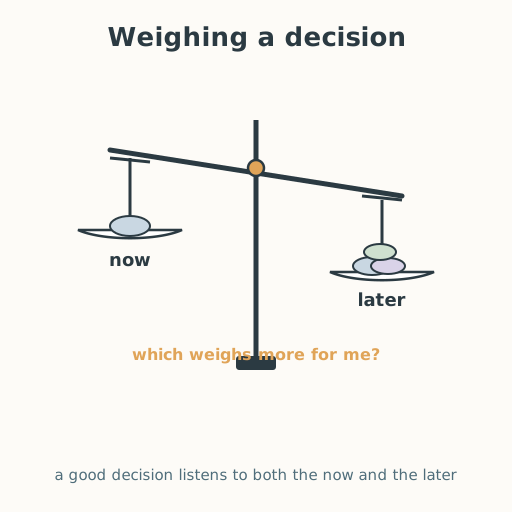
- Decision-note page · 1 per learner A two-pan balance — "now" and "later" — with space to write the choice, both consequences, the weighing, and the decision
- Decision scenarios · 1 set per pair Real-feeling choices with a now-versus-later trade-off (a hard conversation now, a saved amount, a study hour, a repaired friendship)
Low-tech / no-cost
- A page drawn as a balance scale Draw the two pans and write the now and the later in each; no printed page needed
- A real, safe decision the learner faces Use a genuine small decision — what to do with an afternoon, a small amount of money, a difficult message
Enriched / lab & device
- A shared digital decision note · 1 Learners write their weighing in a shared document for peer feedback on the reasoning
- A short account of a real decision · 1 A brief true story of someone weighing now against later, read and mapped onto the balance
Works in different contexts
- large-group Model one decision note on the board, then learners write their own and share only the final "my decision and why"
- multi-age Younger learners name the now and the later; older learners also write the weighing and defend it
- self-directed A learner completes the decision note for one real choice and self-checks that both pans are filled and the decision follows the weighing
- level-grouped Learners ready to extend name the *trade-off* explicitly — what is given up either way — and say which value tipped the scale
- outdoor-only Draw the balance in the dust and talk a real outdoor decision (water now or saved, a path, a shared resource); no paper needed
Lesson 9 — Weighing It: A Decision in Two Time Scales
Summary
Learners weigh short-term against long-term consequences in a real decision, completing a two-pan decision note that names both consequences, does the weighing, and states a decision with a reason. This is the unit’s formal decision-portfolio artifact.
Objectives
- Explain the difference between short-term and long-term consequences and weigh them in a decision. (D01.S3.08.02)
Connection
Naming the now and the later is the first step; weighing them is the second, and it is the difference between knowing and choosing. A balance scale does not tell you which pan to prefer — it shows you how much is on each, so you can decide with your eyes open. Today you put a real decision of your own onto the scale and choose deliberately.
Materials
- Decision-note page
- Decision scenarios
Preparation
- Copy the decision-note page and decision scenarios.
- Retrieval: from Lesson 8, recall the two time scales and present bias. Today you weigh them, not just name them.
Facilitator note
This lesson is written to the learner (“you”). The idea to land: weighing short-term against long-term consequences means naming both, saying what is given up either way, and choosing with a reason. This is a skill, so model the full decision note once (worked example — Kirschner, Sweller & Clark 2006, S-011), then guided practice before independent work. The ethics lens: a good weighing includes consequences for other people, not only for oneself — the friend’s trust, the family’s need. The egalitarian lens: there is no single “correct” weighing; two reasonable people can weigh the same now-and-later differently, and both reasonings can be sound — what we assess is the reasoning, not the answer. The global lens: what counts as “short” and “long” differs by life — for a family planting a crop the long term is a season; for a student it may be a year — so the tool is the same while the numbers differ. The environment lens: some of our most important decisions — how much to take from a commons today — are now/later weighings whose “later” is a whole community and a whole ecosystem. The critical-thinking lens: the decision note makes the reasoning visible so it can be questioned and improved — your own, and a partner’s. Let learners choose small, safe decisions; never require disclosure of painful or private choices, and offer a made-up decision as a fully acceptable option. Distinguish evidence from values: that making a weighing explicit improves the quality of a decision is a skill claim (S-011); that every learner is the rightful author of their own small decisions is a value this curriculum holds — name it as one.
Procedure
- Recall (5 min). From Lesson 8: what are the two time scales, and what is present bias? Say them. Today you weigh.
- Meet the balance (10 min). Look at the note page: a balance with two pans — now and later. A decision note has four parts: the choice, the now consequence, the later consequence, and the weighing — which pan is heavier for you and why.
- Watch it modeled (10 min). Worked example: Should I have a hard conversation now or avoid it? Now: it will be uncomfortable. Later: a small hurt can fester into a broken friendship. Weighing: the discomfort lasts minutes; the friendship lasts years — I weigh the later heavier. Decision: have the conversation, with care. Notice the note does not dictate the answer; it makes the reasoning visible.
- Guided practice (15 min). With a partner, run a decision scenario through the note: choice, now, later, weighing, decision. Check each other: are both pans filled? Does the decision follow from the weighing?
- Independent work (10 min). Complete a decision note for one real, safe decision of your own. Name the trade-off — what you give up either way. Write your decision as a concrete action (“I will ___”), not a wish.
- Close (5 min). A decision made with both pans filled, and a reason for the weighing, is a decision you can stand behind — whatever you choose.
Differentiation
- Support: Provide sentence starters (“The choice is ___; now ___, but later ___; I weigh ___ heavier because ___; so I will ___”) and a one-scenario limit.
- Extension: Add a fifth line to the note — whose else’s consequence am I weighing? — and say whether it changes the decision.
Assessment
- Formative (observation): Does the decision note fill both pans, name the trade-off, and give a decision that follows from the weighing?
- Portfolio artifact: The completed decision note, kept for the unit’s decision portfolio.
- Peer check: A partner confirms both time scales were weighed and the reason matches the decision.
Home connection
Take one small real decision home this week, run it through the four-part note with someone at home, and compare weighings.
Resources
- On modeling a new skill before independent practice: Kirschner, Sweller & Clark (2006), https://doi.org/10.1207/s15326985ep4102_1 (S-011).
- On responsible decision-making as a core competency, for classroom framing: CASEL, https://casel.org/fundamentals-of-sel/ (S-001).