Lesson 10 — Capstone: My Map of Feelings, Identity & Purpose
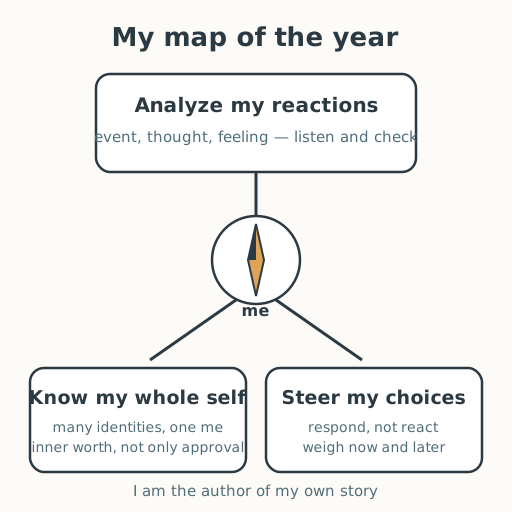
Learners integrate the whole unit into one personal map — analyze reactions, know a whole self, steer choices — using spaced retrieval to recall each movement's key idea, then assembling their portfolio and writing a closing reflection. This is the unit capstone.
Objectives
Objectives
- D01.S1.08.01 Analyze a strong emotional reaction by separating the event, the thought, and the feeling.
- D01.S1.08.02 Explain how emotion can both inform and distort judgment, using a personal example.
- D01.S2.08.01 Explain how multiple and intersecting identities, such as culture, gender, ability, and language, shape a whole self.
- D01.S2.08.02 Analyze where self-esteem comes from and distinguish inner worth from outside approval.
- D01.S3.08.01 Manage impulses deliberately, choosing a response rather than reacting in emotionally charged moments.
- D01.S3.08.02 Explain the difference between short-term and long-term consequences and weigh them in a decision.
Essential question
How do the parts of this unit — analyzing reactions, knowing my whole self, and steering my choices — fit into one map I can carry?
Key vocabulary
Materials
Standard materials
- Personal map page · 1 per learner A one-page map — analyze my reactions, know my whole self, steer my choices — with space to write one takeaway under each
- Portfolio folder · 1 per learner The learner's collected artifacts from the unit (frames, self-map, worth analysis, journal, decision note)
Low-tech / no-cost
- A page drawn as a three-part map Draw the three movements and write one takeaway under each; no printed page needed
- Voice and the collected work Speak the three takeaways aloud from memory, using the collected pages only to check
Enriched / lab & device
- A digital map · 1 Build the personal map on a device, linking each takeaway to the artifact it came from
- A short audio or video reflection · 1 Record a one-minute reflection on the whole unit to keep with the portfolio
Works in different contexts
- large-group Learners complete their maps, then form a closing circle and each shares one takeaway
- multi-age Younger learners recall one takeaway from each movement; older learners also write how the three connect into one life
- self-directed A learner completes the map from memory, checks it against the collected artifacts, and writes the closing reflection
- level-grouped Learners ready to extend write a short "letter to my future self" carrying the three takeaways forward
- outdoor-only Draw the map on the ground and stand at each movement as you speak its takeaway; no paper needed
Lesson 10 — Capstone: My Map of Feelings, Identity & Purpose
Summary
Learners integrate the whole unit into one personal map — analyze reactions, know a whole self, steer choices — using spaced retrieval to recall each movement’s key idea from memory, then assembling their portfolio and writing a closing reflection. This is the unit capstone.
Objectives
- Analyze a strong emotional reaction by separating the event, the thought, and the feeling. (D01.S1.08.01)
- Explain how emotion can both inform and distort judgment, using a personal example. (D01.S1.08.02)
- Explain how multiple and intersecting identities shape a whole self. (D01.S2.08.01)
- Analyze where self-esteem comes from and distinguish inner worth from outside approval. (D01.S2.08.02)
- Manage impulses deliberately, choosing a response rather than reacting. (D01.S3.08.01)
- Explain the difference between short-term and long-term consequences and weigh them in a decision. (D01.S3.08.02)
Connection
You began the year learning to name the water; this unit, you learned to steer. The three movements — analyzing a reaction, knowing your whole self, and steering your choices — are not three separate subjects; they are one skill, and it is you. Today you gather the whole thing into a single map you can carry into the rest of your life, in whatever waters you sail.
Materials
- Personal map page
- Portfolio folder
Preparation
- Copy the personal map page.
- Gather each learner’s collected artifacts (frames, self-map, worth analysis, journal, decision note).
- Retrieval note: this capstone is a deliberate spaced-retrieval pass over the whole unit — a technique with strong evidence behind it (Dunlosky et al. 2013, S-039). Prompt from memory first; check against the artifacts after.
Facilitator note
This lesson is written to the learner (“you”). The idea to land: the unit’s three
movements are one integrated skill — analyze, know, steer — and the learner now owns a
personal map of it. Use spaced retrieval: have learners recall each movement’s key idea
from memory before opening their folders, because recall (not re-reading) is what makes
learning stick (Dunlosky et al. 2013, S-039). This is a capstone, so assess growth and
integration, not ranking. The ethics lens: the map is not only about the self — steering
well means steering toward what is fair to others. The egalitarian lens: every learner’s
map is valid; there is no “best” map, and no learner’s identities or choices are ranked
against another’s. The global lens: the map travels — the same three skills serve a person
in a city, a village, a boat, or a field, even as the details of their life differ. The
critical-thinking lens: the map is held as a living draft, open to revision as the learner
grows — not a fixed verdict on who they are. Have learners return to the “one thing I am
curious about” note from Lesson 1 and see how far they have come. Celebrate completion as a
community; keep the tone warm and forward-looking. See docs/facilitation.md and
docs/art-style.md.
Procedure
- Gather (5 min). Look back at the “one thing I am curious to learn” note you wrote in Lesson 1. Did you learn it? Say what surprised you most this unit.
- Recall, don’t re-read (15 min). Close your folders. From memory, write or say one takeaway under each movement on the map: analyze my reactions (event, thought, feeling — and how emotion informs and distorts), know my whole self (many identities, one me — and inner worth versus outside approval), steer my choices (pause and respond, not react — and weigh now against later). Only after you recall, open your folder and check yourself.
- Assemble your portfolio (15 min). Gather your artifacts in order: the reaction frame, the informs-and-distorts pair, the self-map, the worth analysis, the impulse journal, the decision note. This is the record of what you can now do.
- Write the closing reflection (15 min). Write one short paragraph: what I can do now that I could not do at the start of the unit, and one way I will use it this year. Keep it with your map.
- Close (5 min). Form a circle. Each person shares one takeaway aloud. You are the author of your own story — and now you hold the pen a little more steadily.
Differentiation
- Support: Recall one takeaway per movement with sentence starters (“I can now ___”), and a shorter reflection.
- Extension: Write a short “letter to my future self” carrying the three takeaways forward, sealed to open at the year’s end.
Assessment
- Summative (portfolio): The assembled portfolio plus the completed map and reflection, showing mastery of all six unit objectives across the three movements.
- Self-assessment: “What can I do now that I could not do before, and what will I do next?” — the closing reflection serves as the self-assessment.
Home connection
Share your finished map with someone at home — one takeaway from each movement — and keep the map somewhere you will see it.
Resources
- On spaced retrieval as a high-utility learning technique: Dunlosky et al. (2013), https://doi.org/10.1177/1529100612453266 (S-039).
- On social-emotional learning competencies for classroom framing: CASEL, https://casel.org/fundamentals-of-sel/ (S-001).