Lesson 01 — My Body, Movement & Wellness: Where We've Been, Where We're Going
Learners retrieve what they already know from Grade 7 — internal body signals, body-image messages, game strategies, and movement during puberty — and meet the shape of the new unit: four quadrants around one body. They write wonders and sort them into the quadrants, starting the unit portfolio.
Objectives
Objectives
- D03.S1.08.01 Explain the basic role of the nervous system in sensing and responding, such as the fight, flight, or rest response.
- D03.S1.08.02 Describe how stress affects the body over time and name healthy ways to help the body return to calm.
- D03.S2.08.01 Design a short movement routine and explain how each part builds strength, endurance, or flexibility.
- D03.S2.08.02 Demonstrate fair play and inclusive practices that welcome peers of all abilities into movement and games.
Essential question
What will I learn about my body's sensing, my stress, my movement, and the way I play — and what do I already know?
Key vocabulary
Materials
Standard materials
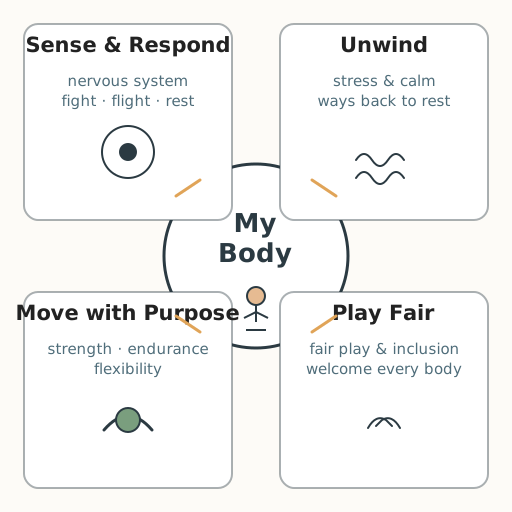
- Unit map card · 1 per learner A four-quadrant map of the unit (sense & respond, unwind, move with purpose, play fair) around a central "my body"
- Wonder slips · 3 per learner Small slips for writing questions to sort into the four quadrants
Low-tech / no-cost
- Voice and a shared surface Draw the four quadrants on any board or the ground and sort spoken questions into them; no slips needed
- A circle conversation Recall Grade 7 ideas aloud and collect wonders as a group rather than on paper
Enriched / lab & device
- Projected unit map · 1 Display the four-quadrant map large and editable so the group can add wonders live
- A short photo set · 1 set Four to six images — a person startled, a person breathing slowly, a person stretching, a group playing a game — one per quadrant
Works in different contexts
- large-group Do the recall and wonder-sort as a whole class on one large map, then pairs each write one wonder per quadrant
- multi-age Younger learners recall one Grade 7 idea; older learners also name the quadrant it belongs to and say why
- self-directed A learner reads the unit map, writes three wonders, and sorts each into a quadrant, then keeps them for the capstone
- level-grouped Learners ready to extend write a "wonder + guess" pair — a question and their current best answer to revisit later
- outdoor-only Use an outdoor place as the example — name something you can sense right there, one way to be calm there, and one way to move or play there
Lesson 1 — My Body, Movement & Wellness: Where We’ve Been, Where We’re Going
Summary
Learners open the unit by retrieving what they learned in Grade 7 and previewing the four quadrants of “My Body, Movement & Wellness.” They meet the unit map, write three wonders, and sort them into the quadrants — starting the unit portfolio they will add to every lesson.
Objectives
- Preview the unit’s four learning goals — explaining the nervous system’s fight, flight, or rest response; describing stress’s effect on the body and healthy ways to return to calm; designing a movement routine for strength, endurance, and flexibility; and demonstrating fair play and inclusive practices. (D03.S1.08.01, D03.S1.08.02, D03.S2.08.01, D03.S2.08.02 — preview)
Connection
Your body has been with you every single day of your life — sensing, moving, resting, and carrying your feelings. It can speed up to meet a sudden danger and slow down to rest, and it changes with how you live. This unit is a chance to understand that body from the inside, and to learn to care for it and move with it in ways that welcome every body around you.
Materials
- Unit map card
- Wonder slips
Preparation
- Copy the unit map card and wonder slips.
- Retrieval: from Grade 7, recall four ideas — internal body signals (D03.S1.07.01), how media images shape body feelings (D03.S1.07.02), game strategies like spacing and timing (D03.S2.07.01), and how movement changes during puberty (D03.S2.07.02). Each returns this unit, at a deeper level.
Facilitator note
This lesson is written to the learner (“you”). The ideas to land: (1) this unit has four quadrants — Sense & Respond, Unwind, Move with Purpose, and Play Fair — all meeting in one body; (2) we build on Grade 7, not start over; (3) wondering is the engine — learners begin by asking. Retrieval practice here is deliberate (spaced recall of last year’s ideas — Dunlosky et al. 2013, S-039); do not skip it. This unit is about the body, so teach it with dignity: never comment on any learner’s body, weight, or ability; never rank bodies or abilities; every body is “the right body” for this work. The ethics lens: how we treat our own and others’ bodies is a question of right and wrong. The egalitarian lens: ask early “who gets welcomed into movement and who gets left out” — it returns in Lesson 6. The global lens: bodies, games, and ways of caring for the body differ across peoples and places; keep the frame broad, never one region’s default. The technology & environment lens: screens, devices, and the places we can safely move all shape the body — this returns across the unit. Hold every wonder as valid; the goal is the asking.
Procedure
- Gather and recall (12 min). Think back to Grade 7. With a partner, recall: what internal body signals could you name (hunger, fatigue, stress)? How can media images shape how a person feels about their body? What game strategies — spacing, timing, teamwork — did you practice? How did movement change during puberty? Share one with the group.
- Meet the unit map (8 min). Look at the unit map. The unit has four quadrants: Sense & Respond, Unwind, Move with Purpose, and Play Fair — all around one my body. Notice the quadrants are not separate boxes; they are four ways of looking at one living body.
- Write your wonders (15 min). On three slips, write three things you wonder about your body’s sensing, your stress, your movement, or how people play together. There are no wrong wonders.
- Sort the wonders (10 min). Place each slip under the quadrant it belongs to. If it fits two quadrants, put it between them — that is where the best questions live.
- Close (5 min). Keep your wonders. At the end of the unit you will return to them and see what you now can say.
Differentiation
- Support: Give sentence starters (“I wonder what happens when ___”, “I wonder how I could ___”).
- Extension: Write a “wonder + guess” pair — your question and your current best answer — and mark it to check again at the capstone.
Assessment
- Formative (observation): Can the learner name the four quadrants and sort a wonder into one (or between two) with a reason?
- Portfolio artifact: The three wonder slips, kept as the first page of the unit portfolio.
Home connection
Ask someone at home: “What is one thing your body tells you, and one way you help it settle when life feels loud?” Bring their answer to mind as the unit unfolds.
Resources
- On spaced retrieval of prior learning: Dunlosky et al. (2013), Psychological Science in the Public Interest, https://doi.org/10.1177/1529100612453266 (S-039).