Lesson 02 — Fight, Flight, or Rest: How My Nervous System Senses and Responds
Learners explain the basic role of the nervous system in sensing and responding, tracing how a signal travels from the senses to the brain and out to the body, and naming the two branches of the response: sympathetic (fight-or-flight) and parasympathetic (rest-and-digest).
Objectives
Objectives
- D03.S1.08.01 Explain the basic role of the nervous system in sensing and responding, such as the fight, flight, or rest response.
Essential question
How does my nervous system sense what is around me and move me between fight, flight, and rest?
Key vocabulary
Materials
Standard materials
- Fight-flight-rest diagram · 1 per learner A diagram tracing a signal from the senses to the brain and out to the body, with two branches — fight/flight and rest
- Response cards · 1 set per group Cards naming body changes (faster heart, slower heart, tensed muscles, calm muscles, wide pupils) to sort under fight/flight or rest
Low-tech / no-cost
- Voice and a shared board Draw the two branches together and act out the body changes; no cards needed
- Your own pulse and breath Feel your pulse and breathing before and after a minute of stillness — no equipment needed
Enriched / lab & device
- A short animation · 1 An age-appropriate animation of the fight-or-flight and rest-and-digest response to watch and then retell
- A stethoscope or pulse oximeter · 1 per group To hear or read a real resting and raised heart rate (used with consent and care, never competitively)
Works in different contexts
- large-group Sort the response cards as a class, then pairs each trace one signal's path and report
- multi-age Younger learners sort two cards; older learners trace the full path and name which branch fired
- self-directed A learner reads the diagram, sorts the cards, and writes the path a signal takes from sense to response
- level-grouped Learners ready to extend explain why the same signal can trigger fight/flight in one moment and rest in another
- outdoor-only Notice a real startle outdoors (a sudden sound or movement) and trace what your body does, then settle it with slow breaths
Lesson 2 — Fight, Flight, or Rest: How My Nervous System Senses and Responds
Summary
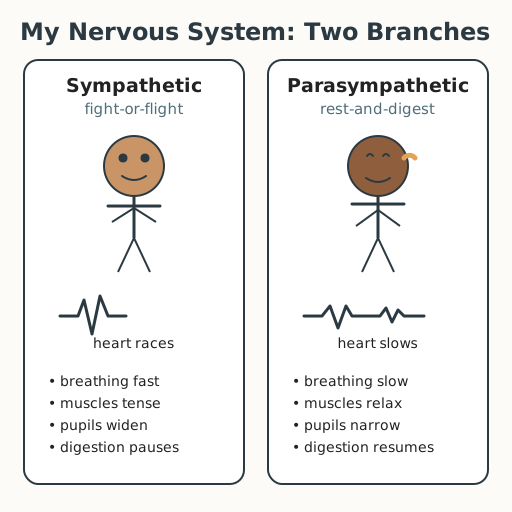
Learners explain the basic role of the nervous system in sensing and responding. They trace a signal from the senses to the brain and spinal cord and out to the body, and name the two branches of the automatic response — sympathetic (fight-or-flight) and parasympathetic (rest-and-digest) — sorting body changes into the right branch.
Objectives
- Explain the basic role of the nervous system in sensing and responding, such as the fight, flight, or rest response. (D03.S1.08.01)
Connection
A door slams behind you and you jump before you even think. Your heart thuds, your breath quickens, your muscles tighten — in under a second, your body has decided you might be in danger and readied you to fight or run. A few minutes later, curled up safe, your breath slows and your shoulders drop. That switch — from alarm to calm — is your nervous system doing its job. Today you trace how it works.
Materials
- Fight-flight-rest diagram
- Response cards
Preparation
- Copy the fight-flight-rest diagram and response cards.
- Retrieval: from Grade 7, recall the internal body signals you learned to notice (D03.S1.07.01 — hunger, fatigue, stress). Today we add the machinery underneath those signals: the nervous system.
Facilitator note
This lesson is written to the learner (“you”). The ideas to land: (1) the nervous system senses (senses pick up information), sends it to the brain and spinal cord, and responds by changing the body; (2) the automatic response has two branches — sympathetic (fight-or-flight: faster heart and breath, tensed muscles, wide pupils, digestion paused) and parasympathetic (rest-and-digest: slower heart and breath, relaxed muscles, digestion resumed); (3) both are healthy and necessary — danger needs alarm, safety needs calm; neither is “bad.” Model the signal path once as a worked example (S-011): sense → brain/spinal cord → response. The scientific account (S-339, S-338) describes the sympathetic and parasympathetic branches; hold it as a well-supported scientific story, and note that many cultures have long described the body’s alarm and calm in their own words (philosophy §11) — held side by side, not ranked. The ethics lens: knowing our own alarm is the first step to meeting it kindly. The egalitarian lens: bodies sense and respond in varied ways — some nervous systems alarm more easily, and that is a fact about a person, never a fault. The global lens: every human body shares this wiring, whatever the place or culture. The technology & environment lens: loud screens, alerts, and unsafe places can keep the alarm switched on — a preview of Lesson 3. The critical-thinking lens: “the brain readies the body before conscious thought” is a checkable scientific fact (S-339), not a guess. Safeguarding: never deliberately startle a learner to demonstrate this; use recalled examples and the diagram instead. Accessibility: the startle example can be told in any mode — a sudden movement, a bright light, or a tap on the shoulder — so learners who are deaf or hard of hearing follow it as fully as those who hear a bang; and the diagram’s meaning lives in its labels and in your spoken trace of the path, so a learner who cannot see the diagram can follow the same signal path in words, by sorting the response cards aloud, or with a tactile two-column chart.
Procedure
- Recall (5 min). From Grade 7: what internal body signals could you name? Today we look at the system underneath them.
- Meet the nervous system (8 min). Your nervous system has a sensing side and a responding side. Senses — eyes, ears, skin, nose, tongue — pick up what is around you. Nerves carry that message to your brain and spinal cord, which decide, and send a response back out.
- Watch it modeled — a signal’s path (12 min). Trace one example: you hear a sudden loud bang. (1) Sense: your ears pick up the sound. (2) Send: nerves carry it to the brain. (3) Decide: the brain reads it as possible danger. (4) Respond: the sympathetic branch switches on — heart beats faster, breathing quickens, muscles tense, pupils widen, and digestion pauses. Your body is ready to fight or flee. Later, safe again, the parasympathetic branch takes over — heart and breath slow, muscles relax, digestion resumes. That is rest-and-digest.
- Sort the responses (15 min). With a group, sort the response cards into two columns: fight-or-flight, or rest-and-digest. For each card, say what the body is doing and why it helps (alarm or calm).
- Close (10 min). Feel your own pulse and breath — if finding your pulse is hard, simply notice your breath rising and falling. Sit still for one slow minute and feel them again. Remember: your body has two gears — alarm and calm — and both keep you alive.
Differentiation
- Support: Provide a pre-labeled two-column chart and two cards; sort and match them to the branch.
- Extension: Explain why the same signal (a loud sound) can trigger fight-or-flight one moment and, once you recognize it as harmless, rest another.
Assessment
- Formative (observation): Can the learner trace a signal’s path (sense → brain/spinal cord → response) and sort body changes into fight-or-flight or rest?
- Portfolio artifact: The completed fight-flight-rest diagram, kept in the portfolio.
Home connection
With someone at home, recall a moment you were startled and a moment you felt completely calm. Which branch — alarm or calm — was switched on in each?
Resources
- On the sympathetic and parasympathetic response: Cleveland Clinic, “What Happens During Fight-or-Flight Response?,” https://health.clevelandclinic.org/what-happens-to-your-body-during-the-fight-or-flight-response (S-339).
- On the acute stress response and the body: American Psychological Association, “Stress effects on the body,” https://www.apa.org/topics/stress/body (S-338).
- On explicit instruction and worked examples: Kirschner, Sweller & Clark (2006), https://doi.org/10.1207/s15326985ep4102_1 (S-011).