Lesson 07 — Capstone: My Body, My Wellness, My Choice
The unit capstone. Learners retrieve the unit's four ideas, revisit the wonders they wrote in Lesson 1, and assemble a personal wellness-and-movement plan — a stress signal and calm practice, one movement for each quality, and one way to make play welcoming — read through all four lenses.
Objectives
Objectives
- D03.S1.08.01 Explain the basic role of the nervous system in sensing and responding, such as the fight, flight, or rest response.
- D03.S1.08.02 Describe how stress affects the body over time and name healthy ways to help the body return to calm.
- D03.S2.08.01 Design a short movement routine and explain how each part builds strength, endurance, or flexibility.
- D03.S2.08.02 Demonstrate fair play and inclusive practices that welcome peers of all abilities into movement and games.
Essential question
How do the unit's ideas fit together — sensing, unwinding, moving with purpose, and playing fairly — into the way I care for my body and welcome every body?
Key vocabulary
Materials
Standard materials
- Wellness-and-movement plan · 1 per learner A one-page plan — one stress signal and a calm practice, one movement for each quality, and one way to make play welcoming
- Unit map (from Lesson 1) · 1 per learner The learner's own Lesson 1 unit map and wonder slips, returned for reflection
Low-tech / no-cost
- Voice and a shared board Build the plan together as a spoken circle, each learner contributing one line
- Wonder slips revisited Return to the Lesson 1 wonders and answer them aloud; no new paper needed
Enriched / lab & device
- A digital slide or poster · 1 Learners assemble their plan into a small poster or slide to share
- A gallery walk · 1 Post the completed plans around the room and walk to read each other's choices
Works in different contexts
- large-group Build one shared plan on the board from volunteered lines, then each learner writes their own copy
- multi-age Younger learners complete the calm-practice and movement lines; older learners add the fair-play line with a reason
- self-directed A learner revisits their wonders, writes the plan, and checks each line is real, specific, and their own
- level-grouped Learners ready to extend add a "what I will check back on in a month" line to their plan
- outdoor-only Build the plan while looking at a real place — name one thing about your body you now understand better and one choice you will make for it
Lesson 7 — Capstone: My Body, My Wellness, My Choice
Summary
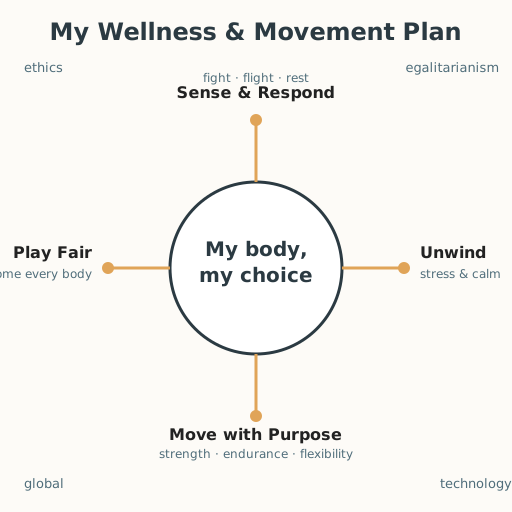
The unit capstone brings all four quadrants together. Learners retrieve the unit’s ideas, revisit the wonders they wrote in Lesson 1, and assemble a personal wellness-and-movement plan read through all four lenses — ethics, egalitarianism, global, and technology & environment.
Objectives
- Synthesize the unit’s four goals — sensing and responding, unwinding, moving with purpose, and playing fairly — into one coherent view of caring for one’s own body and welcoming every body. (D03.S1.08.01, D03.S1.08.02, D03.S2.08.01, D03.S2.08.02 — synthesis)
Connection
For seven days you have looked at one body through four windows: how it senses and responds, how it settles from stress, how it grows stronger and freer through movement, and how it plays fairly with others. Now you bring those windows together. Understanding is not the finish line — it is the starting point for choosing. Today you write down how you will care for your own body and welcome every body around you.
Materials
- Wellness-and-movement plan
- Unit map (from Lesson 1)
Preparation
- Copy the wellness-and-movement plan.
- Return each learner’s Lesson 1 unit map and wonder slips.
- Retrieval: this lesson is itself a spaced, interleaved retrieval pass across the whole unit (Dunlosky et al. 2013, S-039) — it works because learners must recall, not re-read.
Facilitator note
This lesson is written to the learner (“you”). The ideas to land: (1) the four quadrants are one thing — sensing, unwinding, moving, and playing all meet in how we care for a body; (2) the four lenses (ethics, egalitarianism, global, technology & environment) are how we check those choices; (3) a plan is a promise to yourself, and it must fit your own body — no body is the wrong body. This is a summative moment, but mastery is personal, not ranked — celebrate growth, never compare learners or bodies. The ethics lens: “what is right in how I treat my body and others’?” The egalitarian lens: “does my way of moving and playing welcome every body, or leave some out?” The global lens: “which practices from many cultures do I draw on, and do I honor them?” The technology & environment lens: “do my screens and my places help or hurt my body, and what will I choose?” Assess by what each learner can now explain and choose, not by a score. Keep hope and agency central — the unit ends on what each learner can do.
Procedure
- Recall the whole unit (10 min). With a partner, recall the four ideas: how the nervous system senses and moves between fight, flight, and rest; how stress affects the body over time and how to unwind; what strength, endurance, and flexibility build; and what fair play and inclusion look like. Name them without looking.
- Revisit your wonders (8 min). Open your Lesson 1 map and wonder slips. Which wonders can you now answer? Which have grown into new questions? Answer one you can, and mark one to keep wondering about.
- Build your plan (20 min). On your plan, write: (1) one stress signal you notice in your body and one calm practice you will use; (2) one movement for each quality — strength, endurance, flexibility; (3) one way you will make a game or movement welcoming to every body; (4) one choice about your screens or your spaces that helps your body.
- Run it through the lenses (7 min). Check your plan: Is it right (ethics)? Does it welcome every body (egalitarianism)? Does it draw on and honor practices from more than one culture (global)? Does it account for technology and place (technology & environment)? Adjust one line.
- Close (5 min). Share one line you are proud of. Remember: your body is yours to understand and to care for — and so is the choosing.
Differentiation
- Support: Provide sentence starters for each line (“One calm practice I will use is ___ because ___”).
- Extension: Add a “what I will check back on in a month” line, naming how you will know if it is helping.
Assessment
- Summative (portfolio + self): The completed wellness-and-movement plan is the unit’s capstone artifact, kept in the portfolio.
- Self-assessment: Learners mark one line they feel confident explaining and one line they want to keep learning about — “not yet” is information, never a verdict.
Home connection
Share your plan with someone at home, and invite them to add one line of their own — one choice they will make to care for their body or welcome every body.
Resources
- On spaced, interleaved retrieval as a capstone: Dunlosky et al. (2013), Psychological Science in the Public Interest, https://doi.org/10.1177/1529100612453266 (S-039).
- On explicit instruction and worked examples for novice skills: Kirschner, Sweller & Clark (2006), https://doi.org/10.1207/s15326985ep4102_1 (S-011).