Lesson 06 — Fair Play: Movement That Welcomes Every Body
Learners demonstrate fair play and inclusive practices that welcome peers of all abilities into movement and games. They name the habits of fair play and adapt a simple game so everyone can join, then play their adapted version.
Objectives
Objectives
- D03.S2.08.02 Demonstrate fair play and inclusive practices that welcome peers of all abilities into movement and games.
Essential question
How do I play fairly and adapt games and movement so every ability is welcomed?
Key vocabulary
Materials
Standard materials
- Game-adaptation cards · 1 set per group Cards describing a simple game plus ways to adapt it (change equipment, rules, roles, or pace) to welcome every ability
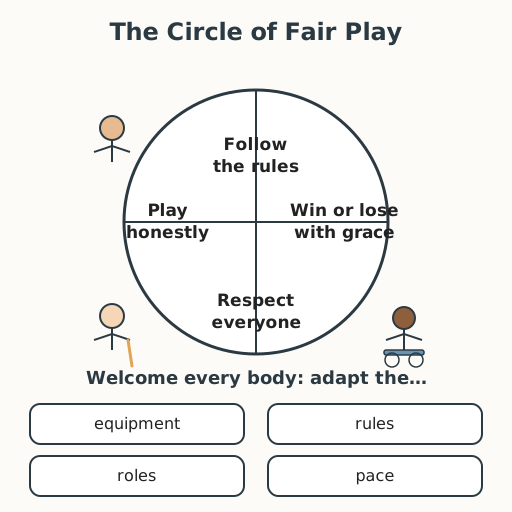
- Fair-play circle sheet · 1 per learner A circle diagram of fair play — follow the rules, play honestly, respect everyone, win or lose with grace — with room to add one inclusive practice
Low-tech / no-cost
- Voice, bodies, and open space Play and adapt a game with only people and space; no cards or equipment needed
- Found objects Use a scarf, a rolled cloth ball, or a chalk circle as adaptable game equipment
Enriched / lab & device
- Adapted-game video clips · 1 set Short clips of adapted and inclusive sport (seated versions, goalball, wheelchair sport) to discuss
- A classroom "inclusive game library" · 1 A growing set of learner-written game adaptations kept for everyone to use
Works in different contexts
- large-group Adapt one game as a whole class, then groups each adapt another and share back
- multi-age Younger learners name one fair-play rule; older learners design one adaptation and say who it welcomes
- self-directed A learner completes the fair-play circle and writes one way to adapt a favorite game for a friend of a different ability
- level-grouped Learners ready to extend design a game from scratch that anyone can play, and write its rules
- outdoor-only Adapt a real outdoor game to the space and people present, welcoming every ability into it
Lesson 6 — Fair Play: Movement That Welcomes Every Body
Summary
Learners demonstrate fair play and inclusive practices that welcome peers of all abilities into movement and games. They name the habits of fair play, adapt a simple game so every ability can join, and play their adapted version together.
Objectives
- Demonstrate fair play and inclusive practices that welcome peers of all abilities into movement and games. (D03.S2.08.02)
Connection
Every game carries a quiet promise: that everyone who plays is safe, respected, and able to join in. When a game leaves someone out — because they cannot reach the ball, keep the pace, or stand the whole time — the promise is broken, and it is usually the rules, not the person, that are the problem. The good news is that rules can change. Today you learn to play fairly, and to change games so every body is welcomed.
Materials
- Game-adaptation cards
- Fair-play circle sheet
Preparation
- Copy the game-adaptation cards and fair-play circle sheet.
- Retrieval: from Grade 6, recall working cooperatively with teammates and encouraging others regardless of skill level (D03.S2.06.02). Today we add adapting the game itself so everyone can join.
Facilitator note
This lesson is written to the learner (“you”). The ideas to land: (1) fair play is a set of habits — follow the rules, play honestly, respect everyone (teammates, opponents, and the spirit of the game), and win or lose with grace; (2) inclusion is a practice — adapt the equipment, rules, roles, or pace so every ability can join; (3) it is the game that should bend to fit people, never people who must bend to fit the game. Model one adaptation as a worked example, then let learners adapt and play (S-011). The UNESCO International Charter frames physical activity and sport as a fundamental right for all, to be practiced inclusively (S-342); hold it as a shared value we act on. This is the unit’s heart for egalitarianism — who gets welcomed and who gets left out. Never frame inclusion as “helping the less able”; frame it as fixing a game whose rules were never designed for everyone. No ranking, no elimination games, no using bodies as the measure of worth. The ethics lens: fair play is right conduct — honesty and respect are chosen, every time. The egalitarian lens: a game is only fair if every body can play; ask “who is left out, and how do we change the game, not the person?” The global lens: games differ across the world — mancala-family counting games such as Ayo (West Africa) and Pallanguli (South India), Kabaddi (South Asia), sepak takraw (Southeast Asia), and countless others — and many traditional games already mix ages and abilities, welcoming players of different ages and bodies. The technology & environment lens: some games need expensive equipment or special fields, which quietly exclude; low-tech, adaptable play opens the door wider. The critical-thinking lens: “the rules leave someone out” is a claim you can check and fix; “that person isn’t suited to games” is a false claim we refuse.
Procedure
- Recall (5 min). From Grade 6: how did you encourage teammates regardless of skill level? Today we adapt the game itself.
- Meet fair play (10 min). Fair play means: follow the rules you all agreed on; play honestly (no cheating, no pretending the ball was in when it was out); respect everyone — teammates, opponents, and the game itself; and win or lose with grace (a win is not a chance to gloat, a loss is not a verdict on your worth).
- Learn to adapt (10 min). Look at the game-adaptation cards. To welcome every ability, change one of four things: the equipment (a bigger, softer, or brighter ball), the rules (allow two bounces, or let a pass replace a throw), the roles (a player who calls, times, or officiates), or the pace (slower, with rests). The game bends; the person doesn’t have to.
- Adapt and play a game (20 min). In your group, choose a simple game and adapt it once so that a friend who moves, sees, hears, or thinks differently can join fully. Play your adapted version. Notice how it feels when everyone is in.
- Close (5 min). Remember: a fair game welcomes every body — and we are the ones who make it welcome.
Differentiation
- Support: Provide a pre-written adaptation and ask the learner to name who it welcomes and why.
- Extension: Design a brand-new game from scratch that anyone can play, and write its rules and one inclusive adaptation.
Assessment
- Formative (performance + observation): Can the learner name the habits of fair play and adapt one game rule or piece of equipment so a peer of a different ability can join?
- Portfolio artifact: The completed fair-play circle sheet, kept in the portfolio.
Home connection
Ask someone at home about a game they loved as a child, and think together about one way to adapt it so someone of a different ability could play too.
Resources
- On physical activity and sport as a right for all, practiced inclusively: UNESCO, “International Charter of Physical Education, Physical Activity and Sport,” https://www.unesco.org/en/sport-and-anti-doping/international-charter-sport (S-342).
- On cooperation and social awareness: CASEL, “Fundamentals of SEL,” https://casel.org/fundamentals-of-sel/ (S-001).
- On explicit instruction and worked examples: Kirschner, Sweller & Clark (2006), https://doi.org/10.1207/s15326985ep4102_1 (S-011).