Lesson 01 — Relationships, Empathy & Conflict: Where We've Been, Where We're Going
Learners open the unit by retrieving what they learned in Grade 7 — boundaries, repair, empathy across difference, and mutual aid — and previewing the four strands of "Relationships, Empathy & Conflict." They meet the unit map, write three wonders, and sort them into the strands, starting the unit portfolio they will add to every lesson.
Objectives
Objectives
- D02.S1.08.01 Analyze how tone, body language, and digital messages can change meaning in communication.
- D02.S1.08.02 Manage conflict in a group by facilitating discussion and seeking a solution all can accept.
- D02.S2.08.01 Analyze a conflict from multiple perspectives, including ones they disagree with.
- D02.S2.08.02 Recognize bias and stereotypes that can block empathy, and question them.
- D02.S3.08.01 Analyze how power and resources are shared within a community and who is left out.
- D02.S3.08.02 Take part in strengthening belonging in their school or local community.
- D02.S4.08.01 Analyze how systems of care and mutual aid operate and what makes them fair or unfair.
- D02.S4.08.02 Distinguish charity from mutual aid and solidarity, and explain the difference.
Essential question
What are we going to learn about relationships, empathy, and conflict — and what do we already know from Grade 7?
Key vocabulary
Materials
Standard materials
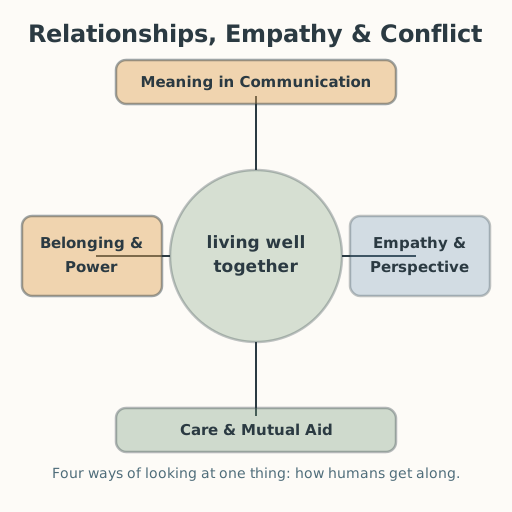
- Unit map card · 1 per learner A four-strand map of the unit (meaning, perspective, belonging, care) around a central "living well together"
- Wonder slips · 3 per learner Small slips of paper for writing questions to sort into the four strands
Low-tech / no-cost
- Voice and a shared surface Draw the four strands on any board or the ground and sort spoken questions into them; no slips needed
- A circle conversation Recall Grade 7 ideas aloud and collect wonders as a group rather than on paper
Enriched / lab & device
- Projected unit map · 1 Display the four-strand map large and editable so the group can add wonders live
- A short photo or clip set · 1 set Four to six images — a tense conversation, a text thread, a circle talking, a community action — one per strand, to spark wondering
Works in different contexts
- large-group Do the recall and wonder-sort as a whole class on one large map, then pairs each write one wonder per strand
- multi-age Younger learners recall one Grade 7 idea; older learners also name the strand it belongs to and say why
- self-directed A learner reads the unit map, writes three wonders, and sorts each into a strand, then keeps them for the capstone
- level-grouped Learners ready to extend write a "wonder + guess" pair — a question and their current best answer to revisit later
- outdoor-only Use an outdoor place as the "living well together" example — name a way people communicate, a group, and an act of care you can see right there
Lesson 1 — Relationships, Empathy & Conflict: Where We’ve Been, Where We’re Going
Summary
Learners open the unit by retrieving what they learned in Grade 7 and previewing the four strands of “Relationships, Empathy & Conflict.” They meet the unit map, write three wonders, and sort them into the strands — starting the unit portfolio they will add to every lesson.
Objectives
- Preview the unit’s eight learning goals — how tone, body language, and digital messages change meaning; facilitating conflict toward a solution all can accept; analyzing a conflict from multiple perspectives; questioning bias and stereotype; analyzing power and resources and who is left out; strengthening belonging; analyzing systems of care and mutual aid; and distinguishing charity from mutual aid and solidarity. (D02.S1.08.01, D02.S1.08.02, D02.S2.08.01, D02.S2.08.02, D02.S3.08.01, D02.S3.08.02, D02.S4.08.01, D02.S4.08.02 — preview)
Connection
Every day you live inside relationships — with family, friends, classmates, neighbors, and people you have never met but whose messages reach you through a screen. In those relationships, meaning can get tangled, feelings can get hurt, and some people can be left out while others hold the power. None of this is fixed; all of it is something you can learn to do better. Today you begin a journey through four big questions about how we communicate, how we understand each other, how we belong, and how we care — alone and together.
Materials
- Unit map card
- Wonder slips
Preparation
- Copy the unit map card and wonder slips.
- Retrieval: from Grade 7, recall four ideas — boundaries (D02.S1.07.01), repair after a disagreement (D02.S1.07.02), empathy across difference (D02.S2.07.02), and a mutual-aid action (D02.S4.07.01). Each returns this unit, at a deeper level.
Facilitator note
This lesson is written to the learner (“you”). The ideas to land: (1) this unit has four strands — Meaning in Communication, Empathy & Perspective, Belonging & Power, and Care & Mutual Aid — and they all meet in one aim, “living well together”; (2) we are building on Grade 7, not starting over; (3) wondering is the engine — learners begin by asking, not by being told. Retrieval practice here is deliberate (spaced recall of last year’s ideas — see Dunlosky et al. 2013, S-039); do not skip it. The ethics lens: living well together is a question of what is right toward others. The egalitarian lens: ask early “who is included and who is left out” — it will return every lesson. The global & anthropological lens: people everywhere have their own ways of communicating, belonging, and caring; keep the frame broad, never one region’s default. The technology & environment lens: the screen now sits inside our relationships — it changes how meaning travels, and we will examine that honestly. The social-emotional and community lenses (D02’s own) run underneath all four strands. Hold every wonder as valid; the goal is the asking, not the answer.
Procedure
- Gather and recall (12 min). Think back to Grade 7. With a partner, recall: What does it mean to set and respect a boundary? What are the steps to repair a relationship after a disagreement? What did “empathy across difference” ask you to do? What was a mutual-aid action you learned about or joined? Share one with the group.
- Meet the unit map (8 min). Look at the unit map. The unit has four strands: Meaning in Communication, Empathy & Perspective, Belonging & Power, and Care & Mutual Aid — all around one aim: living well together. Notice the strands are not separate boxes; they are four ways of looking at one thing: how humans get along.
- Write your wonders (15 min). On three slips, write three things you wonder about how we communicate, understand each other, belong, or care. There are no wrong wonders.
- Sort the wonders (10 min). Place each slip under the strand it belongs to. If it fits two strands, put it between them — that is where the best questions live.
- Close (5 min). Keep your wonders. At the end of the unit you will return to them and see what you now can say.
Differentiation
- Support: Give sentence starters (“I wonder what happens when ___”, “I wonder who gets left out when ___”).
- Extension: Write a “wonder + guess” pair — your question and your current best answer — and mark it to check again at the capstone.
Assessment
- Formative (observation): Can the learner name the four strands and sort a wonder into one (or between two) with a reason?
- Portfolio artifact: The three wonder slips, kept as the first page of the unit portfolio.
Home connection
Ask someone at home: “When our family talks something over, how do we make sure everyone is heard — and who usually is not?” Bring their answer to mind as the unit unfolds.
Resources
- On spaced retrieval of prior learning: Dunlosky et al. (2013), Psychological Science in the Public Interest, https://doi.org/10.1177/1529100612453266 (S-039).
- On the social-emotional competencies this unit practices (social awareness, relationship skills): CASEL, “Fundamentals of SEL,” https://casel.org/fundamentals-of-sel/ (S-001).