Lesson 02 — More Than Words: How Tone and Body Language Change Meaning
Learners discover that meaning lives in more than words: the same sentence, spoken with a different tone and body, can mean warm agreement, cold dismissal, or anger. They learn that tone and body language are patterned and learned (and differ across cultures), then practice reading and sending clear, honest nonverbal messages.
Objectives
Objectives
- D02.S1.08.01 Analyze how tone, body language, and digital messages can change meaning in communication.
Essential question
How do tone of voice and body language change the meaning of the same words?
Key vocabulary
Materials
Standard materials
- Same-words card · 1 per pair A short sentence (for example, "Fine" or "Sure, whatever you like") to say several ways, plus a place to record what each way means
- Meaning chart · 1 per pair A three-column chart — the words, the tone and body, and what the message really means
Low-tech / no-cost
- Voice and body only Say the same sentence aloud several ways and read each other's meaning; no cards needed
- Written and drawn tone markers Express tone without voice or sight — punctuation, a drawn face, a posture sketched as a stick figure, or a feelings word — so deaf, non-speaking, and low-vision learners use an equal pathway; no devices needed
- A shared surface Draw the three-column chart on any board or the ground
Enriched / lab & device
- A recorded clip · 1 A short age-appropriate film or audio clip of the same line delivered two opposite ways, to notice the difference
- A digital voice memo · 1 per pair Record the same sentence two ways and listen back to compare
Works in different contexts
- large-group Model the mismatch once to the whole group, then pairs practice with one sentence each and report one finding
- multi-age Younger learners match a tone to a feeling; older learners explain how the same words can mean opposite things and why
- self-directed A learner records or imagines the same sentence three ways, writes what each means, and self-checks the mismatch
- level-grouped Learners ready to extend find a real example (a conversation, a line of a song or play) where tone changed the words and analyze it
- outdoor-only Practice posture and gesture across a space (near/far, turned toward/away) and notice how distance and stance change meaning
Lesson 2 — More Than Words: How Tone and Body Language Change Meaning
Summary
Learners discover that meaning lives in more than words: the same sentence, spoken with a different tone and body, can mean warm agreement, cold dismissal, or anger. They learn that tone and body language are patterned and learned (and differ across cultures), then practice reading and sending clear, honest nonverbal messages.
Objectives
- Analyze how tone of voice and body language can change the meaning of the same words. (D02.S1.08.01)
Connection
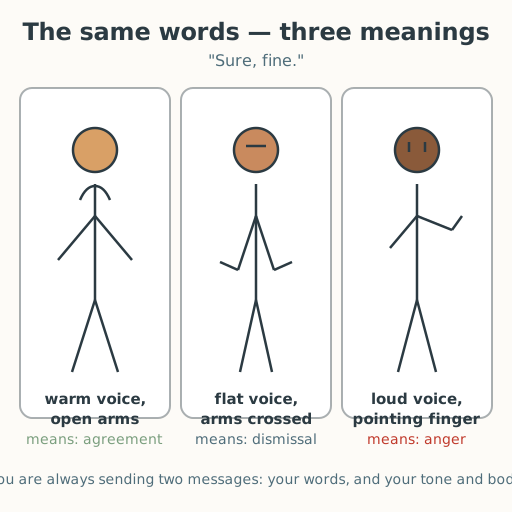
Think of the single word “fine.” One person says it with a warm voice and open hands — it means “I’m okay, and I’m with you.” Another says it flat, arms crossed, looking away — it means “I am not fine, and I am closing the door.” The words are identical; the message is opposite. In a family kitchen, a market stall, a field, or a classroom, meaning rides on more than words. Today you learn to read and send that hidden layer.
Materials
- Same-words card
- Meaning chart
Preparation
- Copy the same-words card and meaning chart.
- Retrieval: recall Grade 7’s work on reading a boundary and speaking “I” statements. Tone and body are how a boundary is felt before it is spoken.
Facilitator note
This lesson is written to the learner (“you”). The ideas to land: (1) meaning is carried by more than words — tone and body language change what the same sentence means; (2) tone and body language are patterned and learned, and the patterns differ across families and cultures — so we ask and check rather than assume (Ekman & Friesen 1969, S-160); (3) honesty and kindness ask us to make our tone and body match our words, and to check when they might not. Model the mismatch once as a worked example (S-011) before pairs practice. Safety: no learner is asked to act out real anger or real hurt; use the invented sentence and neutral examples only. Accessibility: meaning lives in more than words in every way of communicating, so no learner needs a speaking voice or working eyes and ears to join. In a signed language, tone lives in the face, in how large, fast, and sharp the signs are, and in body posture; in an AAC device or in writing, it lives in word choice, punctuation, and emphasis. Offer each learner a path that fits: learners who are deaf or hard of hearing read and send tone through facial expression, sign intensity, or written tone markers (punctuation, a drawn face, a label like “warm” or “flat”); learners who are blind or low vision name the tone aloud and learn posture by describing it in words or copying the shape with their own body; learners who use AAC or do not speak convey tone by choosing words and emphasis on their device or by pointing to a feelings word. Nobody is asked to produce a voice they do not use or to read a face they cannot see. The ethics lens: a message can hurt or heal depending on how it is said, not only what is said. The egalitarian lens: the same words from someone with more power can land harder than from someone with less — noticing power is part of reading meaning. The global & anthropological lens: display rules for tone and body differ across cultures and even families (Ekman & Friesen, S-160) — eye contact, gesture, and silence mean different things in different places, so “read the room” means “check, don’t assume.” The technology & environment lens: this lesson sets up the next one — on a screen, tone and body are often missing, and meaning gets even more fragile. The critical-thinking lens: distinguish what a person said from what the message meant, and be willing to check your guess.
Procedure
- Recall (5 min). In Grade 7 you learned to read a boundary and speak an “I” statement. Say to a partner: what makes an “I” statement different from blame?
- Meet the same-words card (10 min). Look at the sentence: “Sure, fine.” Say it three ways — warm and open; flat with arms crossed; loud with a pointed finger. Each time, the words are the same, but the meaning changes: agreement, dismissal, anger. Tone is how the voice sounds; body language is posture, gesture, face, and distance.
- Model it (10 min). Watch the mismatch be worked: the facilitator says “I’m not angry” with a tight jaw, crossed arms, and a hard voice. Ask: which do you believe — the words or the tone and body? When they clash, people believe the tone and body, and trust cracks.
- Practice in pairs (15 min). One partner says the sentence with a chosen tone and body; the other records on the meaning chart: the words, the tone and body, the meaning. Then swap. Try at least three different meanings. Check your guess with your partner — did they mean what you read?
- Close (5 min). Share one finding. Remember: you are always sending two messages at once — your words, and your tone and body. Make them match.
Differentiation
- Support: Provide a word bank of tones (warm, flat, sharp, worried, playful) to choose from before speaking.
- Alternative modes: Let a learner send tone however they can — sign, a drawn face, a written word with punctuation, or a described posture — and read tone back the same way; the skill is noticing the layer beyond the words, not producing a specific voice or face.
- Extension: Find a real example — a line from a song, play, or conversation — where tone changed the meaning, and write one sentence analyzing how.
Assessment
- Formative (observation): Can the learner name tone and body language as carriers of meaning and give one example of the same words meaning two different things?
- Performance: The pair practice, observed for whether the learner checks their reading with their partner rather than assuming.
Home connection
At home this week, listen for one sentence said two different ways (for example, “fine,” “okay,” “later”). Ask yourself: what did the tone and body say that the words did not?
Resources
- On nonverbal behavior as patterned, learned, and varying across cultures: Ekman & Friesen, “The Repertoire of Nonverbal Behavior,” Semiotica 1(1), 1969 (S-160).
- On explicit instruction and worked examples for novice skills: Kirschner, Sweller & Clark (2006), https://doi.org/10.1207/s15326985ep4102_1 (S-011).
- On the social-emotional competencies of social awareness and relationship skills: CASEL, https://casel.org/fundamentals-of-sel/ (S-001).