Lesson 07 — Who Is Left Out? Power and Resources in a Community
Learners analyze how power and resources are shared in a community and who is left out, using a four-question tool: who decides, who receives, who is not at the table, and why. They learn to distinguish individual acts from structural causes — where someone is born, how work and pay and access are arranged — without ever measuring a person's worth by their resources.
Objectives
Objectives
- D02.S3.08.01 Analyze how power and resources are shared within a community and who is left out.
Essential question
How are power and resources shared in a community, and who is left out — and why?
Key vocabulary
Materials
Standard materials
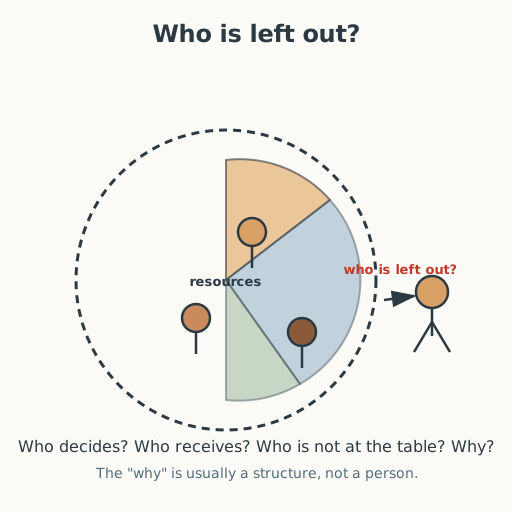
- Resource-sharing map · 1 per group A diagram of one community's shared resources (space, time, information, money, voice) and who decides and receives them
- "Who is left out" questions · 1 per group A short question set — who decides? who receives? who is not at the table? why? — to run on the map
Low-tech / no-cost
- Voice and a shared surface Draw the map on any board or the ground and answer the questions aloud; no cards needed
- The room or place itself Use your own classroom, school, or neighborhood as the community to analyze
Enriched / lab & device
- A data page · 1 per group A short age-appropriate data summary (for example, on who has and lacks a resource) from a vetted source, to ground the analysis
- A guest or interview · 1 A community worker or organizer to talk with about who is served and who is missed
Works in different contexts
- large-group Analyze one community together on the board, then small groups each analyze one resource and report who is left out
- multi-age Younger learners name who has a resource and who does not; older learners name who decides and why, and connect it to structural causes
- self-directed A learner maps their own school or neighborhood and answers the four questions in writing
- level-grouped Learners ready to extend compare two communities (or one community over time) and explain what changed who was left out
- outdoor-only Walk the actual place — the field, the water point, the path — and ask who can reach it and who cannot, and why
Lesson 7 — Who Is Left Out? Power and Resources in a Community
Summary
Learners analyze how power and resources are shared in a community and who is left out, using a four-question tool: who decides, who receives, who is not at the table, and why. They learn to distinguish individual acts from structural causes — where someone is born, how work and pay and access are arranged — without ever measuring a person’s worth by their resources.
Objectives
- Analyze how power and resources are shared within a community and who is left out. (D02.S3.08.01)
Connection
In every community, some things are shared — a classroom’s supplies, a village’s water, a city’s spaces, a family’s time and money — and some people decide how they are shared while others do not. It is not random: the ones who decide are usually the ones with more power, and the ones left out are often the ones already carrying less. Seeing this clearly — who is at the table, who is missing, and why — is the first step toward sharing more fairly. Today you learn to see it.
Materials
- Resource-sharing map
- “Who is left out” questions
Preparation
- Copy the resource-sharing map and questions.
- Retrieval: recall Grade 7’s work on communities changing, and Grade 6’s “why some have more than they need while others lack.” Today you turn that into a structured analysis of one community.
Facilitator note
This lesson is written to the learner (“you”). The ideas to land: (1) power is the ability to influence who gets what, and resources are the things a community shares — space, time, information, money, and voice; (2) to see who is left out, ask four questions: who decides, who receives, who is not at the table, and why; (3) the “why” is usually structural — where someone is born, how work and pay and access are arranged — not a measure of anyone’s worth. Widely documented data show poverty and inequality are driven largely by structural, place-based factors rather than individual merit (World Bank, S-234; UNDP, S-283); hold the value commitment separately — “no person’s worth is measured by their resources” is a value, not a statistic. Model the map once (S-011). Keep it concrete and non-shaming: analyze systems, not classmates; use invented or public examples, never call out an individual learner’s family. The ethics lens: fairness asks whether the sharing is just, not just whether it is orderly. The egalitarian lens: the whole point is to notice the people the arrangement forgets — the quieter, the poorer, the newcomer, the one whose needs are invisible. The global & anthropological lens: different communities share differently — a commons, a council, a market, a state — and each has its own pattern of who is left out; compare without ranking. The technology & environment lens: technology can widen or narrow the gap (who can pay for data, who can reach the well or the clinic) — ask how tools change access here. The critical-thinking lens: separate individual actions from structural causes — one person’s choice is not the same as a system that sorts who gets what.
Procedure
- Recall (5 min). In Grade 6 you asked why some people have more than they need while others lack. Say to a partner: what did you learn was the bigger cause — a person’s choices, or the structures around them? Today we analyze one community in detail.
- Meet the four questions (10 min). Look at the resource-sharing map and the question set. Pick one shared resource in a community. Ask four questions: Who decides? Who receives? Who is not at the table? Why? The fourth question is the important one — it usually points to a structure, not a person.
- Model it (10 min). Watch a community be analyzed: A school has one after-hours study room, and only the sports teams get keys. Who decides? The staff who run the teams. Who receives? The team members. Who is not at the table? Students who work after school, or who care for siblings, or who were never invited to join a team. Why? The room’s schedule was built around one group’s needs without asking the rest. Notice: nobody here is evil — the arrangement is what leaves people out.
- Analyze in groups (20 min). Choose a community you know — your school, neighborhood, or an invented one. Pick one resource (a space, a schedule, a budget, information, a voice in decisions). Answer all four questions. Then write one sentence naming who is left out and why.
- Close (5 min). Share one finding. Remember: seeing who is left out is not blaming — it is the first move toward a fairer arrangement.
Differentiation
- Support: Provide the map with “who decides” and “who receives” pre-filled for one resource, and a sentence starter for the “why” (“They are left out because the arrangement ___”).
- Extension: Add the “missing voice” column — name who is not at the table and write one thing that would change if they were invited in.
Assessment
- Formative (observation): Can the learner answer all four questions for one resource and name who is left out and why?
- Portfolio artifact: The completed resource-sharing map and the “who is left out and why” sentence, kept in the unit portfolio.
Home connection
At home, notice one shared resource (time, money, space, the last word in decisions). Ask quietly: who decides, who receives, who is not at the table — and why? You do not have to announce the answer; noticing is the practice.
Resources
- On structural drivers of poverty and inequality: World Bank, Poverty, Prosperity, and Planet Report, https://www.worldbank.org/en/topic/poverty (S-234); and UNDP, Human Development Reports data center, https://hdr.undp.org/data-center (S-283).
- On belonging shaped by how identity is received, and inclusive settings removing barriers: UNESCO, Inclusion in Education, https://www.unesco.org/en/inclusion-education (S-235).
- On explicit instruction and worked examples: Kirschner, Sweller & Clark (2006), https://doi.org/10.1207/s15326985ep4102_1 (S-011).