Lesson 06 — Bias and Stereotype: Questioning What Blocks Empathy
Learners recognize that bias and stereotypes can block empathy by replacing a real person with a narrow label, and learn to question them with a four-step log: name the snap judgment, name the stereotype behind it, check the evidence, and find a counterexample. They practice on invented situations, and learn that bias is often automatic — and therefore something to catch, not to pretend away.
Objectives
Objectives
- D02.S2.08.02 Recognize bias and stereotypes that can block empathy, and question them.
Essential question
How do bias and stereotypes block empathy, and how do I recognize and question them — in myself and around me?
Key vocabulary
Materials
Standard materials
- Bias-and-stereotype log · 1 per learner A four-column log — the snap judgment, the stereotype behind it, the evidence, and the counterexample — to practice questioning
- Stereotype scenario cards · 1 set per group Invented situations where a snap judgment about a person gets in the way of seeing them
Low-tech / no-cost
- Voice and a shared surface Build the log aloud on any board; use invented situations only
- A circle conversation Share one snap judgment you caught and questioned, as a group; no paper needed
Enriched / lab & device
- A short media-clip set · 1 set Age-appropriate images or clips showing a group reduced to a single narrow image, to notice the stereotype at work
- A projected log · 1 Fill the four columns live as a class on a device or board
Works in different contexts
- large-group Work one stereotype as a whole class, then pairs each work a second scenario and share one counterexample
- multi-age Younger learners name the snap judgment and the feeling behind it; older learners add the evidence and counterexample
- self-directed A learner completes the log for two invented situations and writes one counterexample for each
- level-grouped Learners ready to extend trace where a stereotype came from (media, family, a single experience) and how it got repeated
- outdoor-only Use a found example — a label people put on a place, an animal, or a person — and question it with evidence and counterexample
Lesson 6 — Bias and Stereotype: Questioning What Blocks Empathy
Summary
Learners recognize that bias and stereotypes can block empathy by replacing a real person with a narrow label, and learn to question them with a four-step log: name the snap judgment, name the stereotype behind it, check the evidence, and find a counterexample. They practice on invented situations and learn that bias is often automatic — and therefore something to catch, not to pretend away.
Objectives
- Recognize bias and stereotypes that can block empathy, and question them. (D02.S2.08.02)
Connection
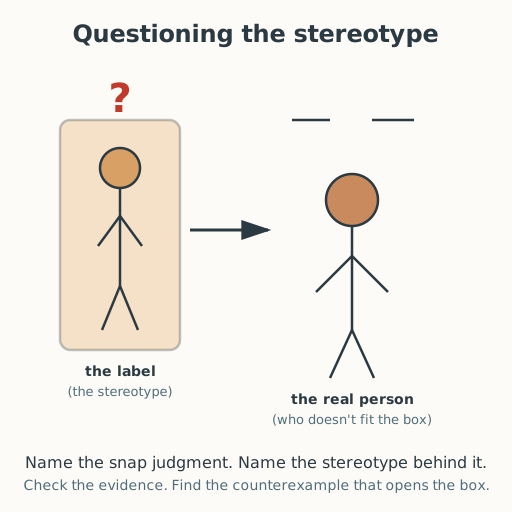
Before you know a person, a story about “people like them” may already be in your head — too quiet to notice, too quick to argue with. A stereotype is a box: it turns one feature (where someone is from, how they look, how they speak, what they use to get around) into a claim about the whole person. That box blocks empathy, because you can’t feel with someone you have already reduced to a label. The good news: the box is a habit, and habits can be caught and questioned. Today you learn how.
Materials
- Bias-and-stereotype log
- Stereotype scenario cards
Preparation
- Copy the bias-and-stereotype log and scenario cards.
- Retrieval: recall Lesson 5’s “strongest case” skill, and Grade 7’s work on stereotypes and labels (how a label can narrow a person). Today you build the tool that questions the label.
Facilitator note
This lesson is written to the learner (“you”). The ideas to land: (1) a stereotype is an oversimplified belief that turns one feature into a claim about a whole group, and bias is the leaning it creates — often automatic (“implicit”) rather than deliberate (Banaji & Greenwald 2013, S-344); (2) stereotypes block empathy because they replace the person with the label; (3) the skill is a four-step question: what is my snap judgment? what stereotype is behind it? what is the evidence? what counterexample breaks it? Group-formation research (Tajfel 1971, S-232) shows in-group/out-group habits can form from almost nothing, and stereotype threat (Steele & Aronson 1995, S-284) shows labels can weigh on a person’s performance — both are about systems and habits, not about any person being born prejudiced. Model the log once as a worked example (S-011). Hold this with care and without shame: everyone inherits stereotypes from a culture; noticing one is the courageous step, not a failing. The ethics lens: reducing a person to a label is a small injustice that can scale into big ones — questioning it is right. The egalitarian lens: stereotypes most often fall on the less powerful, and they do real work in deciding who is trusted, believed, or left out. The global & anthropological lens: every culture carries its own stereotypes, and the same person may be labeled differently in different places — the label is not the truth. The technology & environment lens: media and screens repeat narrow images until types feel like laws (Common Sense Education, S-063); noticing the repetition is part of questioning it. The critical-thinking lens: a stereotype is a generalization with weak evidence — test it the way you would test any claim.
Procedure
- Recall (5 min). In Grade 7 you learned how a label can narrow a person. Say to a partner: what was one way a label gets “inside” and weighs on someone? Today we build the tool that questions the label.
- Meet the four-step log (10 min). Look at the log. When you catch a snap judgment about a person, run four questions: (1) What is my snap judgment? (2) What stereotype is behind it? (3) What is the actual evidence? (4) What counterexample breaks the box? A stereotype is a box; a counterexample is a real person who does not fit it.
- Model it (10 min). Watch a judgment be questioned: “Someone new joins the group who uses a wheelchair; a voice in my head says they can’t play our game.” Snap judgment: “they can’t.” Stereotype behind it: “people who use wheelchairs can’t do what we do.” Evidence: none — I haven’t asked. Counterexample: people who use wheelchairs play basketball, race, and lead. The box opened; now I can actually meet the person.
- Practice (15 min). Choose a scenario card — an invented situation. Fill all four columns of the log. The hard part is column two: name the stereotype honestly, without pretending it is not there. Share one counterexample with the group.
- Close (5 min). Share one thing you caught and questioned. Remember: catching a stereotype is not shame — it is the moment empathy gets its chance back.
Differentiation
- Support: Provide a word bank of feelings and a sentence starter (“The stereotype behind my judgment is ___”), and work the first column only if needed.
- Extension: Trace where a stereotype came from — media, family, one experience — and write one sentence about how it got repeated.
Assessment
- Formative (observation): Can the learner name the snap judgment, the stereotype behind it, and a counterexample for an invented situation?
- Portfolio artifact: The completed bias-and-stereotype log, kept in the unit portfolio.
Home connection
At home this week, notice one moment you (or someone close to you) judged a stranger by a label. Quietly run the four questions. You do not have to announce it — noticing it is the practice.
Resources
- On implicit (automatic) bias: Mahzarin R. Banaji & Anthony G. Greenwald, Blindspot: Hidden Biases of Good People (Delacorte Press, 2013) (S-344).
- On in-group/out-group habits forming from almost nothing: Tajfel, “Experiments in Intergroup Discrimination,” Scientific American 223(5), 1970 (S-232).
- On labels weighing on performance (stereotype threat): Steele & Aronson, Journal of Personality and Social Psychology 69(5), 1995 (S-284).
- On media repeating narrow images: Common Sense Education, “News & Media Literacy,” https://www.commonsense.org/education/digital-citizenship/topic/news-and-media-literacy (S-063).
- On explicit instruction and worked examples: Kirschner, Sweller & Clark (2006), https://doi.org/10.1207/s15326985ep4102_1 (S-011).