Lesson 09 — Systems of Care and Mutual Aid: Fair and Unfair
Learners analyze how systems of care and mutual aid operate and what makes them fair or unfair, using a map of who gives, who receives, and who decides, and a fairness checklist: access, dignity, and who is included. They learn that mutual aid — people meeting each other's needs together — is a widespread, documented human practice, and that its fairness turns on whether power and dignity are shared, not only on whether goods are.
Objectives
Objectives
- D02.S4.08.01 Analyze how systems of care and mutual aid operate and what makes them fair or unfair.
Essential question
How do systems of care and mutual aid operate, and what makes them fair or unfair?
Key vocabulary
Materials
Standard materials
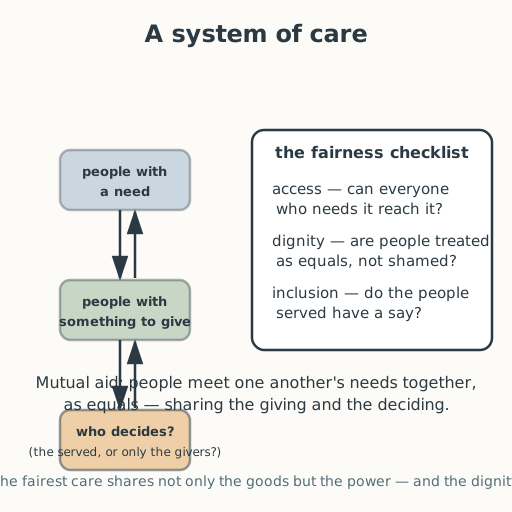
- Care-system map · 1 per group A diagram of one care system or mutual-aid arrangement — who gives, who receives, who decides, and how — with a fairness checklist
- Mutual-aid examples card · 1 per group Short, documented examples of care systems and mutual aid (a food co-op, a rotating savings group, a neighborhood watch, a disaster mutual-aid network)
Low-tech / no-cost
- Voice and a shared surface Draw the care-system map on any board or the ground and run the fairness checklist aloud
- A found object as the "resource" Use a stone or stick to stand for the resource and pass it around to trace who gives and who receives
Enriched / lab & device
- A short documentary clip · 1 An age-appropriate clip of a mutual-aid network in action, to analyze
- A guest or interview · 1 A member of a local care system (a food bank, a co-op, a health worker) to talk with about how it works
Works in different contexts
- large-group Analyze one care system together on the board, then small groups each analyze one system and report one fair and one unfair feature
- multi-age Younger learners name who gives and who receives; older learners analyze who decides and whether the system treats people with dignity
- self-directed A learner maps one care system or mutual-aid arrangement and runs the fairness checklist in writing
- level-grouped Learners ready to extend compare two systems (or one system before and after a change) and explain what made one fairer
- outdoor-only Trace a real shared resource outdoors — water, a path, a harvest — and map who tends it, who uses it, and who decides
Lesson 9 — Systems of Care and Mutual Aid: Fair and Unfair
Summary
Learners analyze how systems of care and mutual aid operate and what makes them fair or unfair, using a map of who gives, who receives, and who decides, and a fairness checklist: access, dignity, and who is included. They learn that mutual aid — people meeting each other’s needs together — is a widespread, documented human practice, and that its fairness turns on whether power and dignity are shared, not only on whether goods are.
Objectives
- Analyze how systems of care and mutual aid operate and what makes them fair or unfair. (D02.S4.08.01)
Connection
When someone is sick, hungry, or without shelter, people do not usually solve it alone — they turn to a system of care: a family network, a clinic, a food co-op, a neighborhood that watches out for its elders, a rotating savings group where each member contributes and each takes a turn. These systems can be fair or unfair. A fair one gives everyone access, treats people with dignity rather than shame, and lets the people it serves have a say in how it runs. Today you learn to tell the difference.
Materials
- Care-system map
- Mutual-aid examples card
Preparation
- Copy the care-system map and examples card.
- Retrieval: recall Lesson 7’s “who decides, who receives, who is left out” tool, and Grade 7’s mutual-aid action. Today you run that same tool on a system of care.
Facilitator note
This lesson is written to the learner (“you”). The ideas to land: (1) a system of care is a standing arrangement for meeting needs — a clinic, a co-op, a savings group, a neighborhood network; mutual aid is people meeting one another’s needs together, in reciprocity, rather than through a top-down giver and a passive receiver; (2) to judge fairness, map who gives, who receives, and who decides, then run a three-point checklist: access (can everyone who needs it reach it?), dignity (are people treated as equals, not shamed?), and inclusion (do the people served have a say?); (3) mutual aid is widespread and documented across cultures and times (Kropotkin 1902, S-163; communal-work traditions such as harambee, gotong royong, mink’a/minga, and barn-raising, S-164). Model the map once (S-011). Hold the value commitment separately: “people meeting one another’s needs is good” is a value; “mutual-aid traditions are widespread and documented” is a fact — teach them as distinct. The ethics lens: a care system can be generous and still unjust if it shames or excludes. The egalitarian lens: the fairness test is not only “were goods given” but “was power shared” — the people served must help decide. The global & anthropological lens: the examples are many and specific — harambee (Kenya), gotong royong (Indonesia), mink’a/minga (the Andes), barn-raising (North America) — presented as living traditions, never ranked, with local details to verify with community members. The technology & environment lens: tools change care systems — mobile money, a shared group chat, a map of who needs help — and each tool also raises a fairness question of access. The critical-thinking lens: separate a system’s intentions from its outcomes — a system can mean well and still leave people out.
Procedure
- Recall (5 min). From Lesson 7, what four questions reveal who is left out? Say them to a partner. Today we run them on a whole system of care.
- Meet the care-system map (10 min). Look at the map. For any system of care, trace who gives, who receives, and who decides. Then run the fairness checklist: Access — can everyone who needs it reach it? Dignity — are people treated as equals, not shamed? Inclusion — do the people served have a say?
- Model it (10 min). Watch a system be analyzed: A neighborhood food co-op pools money each week and buys in bulk; members take what they need. Who gives? Every member. Who receives? Every member, including those short that week. Who decides? The members, together, at a weekly meeting. Checklist: access — yes, membership is open and contributions flex; dignity — yes, no one is asked to prove they are poor; inclusion — yes, the served are the deciders. This is mutual aid: reciprocity among equals, not a handout from above.
- Analyze in groups (20 min). Choose a care system from the examples card or one you know. Map who gives, receives, and decides. Run the three-point checklist. Write one sentence naming what makes it fair and one naming what makes it unfair (or could).
- Close (5 min). Share one finding. Remember: the fairest care shares not only the goods but the power — and the dignity.
Differentiation
- Support: Provide the map with “who gives” and “who receives” pre-filled, and a sentence starter for each checklist point (“Access is fair/unfair because ___”).
- Extension: Compare two systems (or one system before and after a change) and explain what made one fairer, naming the specific difference.
Assessment
- Formative (observation): Can the learner map who gives, receives, and decides, and apply the three-point fairness checklist with a concrete reason for each?
- Portfolio artifact: The completed care-system map and the fair/unfair sentences, kept in the unit portfolio.
Home connection
At home, think of one system of care your family is part of (a shared fund, a neighbor network, a place of worship’s help, a community kitchen). Ask quietly: who gives, who receives, who decides — and is it fair? Notice, without needing to fix it all.
Resources
- On mutual aid as a widespread, documented practice: Peter Kropotkin, Mutual Aid: A Factor of Evolution (1902) (S-163).
- On documented communal-work traditions — harambee (Kenya), gotong royong (Indonesia), mink’a/minga (the Andes), barn-raising (North America): see the source registry entry S-164; verify local details with community members.
- On cooperation helping groups thrive: Johnson & Johnson, “Cooperation and Competition: Theory and Research” (S-233); and Slavin, Cooperative Learning (S-147).
- On explicit instruction and worked examples: Kirschner, Sweller & Clark (2006), https://doi.org/10.1207/s15326985ep4102_1 (S-011).