Lesson 10 — Charity, Mutual Aid, Solidarity — and Our Capstone
The unit capstone. Learners distinguish charity — a one-way gift in which the giver keeps the power and the receiver stays passive — from mutual aid and solidarity, in which people meet one another's needs as equals, sharing both the giving and the deciding. Then they retrieve the unit's eight ideas, revisit the wonders they wrote in Lesson 1, and assemble a personal commitment card to carry forward into how they live with others.
Objectives
Objectives
- D02.S1.08.01 Analyze how tone, body language, and digital messages can change meaning in communication.
- D02.S1.08.02 Manage conflict in a group by facilitating discussion and seeking a solution all can accept.
- D02.S2.08.01 Analyze a conflict from multiple perspectives, including ones they disagree with.
- D02.S2.08.02 Recognize bias and stereotypes that can block empathy, and question them.
- D02.S3.08.01 Analyze how power and resources are shared within a community and who is left out.
- D02.S3.08.02 Take part in strengthening belonging in their school or local community.
- D02.S4.08.01 Analyze how systems of care and mutual aid operate and what makes them fair or unfair.
- D02.S4.08.02 Distinguish charity from mutual aid and solidarity, and explain the difference.
Essential question
What is the difference between charity and mutual aid and solidarity — and how do the unit's ideas come together into how I will live with others?
Key vocabulary
Materials
Standard materials
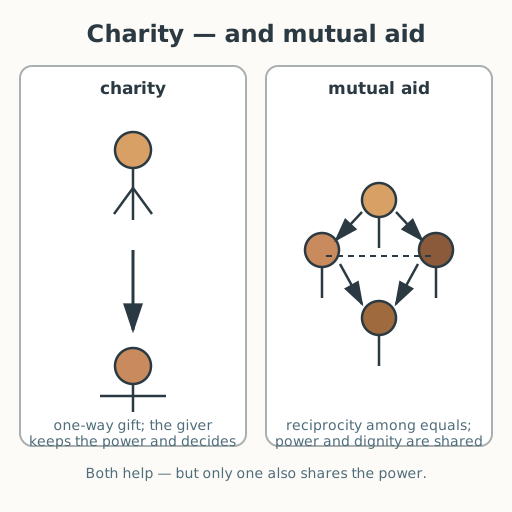
- Charity-vs-mutual-aid chart · 1 per pair A two-column chart — charity (one-way gift, giver keeps power, receiver passive) vs mutual aid (reciprocity among equals, power and dignity shared) — plus the bridge of solidarity
- Capstone commitment card · 1 per learner A one-page card — one communication habit, one facilitation move, one perspective to seek, one bias to question, one belonging action, one act of care — to carry forward
Low-tech / no-cost
- Voice and a shared surface Build the chart and the commitment card aloud in a circle; no paper needed
- Wonder slips revisited Return to the Lesson 1 wonders and answer them aloud; no new paper needed
Enriched / lab & device
- A short clip or case · 1 One age-appropriate example of mutual aid and one of charity, to compare side by side
- A gallery of commitments · 1 Post completed commitment cards and walk to read each other's, then add one line to your own
Works in different contexts
- large-group Build the chart as a class, then small groups each complete one strand of the commitment card and share a line
- multi-age Younger learners complete the communication and belonging lines; older learners add the bias-to-question and care lines with reasons
- self-directed A learner revisits their wonders, fills both the chart and the commitment card, and checks each line is real and their own
- level-grouped Learners ready to extend add a "who benefits" and a "what I will check back on" line to their commitment
- outdoor-only Build the commitment while looking at a real place — name one relationship or act of care you now understand better and one commitment you will keep
Lesson 10 — Charity, Mutual Aid, Solidarity — and Our Capstone
Summary
The unit capstone. Learners distinguish charity — a one-way gift in which the giver keeps the power and the receiver stays passive — from mutual aid and solidarity, in which people meet one another’s needs as equals, sharing both the giving and the deciding. Then they retrieve the unit’s eight ideas, revisit the wonders they wrote in Lesson 1, and assemble a personal commitment card to carry forward into how they live with others.
Objectives
- Distinguish charity from mutual aid and solidarity, and explain the difference. (D02.S4.08.02)
- Synthesize the unit’s eight goals into one view of how to communicate, understand, belong, and care — and turn that view into a personal commitment. (D02.S1.08.01, D02.S1.08.02, D02.S2.08.01, D02.S2.08.02, D02.S3.08.01, D02.S3.08.02, D02.S4.08.01, D02.S4.08.02 — synthesis)
Connection
For ten days you have studied how we communicate, understand, belong, and care. One last question pulls it all together: when someone needs help, there are two very different ways to give it. Charity is a gift from above — the giver keeps the power and decides, the receiver is expected to be grateful and stay quiet. Mutual aid is different: people who share a situation meet one another’s needs together, as equals, each giving what they can and deciding together — and solidarity is the bond that makes them stand with one another, not just for one another. Today you learn that difference, and you write down the kind of person you want to be with others.
Materials
- Charity-vs-mutual-aid chart
- Capstone commitment card
Preparation
- Copy the charity-vs-mutual-aid chart and the capstone commitment card.
- Return each learner’s Lesson 1 unit map and wonder slips.
- Retrieval: this lesson is itself a spaced, interleaved retrieval pass across the whole unit (Dunlosky et al. 2013, S-039) — it works because learners must recall, not re-read.
Facilitator note
This lesson is written to the learner (“you”). The ideas to land: (1) charity and mutual aid both help, but they are not the same: charity is a one-way gift in which the giver keeps the power and the receiver stays passive and often must prove need; mutual aid is reciprocity among equals, where power and dignity are shared, and solidarity is the commitment to stand with others rather than only for them (Dean Spade, S-345; Kropotkin, S-163); (2) the difference is not “charity is bad” — it is that charity alone can leave inequality and the power imbalance untouched, while mutual aid aims to share power too; (3) the unit’s eight ideas are one thing — living well with others — and the capstone turns them into a personal commitment. Model the chart once (S-011). Hold the value gently and without shame: a genuine gift is not wrong; the question is whether our helping also asks who decides and who is treated as an equal. This is a summative moment, but mastery is personal, not ranked — celebrate growth, never compare learners. The ethics lens: how we help can honor or wound dignity. The egalitarian lens: the deepest test is whether the power is shared, not just the goods. The global & anthropological lens: mutual aid and solidarity have long histories in many places — from communal work (harambee, gotong royong, mink’a/minga, barn-raising) to movements of people standing together — and giving itself has many distinct traditions, held side by side, never as one correct way. Several traditions frame giving as a duty or a form of justice rather than a condescension from above: zakat and sadaqah in Islamic practice, tzedakah in Jewish tradition, and dāna and sevā in South Asian traditions. So “charity” is not one universal thing — the simple one-way contrast here is a starting lens to think with, not a verdict on any tradition’s way of giving; invite learners to notice how the place they live names and practices giving. The technology & environment lens: tools can serve charity or mutual aid — a donation app versus a shared network of neighbors — and the same fairness questions from Lesson 9 apply. End on hope and agency, never despair: the learner is leaving with something they can do.
Procedure
- Recall the whole unit (10 min). With a partner, recall the eight ideas: how tone and body change meaning; how digital messages lose cues; how to facilitate toward a solution all can accept; taking perspectives you don’t share; questioning bias and stereotype; who is left out in power and resources; strengthening belonging; and systems of care and mutual aid. Name them without looking.
- Meet charity vs. mutual aid (15 min). Look at the chart. Charity: one-way gift; the giver keeps the power and decides; the receiver is expected to be grateful and quiet, and may have to prove they are poor enough. Mutual aid: people in the same situation meet one another’s needs together, as equals; each gives what they can; decisions are shared; dignity is kept. Solidarity: the bond of standing with others, not only for them. Both help — but only one also shares the power.
- Model it (5 min). Watch the difference be shown: A storm floods a street. Charity: a distant donor sends boxes of what they think is needed. Mutual aid: the neighbors meet, share who has water, who has a dry room, who can cook, and decide together what to do — and they stand with the people downstream who were hit hardest. Notice: the second one shares the deciding, not just the goods.
- Revisit your wonders (5 min). Open your Lesson 1 map and wonder slips. Which wonders can you now answer? Which have grown into new questions? Answer one you can, and mark one to keep wondering about.
- Build your commitment card (15 min). Write six lines: (1) one communication habit you will keep (tone, body, or digital); (2) one facilitation move you will use; (3) one perspective you will seek out; (4) one bias you will keep questioning; (5) one belonging action you will do; (6) one act of care, in the spirit of mutual aid, not only charity.
- Close (5 min). Share one line you are proud of. Remember: living well together is not a lesson you finish — it is a practice you carry.
Differentiation
- Support: Provide sentence starters for each line (“One communication habit I will keep is ___ because ___”).
- Extension: Add a “who benefits” line and a “what I will check back on in a month” line to your commitment.
Assessment
- Summative (portfolio + self): The completed charity-vs-mutual-aid chart and the commitment card are the unit’s capstone artifacts, kept in the portfolio.
- Self-assessment: Learners mark one line they feel confident explaining and one line they want to keep learning about — “not yet” is information, never a verdict.
Home connection
Share your commitment card with someone at home, and invite them to add one line of their own — one way they will help, in the spirit of mutual aid rather than only charity.
Resources
- On the charity vs. mutual-aid distinction and solidarity: Dean Spade, Mutual Aid: Building Solidarity During This Crisis (and the Next) (Verso, 2020) (S-345).
- On mutual aid as a widespread, documented practice: Peter Kropotkin, Mutual Aid: A Factor of Evolution (1902) (S-163).
- On spaced, interleaved retrieval as a capstone: Dunlosky et al. (2013), Psychological Science in the Public Interest, https://doi.org/10.1177/1529100612453266 (S-039).
- On explicit instruction and worked examples: Kirschner, Sweller & Clark (2006), https://doi.org/10.1207/s15326985ep4102_1 (S-011).