Lesson 01 — Words That Shape, Voices That Meet
Learners recall what they already know from Grade 7 — evaluating a speaker's reasoning, checking source credibility, precise language, and translation vs. interpretation — and meet the shape of the new unit: three clusters around one central idea. They write wonders and sort them into the clusters, starting the unit portfolio.
Objectives
Objectives
- D04.S1.08.01 Analyze how a speaker's word choice, tone, and delivery shape meaning and persuade an audience.
- D04.S1.08.02 Engage in a structured debate or deliberation, arguing a position with reasons while listening to opposing views.
- D04.S2.08.01 Analyze how point of view, tone, and figurative language shape a reader's understanding of a text.
- D04.S2.08.02 Read texts from multiple cultures and time periods, comparing how each reflects its context.
- D04.S3.08.01 Write in multiple forms, including narrative, argument, and informational text, with coherent organization and voice.
- D04.S3.08.02 Cite sources accurately in writing and distinguish their own words and ideas from those of others.
- D04.S4.08.01 Analyze how language can include or exclude people, such as jargon or the use of one language over another.
- D04.S4.08.02 Use digital translation tools critically, knowing their limits and when human translation is needed.
Essential question
What will we learn about how words shape meaning, argument, and language — and what do we already know from Grade 7?
Key vocabulary
Materials
Standard materials
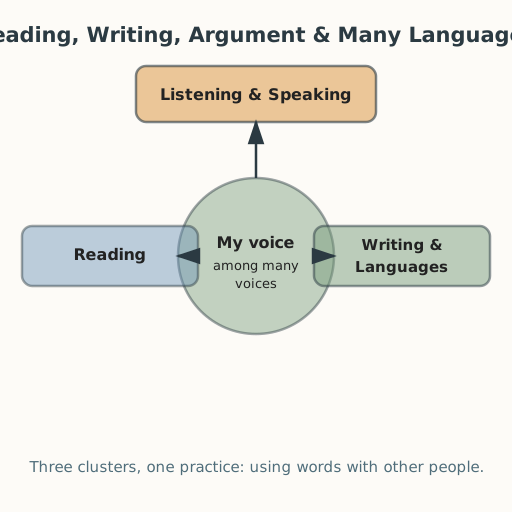
- Unit map card · 1 per learner A three-cluster map of the unit (listening & speaking, reading, writing & languages) around a central "my voice among many voices"
- Wonder slips · 3 per learner Small slips of paper for writing questions to sort into the three clusters
Low-tech / no-cost
- Voice and a shared surface Draw the three clusters on any board or the ground and sort spoken questions into them; no slips needed
- A circle conversation Recall Grade 7 ideas aloud and collect wonders as a group rather than on paper
Enriched / lab & device
- Projected unit map · 1 Display the three-cluster map large and editable so the group can add wonders live
- A short clip set · 1 set Three to six very short clips — a speaker persuading, two people debating, a poem read aloud — one per cluster, to spark wondering
Works in different contexts
- large-group Do the recall and wonder-sort as a whole class on one large map, then pairs each write one wonder per cluster
- multi-age Younger learners recall one Grade 7 idea; older learners also name the cluster it belongs to and say why
- self-directed A learner reads the unit map, writes three wonders, and sorts each into a cluster, then keeps them for the capstone
- level-grouped Learners ready to extend write a "wonder + guess" pair — a question and their current best answer to revisit later
- outdoor-only Use the outdoors as the example — name something spoken, something written, and something in another language you can find or recall right there
Lesson 1 — Words That Shape, Voices That Meet
Summary
Learners open the unit by retrieving what they learned in Grade 7 and previewing the three clusters of “Reading, Writing, Argument & Many Languages.” They meet the unit map, write three wonders, and sort them into the clusters — starting the unit portfolio they will add to every lesson.
Objectives
- Preview the unit’s eight learning goals — analyzing a speaker’s word choice, tone, and delivery; debating while listening to opposing views; analyzing point of view and figurative language; comparing texts across cultures; writing in multiple forms; citing sources; noticing how language includes or excludes; and using digital translation critically. (D04.S1.08.01, D04.S1.08.02, D04.S2.08.01, D04.S2.08.02, D04.S3.08.01, D04.S3.08.02, D04.S4.08.01, D04.S4.08.02 — preview)
Connection
Every day you use words to be heard and to hear others — a message to a friend, a line from a poem, a speaker making a case, a phrase in a language that is not your first. Words can open a door or shut one, persuade or confuse, welcome or leave out. Today you begin a journey through three big questions about how words shape meaning, how argument works, and how the world’s many languages meet — always with your language honored first.
Materials
- Unit map card
- Wonder slips
Preparation
- Copy the unit map card and wonder slips.
- Retrieval: from Grade 7, recall four ideas — evaluating a speaker’s reasoning (D04.S1.07.01), checking source credibility (D04.S2.07.02), developing ideas with precise language (D04.S3.07.01), and translation vs. interpretation (D04.S4.07.01). Each returns this unit, at a deeper level.
Facilitator note
This lesson is written to the learner (“you”). The ideas to land: (1) this unit has three clusters — Listening & Speaking, Reading, and Writing & Languages — and they all meet in one central idea: “my voice among many voices”; (2) we are building on Grade 7, not starting over; (3) wondering is the engine — learners begin by asking, not by being told. Retrieval practice here is deliberate (spaced recall of last year’s ideas — see Dunlosky et al. 2013, S-039); do not skip it. The ethics lens: how we use words toward others is a question of right and wrong. The egalitarian lens: ask early “who is included and who is left out by the way this is said?” — it returns every lesson. The global lens: language is many languages, many scripts, many ways of speaking — keep the frame broad, never one language’s default. The technology lens: digital tools now carry and translate our words, which makes the unit’s questions more urgent, not less. Hold every wonder as valid; the goal is the asking, not the answer.
Procedure
- Gather and recall (12 min). Think back to Grade 7. With a partner, recall: how did you evaluate a speaker’s reasoning? How did you check whether a source was credible? What did it mean to develop ideas with precise language? What was the difference between translation and interpretation? Share one with the group.
- Meet the unit map (8 min). Look at the unit map. The unit has three clusters: Listening & Speaking, Reading, and Writing & Languages — all around one idea: “my voice among many voices.” Notice the clusters are not separate boxes; they are three ways of looking at one practice — using words with other people.
- Write your wonders (15 min). On three slips, write three things you wonder about how words persuade, how argument works, or how the world’s languages meet. There are no wrong wonders. Write in your home language if you wish.
- Sort the wonders (10 min). Place each slip under the cluster it belongs to. If it fits two clusters, put it between them — that is where the best questions live.
- Close (5 min). Keep your wonders. At the end of the unit you will return to them and see what you now can say.
Differentiation
- Support: Give sentence starters (“I wonder what happens when a speaker ___”, “I wonder who is left out when ___”, “I wonder what is lost when a text is translated ___”).
- Extension: Write a “wonder + guess” pair — your question and your current best answer — and mark it to check again at the capstone.
- Expression (UDL): Writing the slips is optional, not the goal. A wonder can be dictated to a scribe, spoken into a recording, signed, or acted out — the wondering is what counts. The unit map is only three clusters around one idea, so it can be described aloud for anyone who cannot see it; no sight or pen is required to meet the shape of the unit.
Assessment
- Formative (observation): Can the learner name the three clusters and sort a wonder into one (or between two) with a reason?
- Portfolio artifact: The three wonder slips, kept as the first page of the unit portfolio.
Home connection
Ask someone at home: “What is one thing people say or write that makes you feel heard, and one thing that makes you feel shut out?” Bring their answer to mind as the unit unfolds.
Resources
- On spaced retrieval of prior learning: Dunlosky et al. (2013), Psychological Science in the Public Interest, https://doi.org/10.1177/1529100612453266 (S-039).
- On honoring every language: UNESCO — International Mother Language Day, https://www.unesco.org/en/days/mother-language (S-019).