Lesson 02 — Word Choice, Tone, and Delivery: How a Speaker Shapes Meaning
Learners analyze how a speaker's word choice, tone, and delivery shape meaning and persuade an audience. They work one speech pair as a modeled example, then analyze a second pair with a partner, naming what each lens does to the message.
Objectives
Objectives
- D04.S1.08.01 Analyze how a speaker's word choice, tone, and delivery shape meaning and persuade an audience.
Essential question
How do a speaker's word choice, tone, and delivery shape meaning and persuade an audience?
Key vocabulary
Materials
Standard materials
- Three-lens analysis card · 1 per learner A card with three lenses — word choice, tone, delivery — each with two guiding questions
- Speech pairs · 1 set per pair Two short versions of the same message (different word choice/tone) for comparison
Low-tech / no-cost
- Voice and a shared surface Speak the same sentence several ways aloud and name what changed; build the three-lens card together on any board
- A message from daily life Use a real spoken message learners have heard — an announcement, an ad, a request — instead of printed speech pairs
Enriched / lab & device
- A recorded speech clip · 1 A short recorded speech (a public address, a speech by a young person) to analyze with the three lenses, played for the group
- A delivery re-record · 1 per group Where devices allow, learners re-record one sentence with changed tone/delivery and compare meaning
Works in different contexts
- large-group Analyze one speech together on the board, then pairs analyze a second speech pair and report one difference
- multi-age Younger learners name the words that carry feeling; older learners also name the tone and how delivery changes it
- self-directed A learner reads the speech pair, completes the three lenses in writing, and checks that each answer points to a real word, sound, or delivery cue
- level-grouped Learners ready to extend analyze how all three lenses work together to persuade one audience, in one sentence
- outdoor-only Use a spoken request or warning heard outside (a call across a field, a "mind the path" warning) and run the three lenses on it aloud
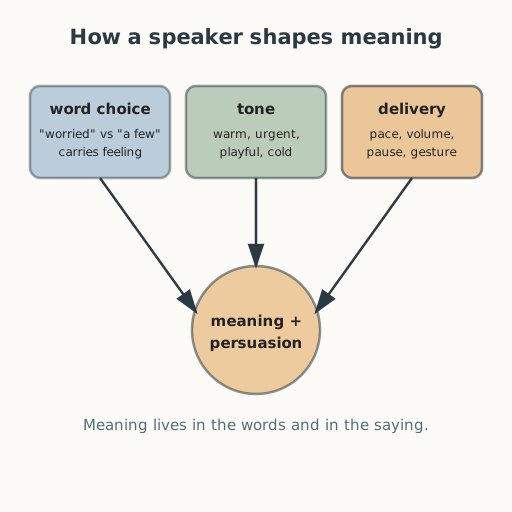
Lesson 2 — Word Choice, Tone, and Delivery: How a Speaker Shapes Meaning
Summary
Learners learn three lenses for analyzing a speaker — word choice, tone, and delivery — and use them to see how a message shapes meaning and persuades an audience. They work one speech pair as a modeled example, then analyze a second pair with a partner.
Objectives
- Analyze how a speaker’s word choice, tone, and delivery shape meaning and persuade an audience. (D04.S1.08.01)
Connection
Think of the same three words said two ways: “come here” spoken with a warm smile, and “come here” snapped with a frown. The words are identical; the meaning is not. Every speaker shapes a message twice — once by choosing the words, and again by how the words are said. Today you learn three lenses that let you see exactly how a speaker shapes what you understand and feel — a skill that works on every message in every language you hear.
Materials
- Three-lens analysis card
- Speech pairs
Preparation
- Copy the three-lens analysis card and speech pairs.
- Retrieval: from Grade 7, recall how you evaluated a speaker’s reasoning (D04.S1.07.01). Today we look closer — at the words, the tone, and the delivery, not only the logic.
Facilitator note
This lesson is written to the learner (“you”). The ideas to land: (1) a speaker shapes meaning with three moves — word choice (the words and their connotations), tone (the speaker’s attitude carried by the words), and delivery (pace, volume, pitch, pause, gesture, expression); (2) all three work together to persuade; (3) analyzing them is a skill of attention, not a ranking of speakers. Model the first pair once (worked example, S-011). The concept of persuasion as analyzed craft is ancient — Aristotle named three appeals (ethos, pathos, logos) in the Greek tradition (S-346), but it is one tradition among many; many cultures have their own arts of speaking. The ethics lens: persuasion can be used to help or to harm; noticing how it works is how we choose. The egalitarian lens: the same words persuade some people and leave others out — ask “who is this speaking to, and who is it leaving out?” The global lens: tone and delivery vary across cultures; a loud, fast delivery is respectful in one place and rude in another. The social-emotional lens: noticing tone is also noticing feeling — ours and the speaker’s. Use a low-stakes example so the skill is practiced without fear.
Procedure
- Recall (5 min). How did you evaluate a speaker’s reasoning in Grade 7? Today we look even closer — at the words, the tone, and the delivery.
- Meet the three lenses (8 min). To analyze a speaker, ask three questions. Word choice: which words did they pick, and what feeling do those words carry? Tone: what attitude do the words carry — warm, urgent, playful, cold? Delivery: how are the words said — fast or slow, loud or soft, with what pauses, face, and gesture?
- Watch it modeled (15 min). Here is one message said two ways. Version A: “A few of our neighbors have raised a concern about the path.” Version B: “A small but worried group of families is pleading with us about the danger on the path.” Run all three lenses. Version B’s words (“worried,” “pleading,” “danger”) carry stronger feeling; its tone is more urgent; said with a slower, softer delivery, it asks for sympathy, not just attention. Neither is more “true” — but each shapes a different meaning.
- Analyze a second pair (15 min). With a partner, take a speech pair. Run the three lenses on each version, then say how the word choice, tone, and delivery change what the audience understands and feels.
- Close (7 min). Share one difference you found. Remember: meaning lives in the words and in the saying.
Differentiation
- Support: Provide the three lenses with two possible answers each (“warm words / sharp words,” “calm tone / urgent tone”) and ask learners to circle which each version uses.
- Extension: Take one message and write a third version that uses word choice, tone, and delivery to persuade a different audience, then explain each choice.
- Expression (UDL): Analysis can be spoken or dictated to a scribe instead of written — the thinking is the skill, not the pen. For learners who do not hear speech: “delivery” also lives in the face and hands — gesture, expression, visible sign, and written pace all shape meaning, so read the speech pairs as text or sign them rather than only hearing them, and caption any recorded clip.
Assessment
- Formative (observation): Can the learner name the three lenses and use them on two versions of a message to say how meaning and persuasion change, with a reason?
- Portfolio artifact: The completed analysis of one speech pair, kept in the portfolio.
Home connection
Listen this week to one person speaking — a family member, a shopkeeper, a voice on the radio — and name one word they chose and one thing their delivery added to the meaning.
Resources
- Aristotle, Rhetoric (c. 350 BCE), on ethos, pathos, and logos: Stanford Encyclopedia of Philosophy, https://plato.stanford.edu/entries/aristotle-rhetoric/ (S-346).
- On explicit instruction and worked examples: Kirschner, Sweller & Clark (2006), https://doi.org/10.1207/s15326985ep4102_1 (S-011).