Lesson 03 — Arguing With Reasons, Listening to Opposing Views
Learners engage in a structured deliberation — arguing a position with reasons and evidence while genuinely listening to and paraphrasing opposing views before responding. They learn a four-step flow, watch it modeled, and then hold a short real deliberation in two sides.
Objectives
Objectives
- D04.S1.08.02 Engage in a structured debate or deliberation, arguing a position with reasons while listening to opposing views.
Essential question
How do I argue a position with reasons while truly listening to opposing views?
Key vocabulary
Materials
Standard materials
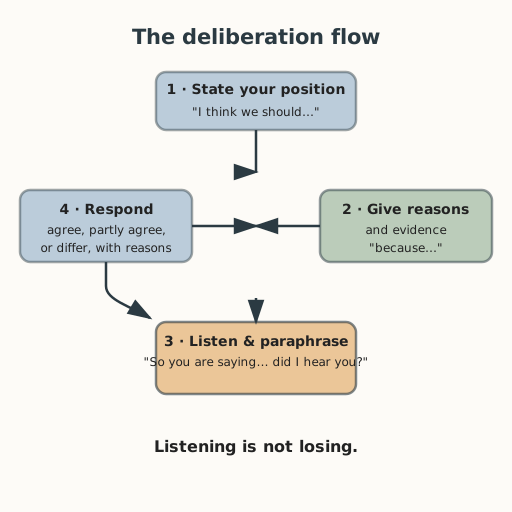
- Deliberation flow card · 1 per learner A four-step flow — state position, give reasons, listen and paraphrase the other side, respond — with sentence starters
- A shared question · 1 A low-stakes, fair, real question the group can genuinely disagree about (e.g., "Should our community build a new park or a new clinic first?")
Low-tech / no-cost
- Voice and a talking object Pass a talking object to take turns; the four-step flow spoken aloud, no cards needed
- A question from shared life Use a real, shared, low-stakes decision the group actually faces instead of a printed question
Enriched / lab & device
- A timed deliberation format · 1 A timer and speaker-order cards (opening, response, rebuttal, close) for a more formal structured debate
- A recording for reflection · 1 per group Where devices allow, record the deliberation and listen back to check whether each side was truly heard
Works in different contexts
- large-group Split into two sides plus listeners; listeners hold up a card when they hear a reason, and one records reasons on the board
- multi-age Younger learners give one reason and repeat one opposing reason; older learners add evidence and a rebuttal
- self-directed A learner writes their position, two reasons, the strongest opposing reason they can think of, and one response — treating the page as the other side
- level-grouped Learners ready to extend research one piece of evidence before the deliberation and cite where it came from
- outdoor-only Hold the deliberation in a circle outdoors around a real shared choice (where to sit, what to build first) using the talking object
Lesson 3 — Arguing With Reasons, Listening to Opposing Views
Summary
Learners practice structured deliberation: arguing a position with reasons and evidence while truly listening to the other side — paraphrasing it before responding. They learn a four-step flow, watch it modeled, and then hold a short, low-stakes deliberation in two sides.
Objectives
- Engage in a structured debate or deliberation, arguing a position with reasons while listening to opposing views. (D04.S1.08.02)
Connection
Disagreement is ordinary — in a family, a market, a neighborhood, a nation. What is rare, and learnable, is disagreeing well: making your case with reasons and then really hearing the other side before you answer. Arguing well is not about winning; it is about deciding together with more of the truth in the room. Today you practice the skill that lets many voices make one fairer decision.
Materials
- Deliberation flow card
- A shared question
Preparation
- Copy the deliberation flow card.
- Choose a low-stakes, fair, real question the group can genuinely disagree about.
- Retrieval: from Grade 6 and 7, recall your argument scaffold — claim, reasons, evidence, and response to a counterargument (D04.S3.06.01; D04.S3.07.01). Today you speak it and listen to the other side.
Facilitator note
This lesson is written to the learner (“you”). The ideas to land: (1) deliberation is arguing a position with reasons and listening to the opposing view — not just waiting to talk; (2) the four-step flow — state position, give reasons, paraphrase the other side, respond — keeps it fair; (3) “listening is not losing” — hearing the other side is how we decide together. Model the flow once with a learner or co-facilitator (worked example, S-011). Structured discussion of contested issues is a core democratic skill with a real research base (Hess 2009, S-349); the lesson holds “listening is not losing” as a value, distinct from that descriptive claim. The ethics lens: how we disagree is a matter of right and wrong — we can argue without wounding. The egalitarian lens: deliberation only works when every voice can speak; ask “whose view is not in the room, and why?” The global lens: cultures deliberate differently — some speak in turn with a talking object, some seek consensus, some vote; this is one fair structure among many. The community lens: this skill builds the shared decisions that hold a community together. Choose a question where learners can genuinely disagree without fear (a park vs. a clinic, not a question that divides the group along identity lines). Watch that quieter learners get the floor.
Procedure
- Recall (5 min). What were the parts of an argument you built in Grade 6 — claim, reasons, evidence, counterargument? Today you speak it out loud, with a partner who disagrees.
- Meet the four-step flow (8 min). Deliberation is four moves: (1) State your position. (2) Give your reasons and evidence. (3) Listen and paraphrase the other side — say it back in your own words until they agree you heard them. (4) Respond — agree, partly agree, or respectfully differ, with reasons.
- Watch it modeled (10 min). Watch a short example. One voice: “I think we should build the park first, because children need a safe place to play, and the clinic is farther from most homes.” The other voice: “So you are saying play space matters more to you right now — did I hear you?” Then: “I hear that. I think the clinic should come first, because people who are sick must travel far for care.” Notice: no one wins; both are now clearer.
- Hold your deliberation (25 min). In two sides, take the shared question. Use the flow. Paraphrase before you respond. Aim to understand the other side well enough that they say, “Yes, that is what I mean.”
- Close (7 min). Share one thing the other side said that you had not thought of. Remember: listening is not losing.
Differentiation
- Support: Provide sentence starters (“I hear you saying ___, is that right?”, “One reason I think ___ is ___”).
- Extension: Add evidence — find one fact that supports your side and say where it came from, then listen to the other side’s evidence fairly.
- Expression (UDL): A learner may state a position and paraphrase the other side by signing, writing, pointing to a card, or using a communication device or partner — a silent or non-speaking voice is a full voice in the circle. “Listening” includes watching lips, hands, and written turns; anyone can pass rather than speak.
Assessment
- Formative (observation/performance): Can the learner state a position with at least one reason, and paraphrase the opposing view accurately before responding?
- Self-check: The learner asks, “Did I say back the other side’s view until they agreed I had heard them — before I gave my own answer?”
Home connection
Next time you and someone at home disagree about something small, try the flow: say your reason, then say theirs back to them, then respond. Notice what changes.
Resources
- On discussion of contested issues as a democratic skill: Hess, D. E. (2009), Controversy in the Classroom: The Democratic Power of Discussion (Routledge) (S-349).
- On the claim–reasons–evidence–rebuttal scaffold: Toulmin, The Uses of Argument (S-236).
- On explicit instruction and worked examples: Kirschner, Sweller & Clark (2006), https://doi.org/10.1207/s15326985ep4102_1 (S-011).