Lesson 04 — Point of View: Whose Eyes Am I Seeing Through?
Learners analyze how point of view — first person, third person limited, and third person omniscient — shapes what a reader understands. They work one two-view story pair as a modeled example, then identify and compare points of view in a second pair.
Objectives
Objectives
- D04.S2.08.01 Analyze how point of view, tone, and figurative language shape a reader's understanding of a text.
Essential question
How does point of view shape what a reader understands about a text?
Key vocabulary
Materials
Standard materials
- Point-of-view card · 1 per learner A card defining first person, third person limited, and third person omniscient, each with a one-line example
- Two-view story pair · 1 set per pair The same short event told from two different points of view, for comparison
Low-tech / no-cost
- Voice and a shared surface Tell the same small event from two points of view aloud and name what each lets you know; build the card together on any board
- A real shared event Use something that just happened in the room (a spill, a surprise) and retell it from two people's eyes
Enriched / lab & device
- A short film scene · 1 A very short film scene shown twice — once as one character sees it, once as another — to compare points of view
- A two-voice rewrite · 1 per group Where devices allow, learners rewrite one paragraph in a different point of view and read both aloud
Works in different contexts
- large-group Compare the two-view pair as a class on the board, then pairs retell one event from a third point of view
- multi-age Younger learners say who is telling the story ("I" or "she/he"); older learners name limited vs. omniscient and what it hides
- self-directed A learner reads the two-view pair, identifies each point of view, and writes what each version lets them know and hides
- level-grouped Learners ready to extend analyze an unreliable narrator — a teller whose account may not be the whole truth — and why that matters
- outdoor-only Choose a shared outdoor moment (a bird landing, rain starting) and retell it from two people's points of view aloud
Lesson 4 — Point of View: Whose Eyes Am I Seeing Through?
Summary
Learners learn three common points of view — first person, third person limited, and third person omniscient — and analyze how the choice of narrator shapes what a reader understands. They work one two-view story pair as a modeled example, then compare points of view in a second pair.
Objectives
- Analyze how point of view shapes a reader’s understanding of a text. (D04.S2.08.01)
Connection
The same event looks different depending on whose eyes you see it through. A rainy day is a disaster to the child planning a picnic and a gift to the farmer whose fields are dry. Every text chooses a point of view — and that choice quietly decides what you are allowed to know, and what is kept from you. Today you learn to notice whose eyes you are seeing through, and what the view shows and hides.
Materials
- Point-of-view card
- Two-view story pair
Preparation
- Copy the point-of-view card and two-view story pairs.
- Retrieval: from Grade 7, recall how an author develops characters and plot (D04.S2.07.01). Today we zoom in on the lens — point of view.
Facilitator note
This lesson is written to the learner (“you”). The ideas to land: (1) point of view is whose eyes and mind the reader sees through — first person (“I”), third person limited (inside one character’s thoughts), third person omniscient (inside all characters’ thoughts); (2) the choice of point of view shapes what the reader knows, suspects, and feels; (3) no point of view is “better” — each reveals and hides. Model the first pair once (worked example, S-011). These are standard literary terms (S-348). The ethics lens: a story can be told to hide a voice — ask “whose point of view is missing, and what would they say?” The egalitarian lens: whose eyes get to tell the story is a question of power; many great stories center voices that were once left out. The global lens: storytelling traditions around the world choose different points of view — some tell through a collective “we,” some through a single “I,” some through an all-knowing teller. The social-emotional lens: stepping into another’s point of view is the same move as empathy — and it is a muscle, not a gift.
Procedure
- Recall (5 min). How did you see characters and plot develop in a Grade 7 text? Today we ask a sharper question: whose eyes are you seeing through?
- Meet the points of view (8 min). First person uses “I” — you are inside one teller. Third person limited uses “she/he/they” but shows only one character’s thoughts. Third person omniscient shows all characters’ thoughts. Each is a lens: each reveals and hides.
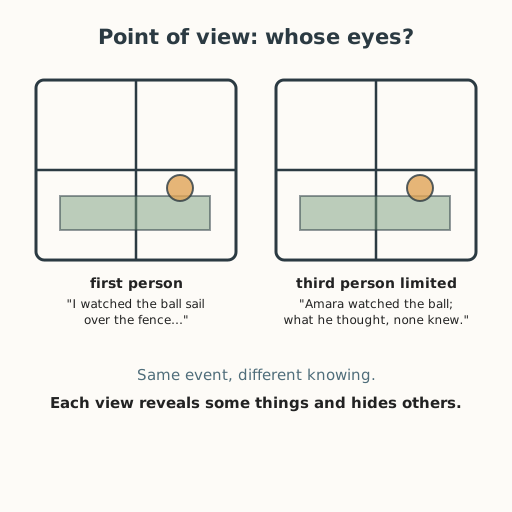
- Watch it modeled (15 min). Here is one event, two ways. First person: “I watched the ball sail over the fence and felt my stomach drop — I was the one who kicked it.” Third person limited: “Amara watched the ball sail over the fence; her stomach dropped. Across the yard, the old gardener looked up, but what he thought, no one could say.” The first puts you inside the kicker’s fear; the second keeps the gardener a mystery. Same event, different knowing.
- Compare a second pair (15 min). With a partner, take a two-view story pair. Name the point of view in each, then say what each version lets you know — and what it hides.
- Close (7 min). Share one thing the second point of view let you know that the first did not. Remember: the lens chooses the view.
Differentiation
- Support: Provide two labels to choose from (“the teller says ‘I’” / “the teller says ‘she/he/they’”) and ask which each version uses.
- Extension: Rewrite one paragraph from a third point of view — an omniscient narrator, or a different character’s “I” — and write one sentence on what changes.
- Expression (UDL): The two-view pair can be read aloud by a partner, a recording, or text-to-speech and analyzed by listening — “point of view” is simply whose mind you are inside, with no eye or seeing metaphor required. Anyone who cannot see the diagram can have it described; the lesson text already names the three points of view in words.
Assessment
- Formative (observation): Can the learner identify the point of view in two versions and say what each reveals and hides, with a reason?
- Portfolio artifact: The completed two-view comparison, kept in the portfolio.
Home connection
Think of one small thing that happened today. Tell it first from your own eyes, then from the eyes of someone else who was there. Notice what changes.
Resources
- Point of view as a standard literary term: Encyclopaedia Britannica, “Point of view (literature and theatre)”, https://www.britannica.com/art/point-of-view-literature-and-theatre (S-348).
- On explicit instruction and worked examples: Kirschner, Sweller & Clark (2006), https://doi.org/10.1207/s15326985ep4102_1 (S-011).