Lesson 05 — Tone and Figurative Language: How a Text Makes You Feel and See
Learners learn four common figures of speech — metaphor, simile, personification, and hyperbole — and practice naming the tone of a text and explaining how figurative language shapes a reader's understanding and feeling. They work one pair of lines as a modeled example, then analyze a second pair.
Objectives
Objectives
- D04.S2.08.01 Analyze how point of view, tone, and figurative language shape a reader's understanding of a text.
Essential question
How do tone and figurative language shape a reader's understanding of a text?
Key vocabulary
Materials
Standard materials
- Tone-and-figure card · 1 per learner A card defining metaphor, simile, personification, and hyperbole, plus a short tone word bank
- Poem or line pairs · 1 set per pair Two short texts with different tone and different figurative language, for comparison
Low-tech / no-cost
- Voice and a shared surface Read the lines aloud with different tones and name the figures together; build the card on any board
- A song or saying Use a line from a song, a saying, or a proverb the learners know, and name its figure and tone
Enriched / lab & device
- A recorded reading · 1 A short poem read aloud (by the poet or a reader) to hear how tone lives in the voice
- A figures gallery · 1 per group Where devices allow, learners collect one metaphor, one simile, and one personification from songs or texts they like and share them
Works in different contexts
- large-group Analyze one line together on the board, then pairs analyze a second line and report the figure and tone they found
- multi-age Younger learners spot "like/as" similes and name the tone in one word; older learners explain what the metaphor adds to meaning
- self-directed A learner reads the line pair, identifies each figure, names the tone, and writes how each shapes what they understand
- level-grouped Learners ready to extend write their own line with a metaphor or personification and explain how it shapes the reader's feeling
- outdoor-only Find something in view (a tree, a cloud, a path) and make a metaphor and a simile for it aloud, then name the tone each carries
Lesson 5 — Tone and Figurative Language: How a Text Makes You Feel and See
Summary
Learners learn four common figures of speech — metaphor, simile, personification, and hyperbole — and practice naming a text’s tone and explaining how figurative language shapes what a reader understands and feels. They work one pair of lines as a modeled example, then analyze a second pair.
Objectives
- Analyze how tone and figurative language shape a reader’s understanding of a text. (D04.S2.08.01)
Connection
People do not say “I am hopeful.” They say “hope is a seed,” or “hope is a candle in the dark.” Figurative language does in one picture what plain words do slowly — it makes you see and feel an idea, not just understand it. And every text has a tone — a mood in the words, like warmth or sharpness in a voice. Today you learn to name both, so you can say not only what a text means but how it makes you feel that meaning.
Materials
- Tone-and-figure card
- Poem or line pairs
Preparation
- Copy the tone-and-figure card and line pairs.
- Retrieval: from Grade 7, recall how an author’s word choice built meaning (D04.S3.07.01, D04.S2.07.01). Today we name the figures and the tone behind that meaning.
Facilitator note
This lesson is written to the learner (“you”). The ideas to land: (1) figurative language says one thing by way of another — metaphor (implicit comparison), simile (comparison with “like/as”), personification (human traits to non-human things), hyperbole (deliberate exaggeration); (2) tone is the attitude or mood the words carry; (3) both shape what a reader understands and feels. Model the first pair once (worked example, S-011). These are standard literary terms (S-347). The ethics lens: figurative language can lift people up or cut them down — a metaphor can wound or heal, so we choose figures with care. The egalitarian lens: figurative language is everywhere, in every language and every social class — it is not “fancy” writing; it is human thinking. The global lens: different languages make different pictures (“it’s raining cats and dogs” is one language’s picture; others say “it’s raining ropes” or “raining pitchers”) — no language’s figures are more correct. The social-emotional lens: naming tone is naming feeling, in a text and in ourselves. Invite learners to share figures from their own languages as gifts.
Procedure
- Recall (5 min). What did precise word choice do in your Grade 7 writing? Today we name the pictures words make and the mood they carry.
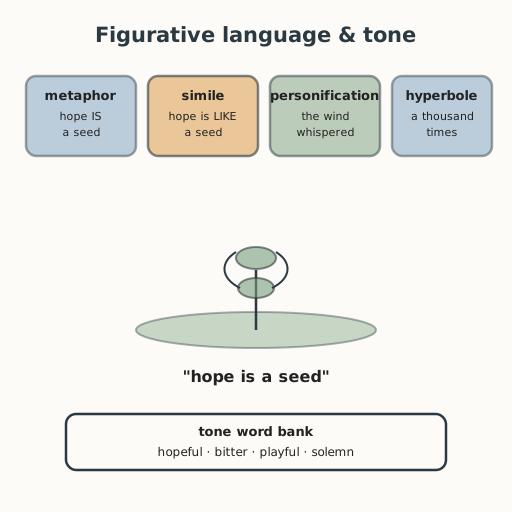
- Meet the figures and the tone (8 min). A metaphor says one thing is another (“hope is a seed”). A simile says one thing is like another (“hope is like a seed”). Personification gives a non-human thing human traits (“the wind whispered”). Hyperbole exaggerates on purpose (“I’ve told you a thousand times”). Tone is the feeling the words carry — hopeful, bitter, playful, solemn.
- Watch it modeled (15 min). Here is one idea two ways. “She was very tired and sad.” And: “Grief sat on her shoulders like a coat of stones, and each step asked more than her legs could give.” The second uses a simile (“like a coat of stones”), personification (“each step asked”), and its tone is heavy and tender. It does not just say she is sad — it makes you feel the weight.
- Analyze a second pair (15 min). With a partner, take a line pair. Name the figure in each, name the tone, and say how each shapes what you understand and feel.
- Close (7 min). Share one figure you found. Remember: figures make the abstract seeable; tone makes it feelable.
Differentiation
- Support: Provide a two-choice label (“metaphor or simile?”, “hopeful tone or sad tone?”) for each line.
- Extension: Write one line of your own using a metaphor or personification, then name the tone it carries and explain the effect.
- Expression (UDL): Figurative language can be heard, felt, and acted, not only seen — a metaphor is a word-picture that lives in sound, touch, and movement. Read the line pairs aloud and let learners render a metaphor through gesture, sound, or spoken image instead of sight. Answers can be spoken or dictated to a scribe.
Assessment
- Formative (observation): Can the learner name the figure and tone in two lines and explain how each shapes understanding and feeling, with a reason?
- Portfolio artifact: The completed line-pair analysis, kept in the portfolio.
Home connection
Ask someone at home for a saying or proverb they grew up with. Name the picture it makes and the tone it carries, and share one figure from your own language.
Resources
- Figure of speech (metaphor, simile, personification, hyperbole): Encyclopaedia Britannica, “Figure of speech”, https://www.britannica.com/art/figure-of-speech (S-347).
- On explicit instruction and worked examples: Kirschner, Sweller & Clark (2006), https://doi.org/10.1207/s15326985ep4102_1 (S-011).