Lesson 06 — Texts From Many Cultures and Times
Learners read three short texts from different cultures and time periods — a Japanese haiku, a Persian mystic's line, and a West African oral epic — and compare how each reflects its context: its form, its subject, and the culture and time that made it. They then bring a text from their own culture to the same lens.
Objectives
Objectives
- D04.S2.08.02 Read texts from multiple cultures and time periods, comparing how each reflects its context.
Essential question
How do texts from multiple cultures and time periods reflect their contexts?
Key vocabulary
Materials
Standard materials
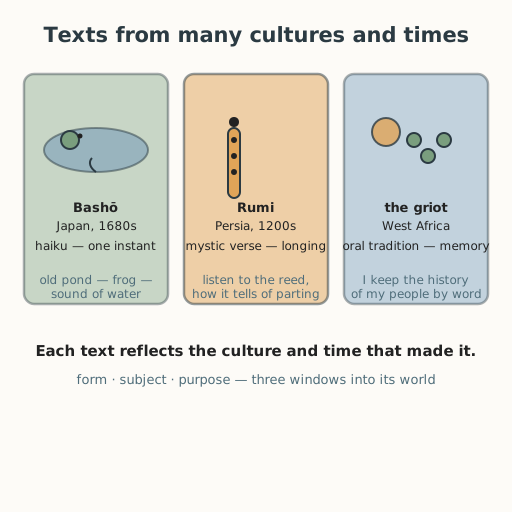
- Three-text card set · 1 set per group Three short texts — Bashō's frog haiku (Japan, 1680s), a Rumi line (Persia, 13th century), and a griot's words from the Sundiata epic (West Africa, oral tradition) — each with a note on its form and time
- Context comparison page · 1 per learner A page to record, for each text, its form, its subject, and one way it reflects the culture and time that made it
Low-tech / no-cost
- Voices in the room Learners share a short text from their own culture — a proverb, a line, a song — and the group names what its form and subject reflect; no cards needed
- A spoken-text circle Take turns speaking a remembered line and naming the culture and time it came from, and what it reflects
Enriched / lab & device
- A texts-across-time wall · 1 A growing wall of short texts from many cultures and times, each with a "reflects its context" note, built by learners and families
- A side-by-side translation view · 1 per group Where devices allow, view one text in its original script and a translation side by side, noting what the translation must add to explain context
Works in different contexts
- large-group Explore the three texts together on the board, then groups compare one text's form and subject to its context and report
- multi-age Younger learners say what a text is about; older learners also name its form and how the form reflects its time and place
- self-directed A learner reads the three texts, completes the context comparison page, and checks that each note points to a real feature of the text
- level-grouped Learners ready to extend add a fourth text from a culture or time of their choice and write how it reflects its context
- outdoor-only Recall a remembered text — a song, a proverb, a line — and walk-and-talk about the culture and time it came from and what it reflects
Lesson 6 — Texts From Many Cultures and Times
Summary
Learners read three short texts from different cultures and time periods and compare how each reflects its context — its form, its subject, and the culture and time that made it. They work the three texts as modeled examples, then bring a text from their own culture to the same lens.
Objectives
- Read texts from multiple cultures and time periods, comparing how each reflects its context. (D04.S2.08.02)
Connection
A poem is not written in the air; it is written by a person in a place and a time, and it carries the shape of that place and time. A short verse that watches a frog jump into an old pond comes from a culture that treasures a single, still instant. A line about longing comes from a tradition of mystic poetry. A story kept by word, passed from grandparent to grandchild, comes from a people who hold their history in memory. Reading across cultures and times, you learn to see the person and the world behind every text — and to see your own texts the same way.
Materials
- Three-text card set
- Context comparison page
Preparation
- Copy the three-text card set and context comparison page.
- Retrieval: from Grade 6 and 7, recall reading across genres (D04.S2.06.02) and how an author’s position shapes a text (D04.S2.07.01). Today we read across cultures and times.
Facilitator note
This lesson is written to the learner (“you”). The ideas to land: (1) every text reflects the culture and time that made it — in its form (haiku, mystic verse, oral epic), its subject, and its purpose; (2) comparing texts across cultures and times is how we hear many human voices, not one; (3) no culture’s texts are “higher” — each is a window into its world. The three texts are real and well documented: Bashō’s frog haiku (Japan, 1680s, S-351); Rumi, the 13th-century Persian poet (S-352); and the Sundiata epic, kept by West African griots (S-269). The global lens is this lesson’s heart — read widely, across the whole human family. The ethics lens: read each text with the respect it asks; do not flatten it into a stereotype. The egalitarian lens: texts survive because people keep them — oral traditions kept by memory are as much literature as printed books, and the lesson says so plainly. The social-emotional lens: these are texts of feeling — a pond, a longing, a people’s memory — and feeling travels across time. Home language first: invite learners to share a text from their own culture in their own language, and treat each speaker as the expert on their own text. If you do not know a language or text, be humble; let those who know it teach.
Procedure
- Recall (5 min). What genres did you read in Grade 6 and 7 — fiction, nonfiction, poetry, drama? Today we read three short texts from very different cultures and times, and ask what each reflects about its world.
- Meet the three texts (15 min). Read each aloud, slowly.
- Bashō (Japan, 1680s): “Old pond — / a frog jumps in — / the sound of water.” A haiku: three brief parts, one instant, one small creature. It reflects a culture that finds the whole world in a single, quiet moment.
- Rumi (Persia, 1200s): “Listen to the reed flute, how it tells a tale, complaining of separation.” A mystic’s verse: longing, music, the soul’s journey. It reflects a tradition of Sufi poetry in which poems are also prayers.
- The griot (West Africa, oral tradition): “I am a griot; it is I, Djeli Mamoudou Kouyaté, who speak. I teach kings the history of their ancestors, so the lives of the ancients may serve them as an example.” A keeper of memory: history held by word and passed down. It reflects a culture where the spoken word carries a people’s past.
- Compare for context (15 min). For each text, ask three questions: What is its form? (haiku, verse, oral epic.) What is its subject? (an instant, a longing, a people’s memory.) What does that form and subject reflect about the culture and time that made it? Record on your page.
- Bring your own (10 min). Share a short text from your own culture — a proverb, a line, a song — in your own language if you wish. Name its form, its subject, and one thing it reflects about where and when it came from.
- Close (5 min). Remember: every text is a window into the world that made it.
Differentiation
- Support: Provide the three questions with two choices each (“short form / long form,” “about nature / about longing / about memory”) and ask learners to match.
- Extension: Add a fourth text from a culture or time of your choice and write one sentence on how its form and subject reflect its context.
- Expression (UDL): The three texts are already read aloud, so learners who read print slowly can simply listen; those who write with difficulty can speak their comparison to a scribe or into a recording. The three-panel image is described in its alt text and in the lesson body.
Assessment
- Formative (observation): Can the learner name, for each text, its form and subject and one way it reflects its culture and time, with a reason?
- Portfolio artifact: The completed context comparison page, kept in the portfolio.
Home connection
Ask someone at home for a text they grew up with — a proverb, a song, a prayer, a story — and find one thing its form or subject reflects about the time and place it came from.
Resources
- Bashō and the frog haiku: Encyclopaedia Britannica, “Matsuo Bashō”, https://www.britannica.com/biography/Basho (S-351).
- Rumi, the 13th-century Persian poet: Encyclopaedia Britannica, “Rumi”, https://www.britannica.com/biography/Rumi (S-352).
- Griots as keepers of oral history: Niane, Sundiata: An Epic of Old Mali (S-269).