Lesson 07 — Writing in Many Forms With My Own Voice
Learners write in three forms — narrative, argument, and informational — with coherent organization and their own voice. They work a one-topic-three-forms model as a worked example, then draft one form on a topic of their own, attending to organization and voice.
Objectives
Objectives
- D04.S3.08.01 Write in multiple forms, including narrative, argument, and informational text, with coherent organization and voice.
Essential question
How do I write in narrative, argument, and informational forms with coherent organization and my own voice?
Key vocabulary
Materials
Standard materials
- Three-forms card · 1 per learner A card showing three forms — narrative, argument, informational — each with its purpose, shape, and a two-line model
- One-topic-three-forms model · 1 One topic written three ways (a short narrative, a short argument, a short informational piece) to compare
Low-tech / no-cost
- Voice and a shared surface Tell one small topic three ways aloud — a story, a case, a report — and name what changes; build the card together on any board
- A topic from shared life Use a real shared topic (the school garden, the long walk home) instead of a printed model
Enriched / lab & device
- A digital three-form draft · 1 per group Where devices allow, learners draft their chosen form in a document and read it aloud to a partner for voice
- A forms gallery · 1 A wall of three forms on one topic — narrative, argument, informational — for the group to compare side by side
Works in different contexts
- large-group Compare the one-topic-three-forms model as a class, then each learner drafts one form and shares a first line
- multi-age Younger learners write a short narrative; older learners also write the argument or informational form and name the difference
- self-directed A learner reads the model, chooses one form, and drafts a short piece with a clear beginning, middle, and end (or claim–reasons–close)
- level-grouped Learners ready to extend write the same topic in two different forms and explain how each changes organization and voice
- outdoor-only Choose something in view and write (or speak) a three-sentence narrative, then a one-sentence argument, then a one-sentence report about it
Lesson 7 — Writing in Many Forms With My Own Voice
Summary
Learners write in three forms — narrative, argument, and informational — with coherent organization and their own voice. They work a one-topic-three-forms model as a worked example, then draft one form on a topic of their own, attending to organization and voice.
Objectives
- Write in multiple forms — narrative, argument, and informational text — with coherent organization and voice. (D04.S3.08.01)
Connection
You already move between forms without thinking about it. You tell a friend what happened (narrative); you persuade someone to agree (argument); you explain how something works (informational). Writing does the same three jobs, with more care. Each form has its own shape and its own voice — and the shape and the voice are yours, not copied. Today you practice all three, so you can choose the right form for the job, in your own words, in your own language.
Materials
- Three-forms card
- One-topic-three-forms model
Preparation
- Copy the three-forms card and the one-topic-three-forms model.
- Retrieval: from Grade 6 and 7, recall writing arguments with claim and reasons (D04.S3.06.01) and developing ideas with precise language (D04.S3.07.01). Today we move across forms.
Facilitator note
This lesson is written to the learner (“you”). The ideas to land: (1) three forms do three jobs — narrative tells what happened (beginning, middle, end), argument makes a case (claim, reasons, close), informational explains (topic, facts, organization); (2) organization is the form’s skeleton, and voice is the writer’s own sound; (3) form is a choice, and the learner is the chooser. Model the one-topic-three-forms set once (worked example, S-011). The ethics lens: choosing the right form for the audience is a matter of honesty — a report should not pretend to be a story, an argument should not hide its claim. The egalitarian lens: every learner has a voice worth hearing; writing in one’s home language is welcome, and voice is not the same as “correctness.” The global lens: forms vary across cultures — a story, a case, and a report look different in different traditions — and all are legitimate. The social-emotional lens: voice is the self in the writing; encourage learners to sound like themselves. Keep the topic low-stakes and real so voice can come through without fear.
Procedure
- Recall (5 min). What were the parts of an argument you built in Grade 6? Today we write in three forms — and choose the one that fits the job.
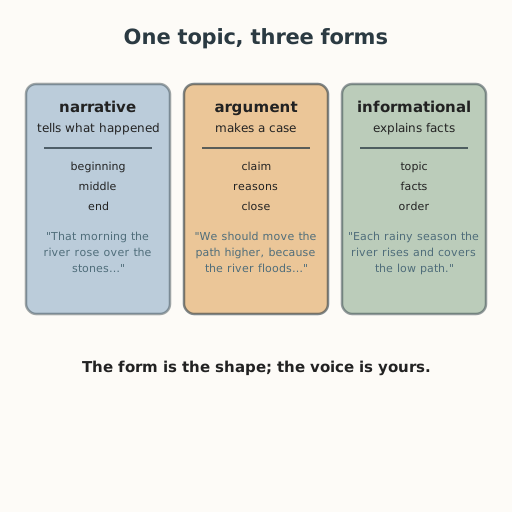
- Meet the three forms (8 min). Narrative tells what happened, with a beginning, a middle, and an end. Argument makes a case, with a claim and reasons. Informational explains, with a topic and organized facts. Each has a shape; each carries your voice.
- Watch it modeled (15 min). Here is one topic — a flooded river — three ways. Narrative: “That morning the river rose over the stones, and Mira watched her family’s small boat lift with it.” Argument: “The village should move the path to higher ground, because the river floods every rainy season and the low path is no longer safe.” Informational: “Each rainy season, the river rises and covers the low path; the high path stays dry because it sits above the flood line.” Same topic, three shapes, three jobs.
- Write your own (22 min). Choose a topic you know well — a place, a change, a choice. Pick one form. Draft a short piece: for narrative, a beginning, middle, and end; for argument, a claim and two reasons; for informational, a topic and three organized facts. Read it back and ask: does it sound like me?
- Close (5 min). Share a first line. Remember: the form is the shape; the voice is yours.
Differentiation
- Support: Provide a sentence starter for each form (“That day, ___”, “We should ___ because ”, “ is ___ and it ___”).
- Extension: Write the same topic in a second form and explain in one sentence how the organization and voice change.
- Expression (UDL): A learner may dictate, record, sign, or tell their piece to a scribe instead of writing it — the organization (beginning–middle–end, claim–reasons, topic–facts) can be shown by speaking, drawing, or gesture. Voice lives in spoken and signed language too, not only on the page.
Assessment
- Formative (observation): Can the learner write a short piece in a chosen form with clear organization (beginning–middle–end, claim–reasons, or topic–facts) and a recognizable voice?
- Self-check: The learner asks, “Did I choose the form on purpose, and does my writing sound like me, not like a copy?”
Home connection
Choose one small thing from your day and tell it to someone at home three ways — what happened, why something should change, and the plain facts — and notice which form they remember best.
Resources
- On explicit instruction and worked examples: Kirschner, Sweller & Clark (2006), https://doi.org/10.1207/s15326985ep4102_1 (S-011).