Lesson 11 — Capstone: My Voice Among Many Voices
Learners close the unit by retrieving its eight goals, selecting and revising one finished piece from their portfolio, and reflecting on how their own voice now sits among many voices. They share their piece in a circle of readings, and the group names a strength in each.
Objectives
Objectives
- D04.S1.08.01 Analyze how a speaker's word choice, tone, and delivery shape meaning and persuade an audience.
- D04.S1.08.02 Engage in a structured debate or deliberation, arguing a position with reasons while listening to opposing views.
- D04.S2.08.01 Analyze how point of view, tone, and figurative language shape a reader's understanding of a text.
- D04.S2.08.02 Read texts from multiple cultures and time periods, comparing how each reflects its context.
- D04.S3.08.01 Write in multiple forms, including narrative, argument, and informational text, with coherent organization and voice.
- D04.S3.08.02 Cite sources accurately in writing and distinguish their own words and ideas from those of others.
- D04.S4.08.01 Analyze how language can include or exclude people, such as jargon or the use of one language over another.
- D04.S4.08.02 Use digital translation tools critically, knowing their limits and when human translation is needed.
Essential question
How do I bring together everything I have learned — speaking, listening, reading, writing, and honoring many languages — into one piece of my own voice?
Key vocabulary
Materials
Standard materials
- Capstone checklist · 1 per learner A checklist of the unit's eight goals, each phrased as a "can I" question, to mark and evidence with portfolio pieces
- Portfolio pieces · 1 set per learner The learner's collected work from the unit — wonder slips, analyses, rewrites, and drafts — to review and select from
Low-tech / no-cost
- Voice and a shared surface Review the unit's eight goals aloud and select/revise portfolio pieces together; no printed checklist needed
- A circle of readings Each learner reads or speaks one finished piece aloud, and the group names one strength in each
Enriched / lab & device
- A digital portfolio · 1 per learner Where devices allow, learners assemble their finished piece and reflection in a document or page to keep and share
- A class collection · 1 A shared gathering of the unit's best pieces — one from each learner — as a "many voices" collection
Works in different contexts
- large-group Run the retrieval pass as a whole class, then pairs check each other's checklist and share one finished piece aloud
- multi-age Younger learners select one piece and read it; older learners also write the reflection connecting the piece to the unit's goals
- self-directed A learner works through the checklist, selects and revises one finished piece, and writes a short reflection on their voice among many
- level-grouped Learners ready to extend assemble two pieces in different forms (e.g., an argument and a narrative) and reflect on the difference
- outdoor-only Hold the circle of readings outdoors; each learner reads or speaks one piece, and the group names one strength in each, to the open air
Lesson 11 — Capstone: My Voice Among Many Voices
Summary
Learners close the unit by retrieving its eight goals, selecting and revising one finished piece from their portfolio, and reflecting on how their own voice now sits among many voices. They share their piece in a circle of readings, and the group names a strength in each.
Objectives
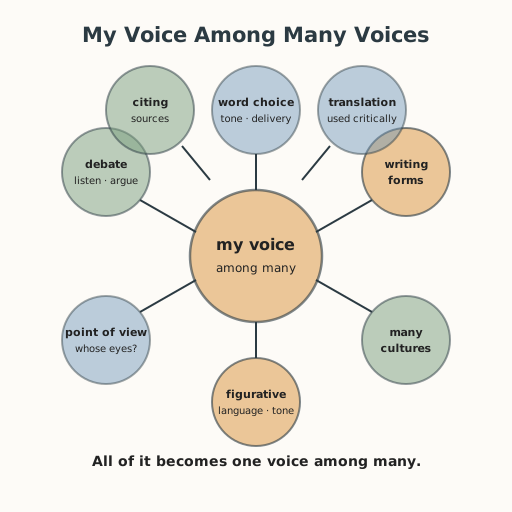
- Bring together the unit’s eight goals — analyzing rhetoric, deliberating fairly, reading point of view and figurative language, comparing texts across cultures, writing in many forms, citing sources, noticing inclusion and exclusion, and using translation critically — into one finished piece of the learner’s own voice. (D04.S1.08.01, D04.S1.08.02, D04.S2.08.01, D04.S2.08.02, D04.S3.08.01, D04.S3.08.02, D04.S4.08.01, D04.S4.08.02)
Connection
A voice is not a single skill; it is everything together — how you choose words, how you listen, how you read others’ eyes and worlds, how you write in your own forms, how you honor the words of others and the languages of the world. Today you gather all of it into one piece, and you let your voice stand among the many voices in the room. That is the whole unit, in one act.
Materials
- Capstone checklist
- Portfolio pieces
Preparation
- Copy the capstone checklist.
- Have learners gather their portfolio pieces from the unit.
- Retrieval: this whole lesson is a spaced, interleaved retrieval pass across the unit (Dunlosky et al. 2013, S-039) — do not skip the recall.
Facilitator note
This lesson is written to the learner (“you”). The ideas to land: (1) the unit’s eight goals are one practice, not eight boxes — using words with other people; (2) the capstone is a retrieval-and-revision act, not a new task; (3) every voice is worth hearing, and the room holds many. Spaced retrieval across the unit is deliberate (S-039). The ethics lens: we end by asking what is right in how we use words. The egalitarian lens: the circle of readings makes every voice equal — one after another, each given attention. The global lens: the pieces will come in many languages and scripts; honor every one. The technology lens: where a tool was used (a translation, a draft), it served the learner’s voice — it did not replace it. The community and social-emotional lenses: this is a moment of belonging and pride; make it safe, warm, and unhurried. Celebrate mastery; do not rank.
Procedure
- Retrieve the unit (10 min). With a partner, recall the eight goals: word choice and tone and delivery; arguing with reasons while listening; point of view; figurative language; texts from many cultures; writing in many forms; citing sources; language that includes and excludes; translation used critically. That is the unit. Which goal felt strongest to you?
- Select one piece (10 min). Look through your portfolio. Choose one piece you are proud of or want to make better. It may be in any language you choose.
- Revise it (15 min). Make one real improvement — a sharper word, a clearer reason, a citation you were missing, a phrase now made plainer so more people can come in. Mark what you changed.
- Reflect (8 min). Write two or three sentences: how does this piece show your voice, and how does your voice sit among the many voices you met this unit?
- Circle of readings (12 min). In turn, read or speak your piece — or a part of it. After each, the group names one thing the voice did well. No ranking; only attention.
Differentiation
- Support: Provide a reflection starter (“This piece sounds like me because ___. One voice I met this unit that changed how I see words is ___.”).
- Extension: Assemble two pieces in different forms (an argument and a narrative) and reflect on how the form changed the voice.
- Expression (UDL): In the circle of readings a learner may sign their piece, have it read by a partner, or share it as a recording; the reflection can be dictated to a scribe. Every voice — spoken, signed, written, or read-aloud by another — is honored equally, with no ranking.
Assessment
- Summative (portfolio): The learner’s finished piece plus reflection, showing at least two of the unit’s goals in action (e.g., a form with voice, a citation, a rewrite that includes more people).
- Performance (circle of readings): The learner reads or speaks their piece; the group names one strength in each.
Home connection
Read your finished piece to someone at home, in whatever language you wrote it, and tell them one thing you learned this unit about how words shape, meet, and include.
Resources
- On spaced, interleaved retrieval as the unit’s closing move: Dunlosky et al. (2013), Psychological Science in the Public Interest, https://doi.org/10.1177/1529100612453266 (S-039).
- On honoring every language: UNESCO — International Mother Language Day, https://www.unesco.org/en/days/mother-language (S-019).