Lesson 01 — Numbers, Dependence, Shape, and Data: Opening the Year
Learners retrieve the key ideas of Grade 7 — fractions and integers, y = kx, circles and π, scale drawings, random sampling, and probability — and preview the four Grade 8 strands they will build this year: numbers beyond the rational, functions and linear equations, transformations and the Pythagorean theorem, and scatter plots that model without mistaking association for cause.
Objectives
Objectives
- D05.S1.08.01 Distinguish rational and irrational numbers and approximate square roots by locating them on the number line.
- D05.S1.08.02 Use integer exponents and scientific notation to represent and compare very large and very small quantities, such as distances in space or the size of cells.
- D05.S2.08.01 Define, evaluate, and compare functions and use function notation to describe how one quantity depends on another.
- D05.S2.08.02 Solve linear equations in one variable and analyze a pair of simultaneous linear equations by graphing.
- D05.S3.08.01 Describe translations, rotations, reflections, and dilations, and use them to show congruence and similarity.
- D05.S3.08.02 Use the Pythagorean theorem to solve problems about right triangles and distances.
- D05.S4.08.01 Construct and interpret scatter plots for two related variables and describe patterns of association.
- D05.S4.08.02 Fit a line informally to data to model a relationship, evaluate the fit, and explain that association does not prove causation.
Essential question
What did I learn in Grade 7 about numbers, relationships, shape, and data — and where is that leading this year?
Key vocabulary
Materials
Standard materials
- Unit map sheet · 1 per learner A one-page map with four labeled strands and blank boxes for the learner to fill with what they already know and what they wonder
- Recall cards · 1 set per pair Cards naming Grade 7 ideas (fractions, integers, y = kx, π, scale drawings, random sampling, probability) to sort under the four strands
Low-tech / no-cost
- Voice and a shared board Draw the four-strand map together and recall Grade 7 ideas aloud; no cards or copies needed
- Found objects Gather a few real things (coins, a round lid, a measuring string) as props for recalling fractions, circles, and measurement
Enriched / lab & device
- A digital unit map · 1 per group A shared document or slide where learners type their recalls and wonders under each strand
- A math-history image gallery · 1 per group A few images of number and geometry records from many traditions (quipu, cuneiform tablets, abacus, woven patterns) to preview the global lens
Works in different contexts
- large-group Build the four-strand map on the board from volunteered recalls, then have pairs sort cards and report one strand each
- multi-age Younger learners recall a single Grade 7 idea; older learners connect several and preview where each strand goes in Grade 8
- self-directed A learner fills the unit map alone, writing what they already know and three questions, then checks against the unit overview
- level-grouped Learners ready to extend add a "what I most want to be able to do by the end" line under each strand
- outdoor-only Recall shape and data while looking at real shapes and counted objects around you, then map the four strands in the dust or on a slate
Lesson 1 — Numbers, Dependence, Shape, and Data: Opening the Year
Summary
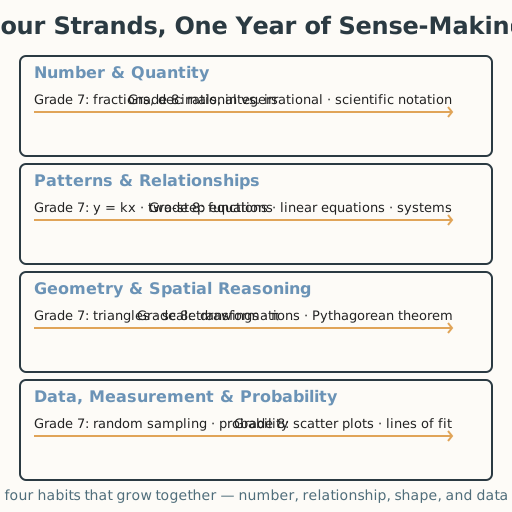
Learners retrieve the big ideas of Grade 7 and preview the four strands of Grade 8. They sort what they already know under four headings — Number & Quantity, Patterns & Relationships, Geometry & Spatial Reasoning, and Data, Measurement & Probability — and record a wonder for each, so the year begins with what they can already do and where they are heading.
Objectives
- Recall and organize Grade 7 ideas — rational numbers, y = kx, circles and π, scale drawings, random sampling, and probability — under the four strands, and preview the Grade 8 build for each. (D05.S1.08.01, D05.S1.08.02, D05.S2.08.01, D05.S2.08.02, D05.S3.08.01, D05.S3.08.02, D05.S4.08.01, D05.S4.08.02 — recall and preview)
Connection
Think of what you can already do with numbers: split a bill into fair shares with fractions, read how far a wheel travels from its size, describe a steady speed as “y = kx,” and ask whether a poll really speaks for everyone. Those four habits — number, relationship, shape, and data — are the same four paths you will walk further this year. You are not starting over; you are starting from strength.
Materials
- Unit map sheet
- Recall cards
Preparation
- Copy the unit map sheet and recall cards.
- Retrieval: this opening is a spaced retrieval pass over Grade 7 — it works because learners must recall, not re-read (Dunlosky et al. 2013, S-039).
Facilitator note
This lesson is written to the learner (“you”). The ideas to land: (1) mathematics is four habits that grow together — number, relationship, shape, and data; (2) Grade 7 already built the foundation (rational numbers, y = kx, circles and π, scale drawings, sampling, probability); (3) Grade 8 extends each one — numbers beyond the rational and scientific notation, functions and linear equations and systems, transformations and the Pythagorean theorem, and scatter plots with lines of fit. This is a recall-and-preview, not a test — celebrate what learners can already name, never rank them. The global lens: mathematics has grown in many lands (numerals from India through the Arab world, π approximated in Egypt, China, and Greece — S-023, S-291); hold those traditions side by side (philosophy §11). The egalitarian lens: mathematics is sense-making open to everyone, not a gate (S-009, S-008). The technology lens: tools (calculator, graphing tool) speed the work but do not replace the sense-making. Keep the map: learners will return to it at the capstone.
Procedure
- Gather (5 min). You have been doing mathematics your whole life. Today you name what you can already do, and see where it is going.
- Recall Grade 7 (15 min). With a partner, sort the recall cards under the four strands: Number & Quantity (fractions, decimals, integers); Patterns & Relationships (y = kx, two-step equations); Geometry & Spatial Reasoning (triangles, scale drawings, circles and π); Data, Measurement & Probability (random sampling, bias, probability). Say one thing you remember about each card as you place it.
- Preview Grade 8 (10 min). For each strand, one new step awaits: numbers that cannot be written as a fraction, and scientific notation for the very large and very small; functions and linear equations and two-at-once systems; transformations and the Pythagorean theorem; scatter plots and lines of fit.
- Write your wonders (15 min). On your unit map, write one thing you already know and one question you wonder about, under each strand. These wonders are the map we will follow all year.
- Close (5 min). Share one wonder. Remember: you already hold the tools — this year you sharpen them.
Differentiation
- Support: Provide the strand labels pre-written; recall with a single word per strand rather than a full sentence; describe cards aloud for learners with low vision.
- Accessibility: Build the four-strand map as a tactile chart (string or glue lines with raised labels) and read every label aloud for learners who are blind or have low vision; for learners with dyscalculia, keep the recall verbal and accept single-word answers instead of written number work.
- Extension: Write a sentence connecting one Grade 7 idea to its Grade 8 extension (for example, “y = kx is a special function”).
Assessment
- Formative (observation/self): Can the learner place at least one Grade 7 idea under each strand and write a wonder for each?
- Self-check: The learner asks, “Can I name one thing I already know in each strand, and one question I want answered?”
Home connection
Ask someone at home a number question from everyday life — how far a trip is, how a price changes with how much you buy, how a shape repeats — and bring one observation back to share.
Resources
- On spaced retrieval as a recall pass: Dunlosky et al. (2013), Psychological Science in the Public Interest, https://doi.org/10.1177/1529100612453266 (S-039).
- On the global, many-lands growth of mathematics: Georges Ifrah, The Universal History of Numbers (S-023); MacTutor, “A history of Pi” (S-291).